One fifth of the air
Air was an element: one substance, everywhere the same. Then a burning lens on a red powder produced a gas in which a candle blazed, and a mercury retort left running for twelve days took the burning part of the atmosphere out of a sealed vessel, held it as a red powder you could weigh — and put it back. Neither of the two men who first made the gas ever accepted what it was.
- Explain why air was thought to be a single substance, and what the pneumatic chemists had to invent before it could be taken apart
- Say who first isolated oxygen, in what order, and what each of them thought they had made
- Explain why taking a component out of the air and putting it back is a stronger argument than either half alone
- Work out how much gas a weighed quantity of red calx can give up, and compare it with what Lavoisier measured
The sealed retort settled that the metal takes something out of the air. It did not say what, and in 1774 that was a much harder question than it looks, because air was not a mixture. It was an element. That is not a superstition either. Look at what supported it. Air is uniform. Sample it in Paris, in London, in Peru, at the top of a mountain and at the bottom of a mine, and it behaves the same way and weighs the same per unit volume once you allow for pressure. Nothing that is a blend of two substances is that reliably the same everywhere. Air cannot be separated. You can distil a liquid into its parts, and every chemist knew how. Nobody had ever distilled a gas, because there was nothing to distil it from. It has no boiling point you can reach and no solvent that takes one part and leaves another. And it had a law. Boyle’s relation between pressure and volume was one of the very few pieces of exact quantitative chemistry in existence, and it treats air as a single elastic fluid. So when Lavoisier’s tin took something out of the vessel, the natural reading was not that it took part of the air. It was that the air had been changed — spoiled, saturated, altered. That is the belief this lesson overturns, and it takes twelve days of patient heating to do it.
Before anything could be taken out of air, someone had to work out how to catch a gas. Stephen Hales built the apparatus, around 1727: a trough of water with a jar inverted in it, and a tube leading the gas up into the jar so that it displaces the water. It sounds trivial. It is the microscope of eighteenth-century chemistry, and nearly everything in this lesson is downstream of it. Joseph Black used it in 1754 to catch the gas driven off limestone, which he called fixed air — our carbon dioxide — and, crucially, he weighed it. The limestone lost exactly what the gas weighed. That is the sealed-flask argument, four years before Lavoisier’s tin. Henry Cavendish caught inflammable air off metals and acid in 1766, measured its density, and found it startlingly light. Priestley made the single most productive change: he ran his trough with mercury instead of water. A gas that dissolves in water can never be collected over water, and half the interesting ones do. Over mercury they survive, and in a few years Priestley isolated something like ten new airs. And yet the framework did not move. These were not new substances. They were common air modified — air with something added to it or taken from it. Priestley’s own titles say so: Experiments and Observations on Different Kinds of Air. Kinds of air. Not kinds of gas.
The burning lens on mercurius calcinatus per se
- The question
- The red powder that forms on mercury when it is heated in air is one of the few calces that can be reduced without charcoal — heat alone drives it back to metal. What comes off when it does?
- The apparatus
- A burning lens about a foot across, focusing sunlight onto a small quantity of red mercuric calx held in a glass vessel standing over mercury, so that whatever gas came off could be collected and kept.
On the phlogiston account, a calx reverting to metal must be ABSORBING phlogiston, not releasing anything. If a gas came off at all, the obvious candidate was fixed air, which is what most calces give.
A gas came off in quantity, and it was not fixed air. A candle placed in it burned with a violence Priestley had never seen. A mouse lived in it several times as long as a mouse in an equal volume of ordinary air. He breathed it himself and found it not obviously different at the time, but reported feeling peculiarly light and easy afterwards. By March 1775 he had measured it against ordinary air by the nitrous-air test and made it five or six times better.
How sure could they be? Priestley’s first reading was wrong: he initially took the gas for a modified nitrous air, and it took him months of retesting to establish that it was something else entirely. The historical record here is a working chemist changing his mind in public over half a year, not a moment of revelation.
A gas exists in which combustion and respiration go faster than in air. Whatever burning consumes, this is more of it. That is a discovery of the first rank, and Priestley made it — but it does not, on its own, say that this gas is a component of the atmosphere rather than a modification of it.
Now be careful, because this is where the popular story gets lazy. Priestley had oxygen in a jar and his explanation of it was coherent. Under phlogiston, air stops supporting a flame when it becomes saturated with the phlogiston coming off the fuel. So air that supports a flame five or six times better than usual must simply be air that is unusually empty of phlogiston, with unusual room to absorb more. He called it dephlogisticated air, and the name is a complete and correct account of every observation he had. The vigorous flame: more capacity to absorb. The long-lived mouse: the same. The fact that it can be made from a calx: a calx is metal that has given up its phlogiston, so it should have a taste for air that can take more. The theory is wrong. The reasoning is not, and if you had been in that room in 1774 you would have said what he said. What would it take to force the other reading? Not a better argument. A quantity — and the quantity has to be conserved, so that you can watch it leave the air and arrive somewhere else.
Four ounces of mercury under about fifty cubic inches of air, sealed and weighed. Heat it — then, when it stops, drive the calx back.
The analysis and synthesis of atmospheric air
- The question
- Is the air a single substance that combustion spoils, or a mixture of which combustion consumes one part? And can that part be removed and then returned?
- The apparatus
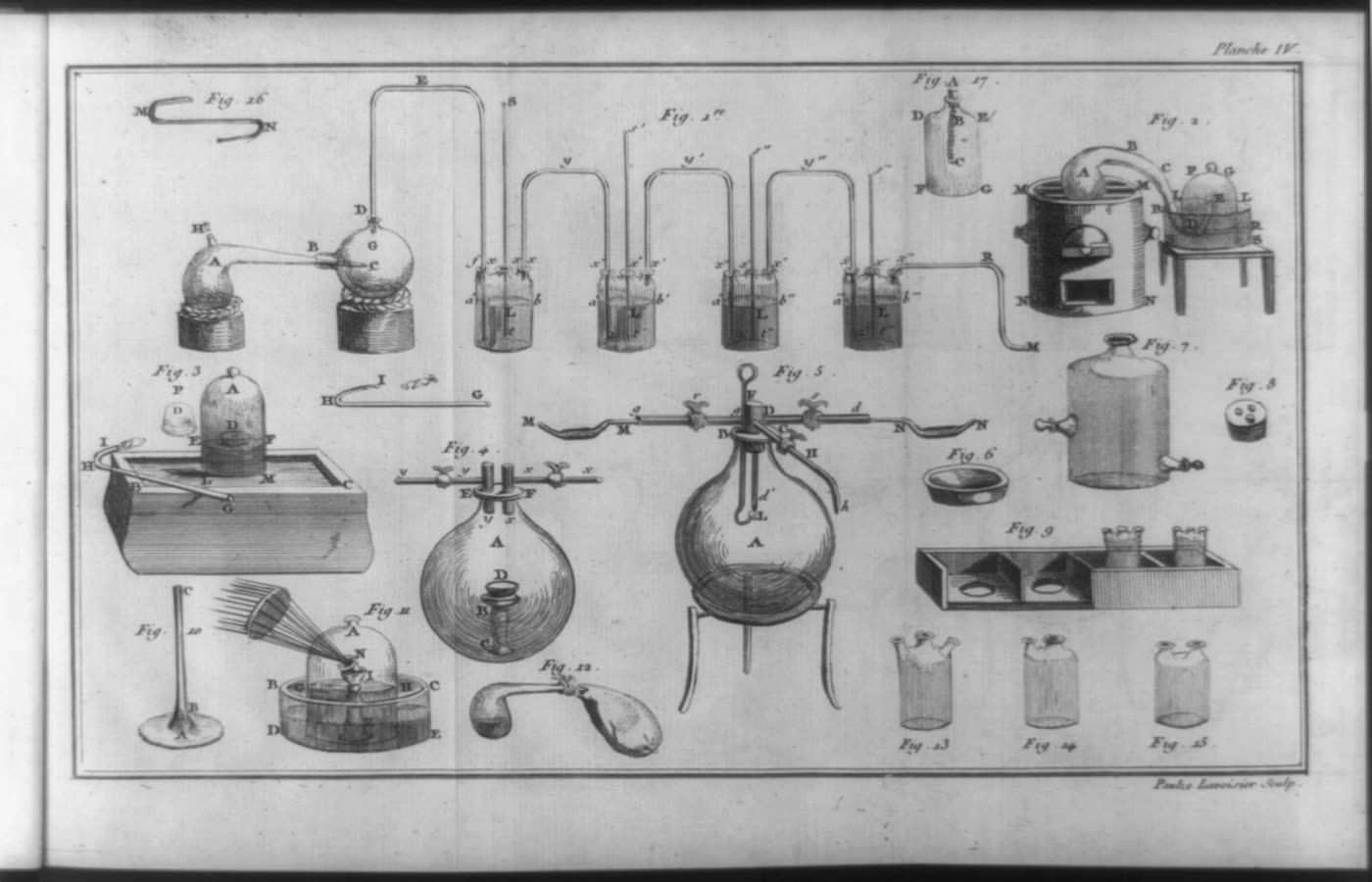
- Four ounces of mercury in a retort whose long neck passed under a bell jar standing on a mercury bath, so that the mercury sealed the apparatus and the level in the jar measured the volume of air enclosed — about 50 cubic inches. Heated in a furnace to just below the boiling point of mercury and held there for twelve days.
If air is one substance, heating mercury in it can only alter the whole of it, and there is no reason for the reaction to stop while mercury and air both remain. If air is a mixture, the reaction should consume one component, stop when that component is exhausted, and leave a residue with different properties from the air it started as.
Red particles appeared on the mercury on the second day, increased for several days, and then stopped increasing. The air had fallen from about 50 cubic inches to about 42 or 43. The residue extinguished a candle and killed animals placed in it. Lavoisier collected 45 grains of the red calx, heated it separately and much harder, and recovered 41.5 grains of running mercury together with seven or eight cubic inches of gas — in which a candle burned with the violence Priestley had described.
How sure could they be? The gas recovered from the calx matched, in volume, what the air in the bell jar had lost. That match is the measurement the argument rests on, and it is a comparison of two independently determined volumes rather than a single reading.
Atmospheric air is a mixture of at least two gases. One supports combustion and respiration and makes up about a fifth of it; the other supports neither. And the first can be taken out of the air, held as a weighable red solid, and put back — which is not something you can do to a modification.
The residue deserves a paragraph of its own, because it is the first substance in this course that was discovered by subtraction. Lavoisier called it mofette atmosphérique — the foul part of air — and later azote, from the Greek for no life, which is still its French name. Daniel Rutherford in Edinburgh had isolated much the same gas in 1772 by burning things in a confined volume and absorbing the fixed air with alkali, and had called it noxious air. It is nitrogen. And here is the honest qualification. Lavoisier’s residue was not pure nitrogen, and could not have been. His run stalled with about a third of the oxygen still in the vessel, so what was left held something like 8 per cent oxygen — easily enough to detect, far too little to keep a flame alight, which needs around sixteen per cent. That is why the test he used was the right one. He did not claim the residue was oxygen-free. He claimed it would not support a candle or a mouse, and he had watched it fail to. A claim you can check beats a claim that sounds cleaner.
Lavoisier, Marie-Anne-Pierrette, 1758-1836, engraver, 1789. Public domain
Priestley refused to accept oxygen out of stubbornness, or because he did not understand his own experiment.
He understood it precisely, and his position stayed defensible for a long time. Dephlogisticated air accounts for everything he personally observed: the fierce flame, the long-lived mouse, the fact that a calx yields it. What it does not account for is the balance sheet — and Priestley, unlike Lavoisier, did not run his chemistry on a balance. When the French system began to win, it won not by refuting any single Priestley result but by rewriting every reaction in chemistry in terms of weighable substances that could be tracked through it, which took twenty years. Priestley’s last defence, The Doctrine of Phlogiston Established, was published in 1800 from exile in Northumberland, Pennsylvania, after a mob had burnt his Birmingham house and laboratory for his politics. He was still doing careful experiments, and still reasoning correctly from premises the rest of chemistry had abandoned. The interesting question is not why he held out. It is how anyone ever decides that a working theory has stopped being worth repairing.
Checking Lavoisier against the formula
Lavoisier collected 45 grains of red calx from the twelve-day run, heated it hard in a small retort, and recovered 41.5 grains of running mercury plus a quantity of gas. Red mercuric calx is HgO — one atom of mercury to one of oxygen. What mass of gas, in grains, should 45 grains of it be able to give up?
- Calx recovered
- 45 grains
- Formula of the calx
- HgO
- Molar mass, mercury
- M(Hg) = 200.59 g/mol
- Molar mass, oxygen atom
- M(O) = 16.00 g/mol
The feeling of it to my lungs was not sensibly different from that of common air; but I fancied that my breast felt peculiarly light and easy for some time afterwards. Who can tell but that, in time, this pure air may become a fashionable article in luxury. Hitherto only two mice and myself have had the privilege of breathing it.
- 1727Hales describes the pneumatic trough. Gases can now be caught, kept and handled.
- 1754Black isolates fixed air from limestone — and weighs it. Gases are substances with mass.
- 1766Cavendish prepares inflammable air from metal and acid and measures its density.
- 1772Rutherford isolates the residue left when things burn in confined air. He calls it noxious air.
- 1771–72Scheele prepares fire air in Uppsala. His book will not appear for another five years.
- 17741 August: Priestley’s burning lens on red mercuric calx. In October he describes it to Lavoisier in Paris.
- 1775Priestley publishes, and makes the new air five or six times better than common air.
- 1777Scheele’s Chemische Abhandlung von der Luft und dem Feuer finally appears, three years late.
- 1777–78Lavoisier reports the analysis and synthesis of air, and begins calling the active part the acidifying principle.
- 1789The Traité sets out the twelve-day mercury run in full, with a list of elements at the front.
- 1800Priestley publishes The Doctrine of Phlogiston Established, from Pennsylvania.