Lavoisier weighs everything
For a century, burning was explained by a substance that left the thing that burned. The explanation was reasonable, useful, and wrong — and what killed it was not an idea but a balance, in a sealed glass vessel that did not change weight.
- Say what phlogiston explained, and why it was a respectable theory rather than a silly one
- Explain why sealing the vessel and weighing it before opening changes the entire conclusion
- State what mass conservation actually claims, and what it does not
- Work out how much oxygen a closed vessel of air can supply, and why calcination stops
A one-paragraph recap, since the previous lesson made the case at length. Phlogiston is a substance contained in everything combustible, and burning is the escape of it. A metal is a calx — an earthy powder — combined with phlogiston, which is why roasting a metal leaves a powder, and why heating that powder with charcoal restores the metal. One idea, covering combustion, calcination, smelting and respiration, and getting the relationships right even though it has the direction backwards. It is a real theory, held by competent people for good reasons. What follows is not an argument against it. It is a measurement.
And its one bad fact: a calx is heavier than the metal it came from — about 27% heavier for tin, which is the wrong sign for a theory about losing something. The repairs on offer were inventive, and the best of them was very nearly right: perhaps something else arrives as the phlogiston leaves. None was treated as fatal, which is the normal and usually correct response to a single awkward fact. What finishes a theory is a rival that explains the awkward fact without needing a repair at all. That is what arrives now, and it arrives as a procedure rather than an idea.
Robert Boyle got within one step of it, in 1673, and the step he missed is the entire lesson. Boyle sealed metal inside a glass vessel, heated it strongly until it had turned to calx, and weighed it. The weight had gone up. He concluded that particles of fire had passed through the walls of the glass and lodged in the metal — which is a perfectly sensible reading of what he saw, and gave the weight gain a physical cause. Now look at the order of operations. Boyle opened the vessel, and then weighed it. That is all. That is the difference between his experiment and the one that ended phlogiston a century later, and it is worth sitting with, because it is not a story about cleverness. Boyle was one of the finest experimentalists who ever lived. The information he needed was in his apparatus the whole time, and it escaped when he broke the seal.
Start the way everyone before Lavoisier did: vessel open to the room. Heat the tin and watch the balance climb.
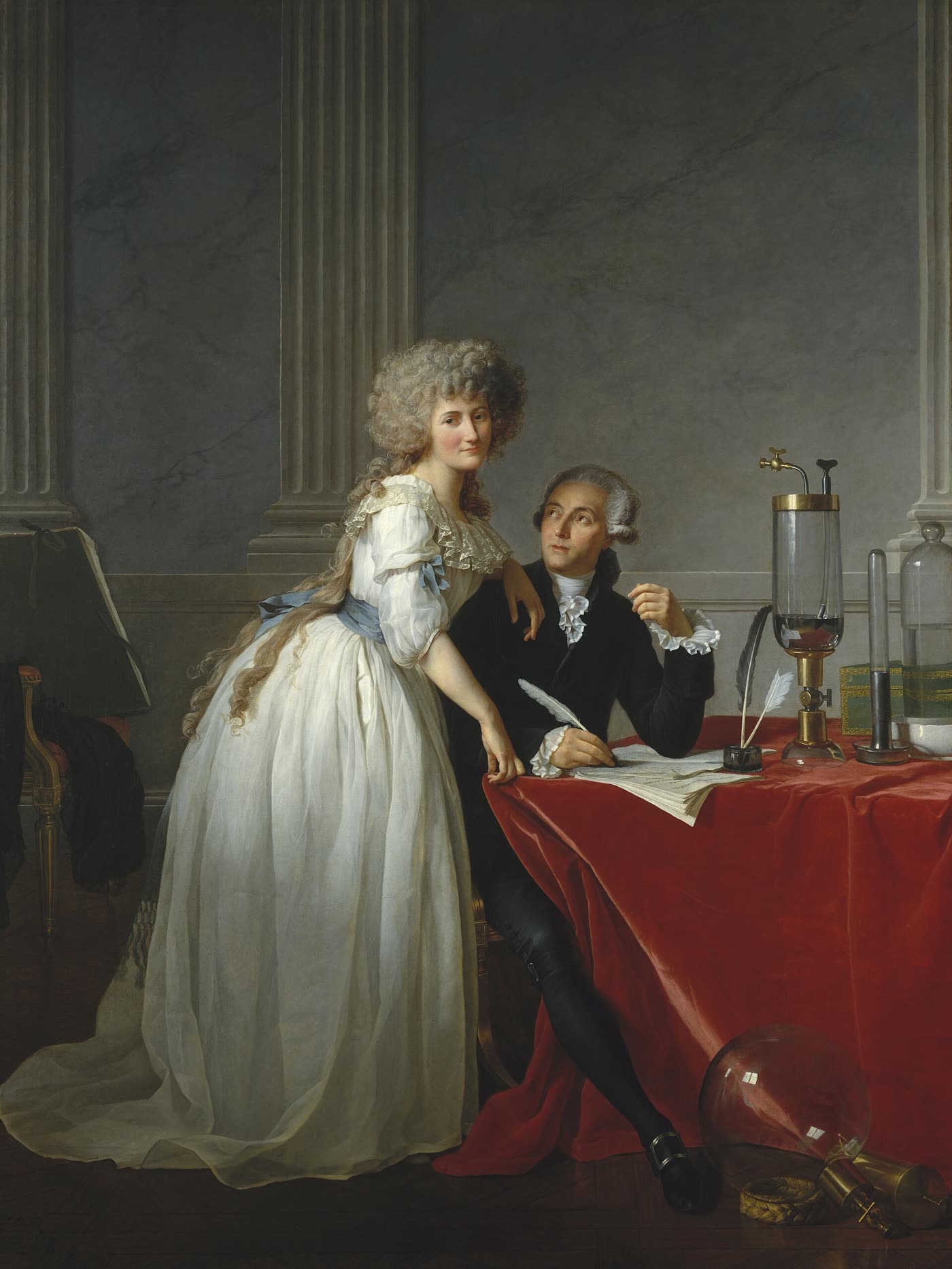
Lavoisier changed the question, and this is his real contribution — larger than any single substance he identified. Everyone else asked: what leaves the metal? He asked: what does the whole system weigh? Not the metal. The metal, the vessel, the air inside it, everything, as one quantity, measured before and measured after. He had the instruments for it — he was wealthy, from tax farming, and could commission balances far better than most laboratories had — but the instruments are not the insight. The insight is deciding that the boundary of the experiment is the sealed vessel, and that nothing may be left out of the sum, including the air, which nobody had been in the habit of weighing at all. If the total is fixed, the argument runs itself. The metal got heavier. Nothing entered from outside. So the weight came from something already inside — and there is only one other thing in there.
Now seal it. Heat the tin — then, once it has stopped, break the seal. Watch the total, the metal, and the oxygen left in the vessel as three separate numbers.
The calcination of tin in closed vessels
- The question
- When a metal is calcined and gains weight, where does the weight come from? Does something enter through the walls of the vessel, as Boyle concluded — or does it come from the air already inside it?
- The apparatus
- Tin in a glass retort, sealed shut, and the whole thing weighed on a precision balance. Heat applied until the metal had turned to calx. The vessel was then weighed AGAIN WHILE STILL SEALED — the step Boyle omitted — before finally being opened and weighed a third time, with the calx and the remaining metal weighed separately afterwards.
If Boyle was right and igneous particles pass through glass, the sealed vessel must be heavier after calcination than before. If phlogiston leaves the metal but cannot escape the vessel, the sealed weight is unchanged and the calx must be LIGHTER than the metal was.
The sealed vessel weighed exactly what it had weighed before: nothing crossed the glass in either direction. The calx was heavier than the tin. The calcination stopped of its own accord while unreacted tin remained. And on opening, air rushed audibly in and the vessel gained weight — by about what the metal had gained.
How sure could they be? The effect being measured is large: tin gaining 27% of its own mass. The null result on the sealed vessel is the demanding measurement, and it is the one the argument rests on — Lavoisier reported no change he could detect, against a predicted gain he could easily have seen.
Combustion and calcination are combination with a component of the air, not the loss of anything. Boyle’s fire particles are unnecessary; phlogiston is unnecessary. And the total quantity of matter in a closed system does not change during a chemical reaction — the principle that makes it possible to balance an equation at all.
Lavoisier discovered oxygen.
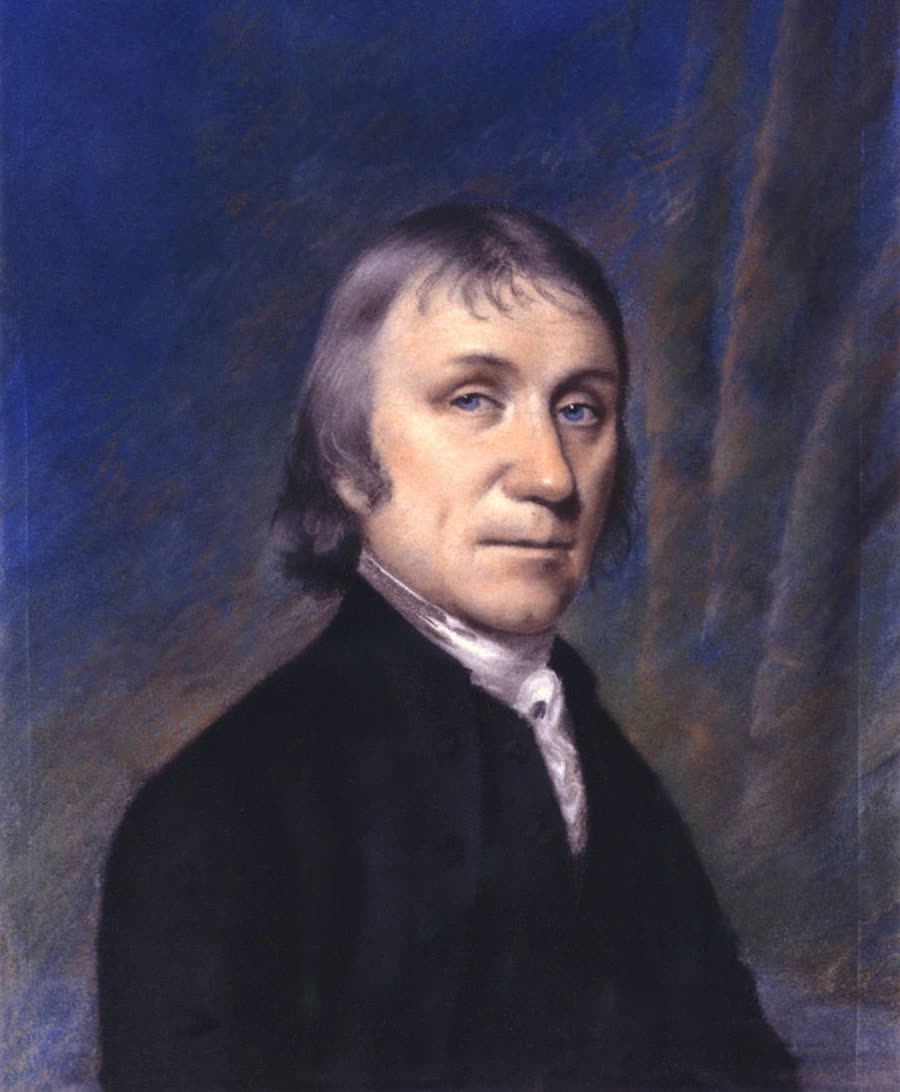
He did not, and both of the men who did went to their graves rejecting what he made of it. Carl Wilhelm Scheele prepared it first, around 1771–72 in Uppsala, and was slow to publish. Joseph Priestley prepared it independently on 1 August 1774 by focusing sunlight onto mercuric oxide, published first, and — this is the part that matters — visited Paris that October and described his method to Lavoisier over dinner. What Lavoisier contributed was the interpretation: that this gas is a constituent of ordinary air, that it is the part consumed by burning and by breathing, and that combustion is combination with it rather than the loss of anything. Priestley called it "dephlogisticated air" for the rest of his life and was still defending phlogiston in 1800. Discovering a substance and understanding what it means are different achievements, and here they belonged to different people.
How far can it get?
A sealed glass retort of volume 2.00 L, containing ordinary air at room temperature, holds 12.0 g of tin. The tin is heated until calcination stops completely. What mass does the tin gain? (These are the simulation’s starting values, so you can check yourself against it.)
- Vessel volume
- 2.00 L
- Oxygen in air, by volume
- 20.95%
- Molar volume at 25 °C, 1 atm
- 24.465 L/mol
- Molar mass, oxygen
- M(O₂) = 32.00 g/mol
- Molar mass, tin
- M(Sn) = 118.71 g/mol
Nothing is created, either in the operations of art or in those of nature, and it may be taken as a principle that in every operation there is an equal quantity of matter before and after the operation.
- 1667Becher proposes terra pinguis, the oily earth that escapes when things burn.
- 1673Boyle calcines metal in a sealed vessel — then opens it before weighing, and concludes fire particles pass through glass.
- 1703Stahl renames the substance phlogiston. It will explain chemistry for seventy years.
- 1772Lavoisier deposits a sealed note with the Académie: sulphur and phosphorus gain weight when burnt, and the gain comes from air.
- 1774The tin in closed vessels. In October, Priestley visits Paris and describes his new air over dinner.
- 1777Lavoisier’s twelve-day mercury experiment separates air into its two parts and puts it back together.
- 1783"Réflexions sur le phlogistique" — he stops working around the old theory and attacks it directly.
- 1789Traité élémentaire de chimie: a list of elements, a naming system, and conservation of mass as a stated principle.
- 1794Lavoisier is guillotined, aged 50. Lagrange: it took only a moment to cut off that head, and a hundred years may not produce another like it.