Water is not an element
Two gases burn together in a sealed globe and the walls fog with dew that weighs exactly what the gases weighed. Steam driven through a red-hot iron gun barrel comes out the far end as inflammable air, leaving the iron heavier by the difference. Synthesis and analysis, within two years of each other, and the second of the four classical elements is gone.
- Explain why water was the most convincing of the four elements, and what evidence had to be cleared away first
- State what Cavendish measured, and why he read his own result in phlogiston terms
- Explain why synthesis and analysis together settle a question that either alone leaves open
- Recover the combining ratio of the two gases from Cavendish’s published volumes
Of the four classical elements, water had by far the best case. It is uniform. Rain, spring water, melted snow and the distillate off a still are the same substance, and they behave identically. Nothing else in the eighteenth-century laboratory was that dependable. It survives every operation. Freeze it, boil it, condense it, freeze it again — you get the water back, exactly, every time. That is what an element is supposed to do. It has no parts you can get at. Every decomposition anyone knew ran on heat or on charcoal, and water laughs at both. Heat turns it into steam and the steam turns back into water. And it appeared to be capable of transmutation into earth. Boil water in a glass vessel for long enough and a solid residue appears. Distil that water and the residue appears again. Boyle had reported it, it had been confirmed many times over, and it was still being defended by respectable chemists in Lavoisier’s own lifetime. The natural reading is that water — the simplest thing there is — can be condensed into earth, the other simple thing. That last one had to go first, and getting rid of it was the first serious thing Lavoisier ever did.
Water boiled for a hundred and one days
- The question
- Prolonged boiling turns water into an earthy residue. Is water transmuting into earth, or is the earth coming from somewhere else?
- The apparatus
- A pelican: a sealed glass vessel whose two curved side-arms return the condensate to the body, so that the water can be boiled indefinitely without any of it escaping. Distilled water sealed inside; the whole apparatus weighed before, and boiled continuously for 101 days.
If water becomes earth, the water plus its residue should weigh what the water did, and the glass should be unaffected.
The earthy residue duly appeared. The apparatus as a whole had not changed weight at all. But the glass vessel, weighed separately afterwards, had lost very nearly the weight of the residue that had appeared inside it.
The earth was the flask. Hot water dissolves glass, slowly, and 101 days is long enough to see it on a good balance. Water does not transmute into anything, and the classic evidence that it does was an artefact of the container. It is also the earliest instance in this course of the move Lavoisier would build a career on: weigh the whole system, including the parts nobody thought to weigh.
Meanwhile there was a gas nobody could place. Drop iron filings or zinc into dilute vitriolic acid and it fizzes off something that is not fixed air and not common air. It is so light that a bladder filled with it rises to the ceiling. It burns instantly, and a mixture of it with air explodes with a sharp bark that will crack a bottle. Inflammable air. Cavendish characterised it properly in 1766 and did the thing nobody else was doing: he measured its density. He made it roughly a fourteenth as heavy as common air — the lightest substance anyone had ever weighed, by a wide margin. And for a while he thought it might be phlogiston itself. That sounds absurd now and it was a good guess then. Phlogiston is what leaves a metal when the metal turns to calx. Here is a metal dissolving in acid and giving off, at that exact moment, a substance that is fantastically light and burns with no residue whatsoever. If you had to nominate a candidate for pure phlogiston, this is what it would look like.
Exploding inflammable air with common air
- The question
- What is left when inflammable air is burned in a closed vessel? Every other combustion produces fixed air, or an acid, or a solid. What does this one produce?
- The apparatus
- A glass globe of known volume, filled with measured volumes of inflammable air and common air, sealed, and fired by an electrical spark. The globe weighed before and after; the condensate collected, weighed and tasted for acidity.
On the phlogiston account inflammable air is a phlogiston-rich substance, and burning it should leave whatever the phlogiston was attached to. Nobody predicted the answer.
The walls fogged with dew. Collected and examined, it was pure water — no acid, no residue, nothing dissolved in it, provided both gases were clean to start with. The two gases were consumed together: 423 measures of inflammable air went with 1000 measures of common air, and about a fifth of the common air disappeared along with nearly all of the inflammable air. The water weighed what the gases had weighed.
How sure could they be? Cavendish was probably the most careful measurer of the century, and this is where it shows. He noticed that when the mixture was not proportioned correctly a trace of acid appeared with the water, tracked it down, and thereby discovered nitric acid — and, in the course of the same work, found that about 1/120 of common air would not react with anything at all. That residue was argon, and it was not identified for another 110 years.
Water can be made. It is the product of burning one gas in another, and the masses balance exactly. Whatever water is, it is not something that arrives from outside the reaction.
It is worth pausing on how strange that result would have been. Everything else that burns produces something obviously different from what went in: ash, a calx, fixed air, an acid smoke. Here, two invisible elastic fluids are exploded together and what is left is a puddle. The most familiar liquid there is, produced out of two gases, in a sealed globe, from nothing that was wet. And the accounting closes. The globe weighs the same before and after — this is a sealed vessel, and by now you know what that means. The water inside it weighs what the two gases weighed. Nothing entered and nothing left. That is one half of the argument, and by itself it is not quite enough. Someone can always say: you have not shown that this dew is water; you have shown that it is a new liquid that resembles water. The way to close that off is to start from water — ordinary water, out of a bucket — and take it apart.
Iron and a weighed charge of water, sealed in together with no air at all. Heat it, and watch three numbers: what the iron gains, what gas appears, and what the total does.
Water decomposed by red-hot iron
- The question
- If water is made of two gases, then starting from water it must be possible to get them back. Can water be taken apart?
- The apparatus
- An iron gun barrel, laid through a furnace at a slight incline and heated to red heat. Water dripped in at the upper end from a weighed retort, flashing to steam as it entered. The far end led through a cooled tube — to condense anything that came over as liquid — and then under a bell jar, where the gas was collected and measured. The barrel weighed before and after.
If water is elementary, it goes in as steam and comes out as steam, and the barrel is unchanged. If it is a compound of inflammable air with the same substance the metals take from the atmosphere, then the iron should seize that substance and gain weight, and the inflammable air should be released.
Inflammable air came off the far end continuously, and it burned. The iron in the barrel was converted to a black scale and had gained weight. The mass the barrel gained plus the mass of the gas collected accounted for the water that had gone in.
How sure could they be? The measurement that carries the argument is the sum, not any single term. Meusnier was a military engineer and the apparatus reflects it: the point of the condenser on the outlet was to make sure that undecomposed water was collected and subtracted rather than quietly written off as gas.
Water is decomposed. Not altered, not spoiled — separated into two weighable products, one of which is a gas that was not there before and the other of which is the substance the last lesson took out of the air. Combined with the globe, this closes the loop: water can be made and water can be unmade, and both directions balance.
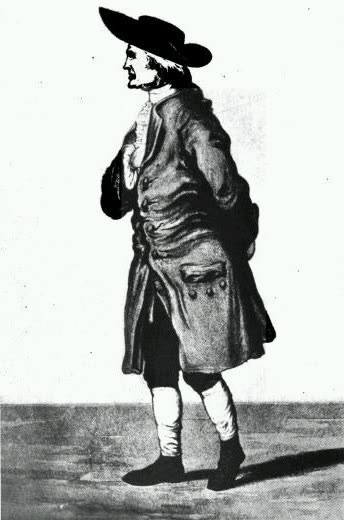
Cavendish’s own reading of his result is the part that gets skipped, and it is the most interesting thing in the lesson. He did not say that water is a compound of two elements. He said, in effect, that water was there all along. Dephlogisticated air is water deprived of phlogiston; inflammable air is water united with phlogiston; put the two together and the phlogiston finds its place and the water is released. That accounts for every observation he made, including the exact mass balance, and it does so without conceding a thing. Lavoisier’s account is that the water is made — that two elementary substances have combined and that neither of them was water. And then, in 1787, he and Guyton de Morveau, Berthollet and Fourcroy published a new system of chemical names, and inflammable air became hydrogène: from the Greek hydro and genes, the water-former. The substance whose defining property is that it makes water. That is not a label. It is Lavoisier’s entire theory compressed into a word, and once chemists were using it every time they mentioned the gas they were asserting his conclusion whether they meant to or not. The naming reform did as much to end phlogiston as any experiment did — which is worth noticing, and worth being slightly uneasy about.
Water is H₂O, so it is two parts hydrogen to one part oxygen — twice as much hydrogen as oxygen.
Twice as many hydrogen atoms, and therefore twice the volume as a gas. By mass it is the other way round and not by a factor of two: water is 11.2% hydrogen and 88.8% oxygen, a ratio of about 1 to 8. An oxygen atom is very nearly sixteen times as heavy as a hydrogen atom, so two hydrogens against one oxygen is 2 against 16. The reason this trips people is that both statements are true of the same substance and they point in opposite directions, and eighteenth-century chemists had exactly the same problem — Cavendish measured volumes because volumes were what a eudiometer gave him, while Lavoisier wanted masses because masses were what a balance gave him, and the two communities took another twenty-five years to work out that the volume ratios were the simpler ones and Avogadro to explain why.
Cavendish’s ratio
Cavendish reported that 423 measures of inflammable air were consumed by 1000 measures of common air, both being used up together. Taking common air to be 20.95% oxygen by volume, in what ratio — by volume — do the two gases combine?
- Inflammable air consumed
- 423 measures
- Common air consumed
- 1000 measures
- Oxygen in common air, by volume
- 20.95%
By the experiments with the globe it appeared that when inflammable and common air are exploded in a proper proportion, almost all the inflammable air, and near one-fifth of the common air, lose their elasticity, and are condensed into dew.
- 1766Cavendish isolates inflammable air and measures its density. He suspects it may be phlogiston itself.
- 1768–70Lavoisier boils water in a sealed pelican for 101 days and shows the "earth" is dissolved glass.
- 1781Cavendish has the globe experiments: inflammable air burned in common air gives water.
- April 1783Watt writes to Priestley proposing water is dephlogisticated air combined with phlogiston.
- June 1783Blagden tells Lavoisier what Cavendish has found. Lavoisier and Laplace repeat it within days.
- 15 Jan 1784Cavendish’s "Experiments on Air" is read to the Royal Society. Watt’s paper follows in April.
- Feb 1785Lavoisier and Meusnier decompose water over hot iron and recompose it, publicly, at the Arsenal.
- 1787Méthode de nomenclature chimique. Inflammable air becomes hydrogène, the water-former.
- 1789The Traité prints a list of 33 simple substances. Water is not on it. Neither is air.