Always the same recipe
Copper carbonate dug out of a mine and copper carbonate made on a bench turn out to have identical composition, to the limit of anyone’s ability to measure. Establishing that took eight years of argument against the best chemist in France — who was not being obtuse, and who was right about half of it.
- State the law of definite proportions, and what has to count as a compound for it to be true
- Explain why Berthollet’s objection was a serious scientific position rather than an error
- Tell a compound from a solution, an alloy or a glass by what its composition does
- Recognise a berthollide, and say why non-stoichiometric solids do not overturn the law
Lavoisier left chemistry with a conserved quantity, and a conserved quantity turns a description into an account. You can now write down what went in and what came out and insist that the two sides match. Which immediately raises the next question: how much of each? It sounds minor. It is the question that ends in atoms, and answering it took twelve years and a long public argument between two chemists who were both very good at their job. The state of the art in 1794 was better than you might expect. Analysis meant burning a known mass and weighing the products, or precipitating a metal out of solution and weighing the precipitate — slow, but reproducible to a fraction of a per cent in careful hands. The instruments were not the obstacle. The obstacle was that nobody agreed on what the numbers were supposed to be.
Start with the answer that turned out to be wrong, and take it seriously, because it was held by the most influential chemist in France. Claude Louis Berthollet thought composition was continuous. Offer a metal more oxygen and it takes up more; the proportions in the product depend on the quantities you began with, on the temperature, on how long you left it. Chemical affinity, on his account, was a force like gravitation — and like gravitation, its effect depended on how much mass was present. Look around a laboratory in 1800 and that is plainly what most things do. Salt in water goes on dissolving until it stops, at whatever proportion you like along the way. Alloys can be made to any composition a founder wants. Glass has no formula at all. If those are your examples, continuous composition is not a hypothesis, it is a description. And he had one observation nobody could wave away. Berthollet went with Napoleon to Egypt in 1798, and at the margins of the salt lakes he found deposits of natron — sodium carbonate — where the accepted chemistry said none should form. In a beaker, sodium carbonate and calcium chloride give chalk and common salt. In Egypt the reaction was running the other way, because there was a vast excess of salt sitting in the water. He drew the right conclusion from it: the quantity of a substance present changes what a reaction does. That is the law of mass action, arrived at fifty years early, and it is correct. It was also, unfortunately, the argument he then used against fixed composition.
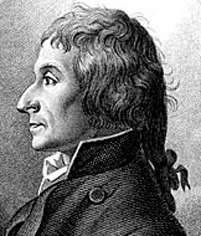
The original uploader was Dr. Manuel at German Wikipedia ., 29 June 2006 (original upload . Public domain
Carbonate of copper, from a mine and from a bench
- The question
- If composition is continuous, then a compound assembled under one set of conditions should differ from the same compound assembled under another. Does it?
- The apparatus
- Two specimens of carbonate of copper. One dug out of the ground and picked clean; the other precipitated on the bench from a solution of a copper salt. Each analysed by decomposing a weighed sample, driving off the carbon dioxide, reducing the residue and weighing the metal.
On Berthollet’s view the two should differ, and differ systematically — the mineral formed slowly under whatever quantities the ground supplied, the precipitate formed quickly under quantities Proust chose. On Proust’s view they must be identical.
Identical, within the error of the analysis, which was a few parts in a thousand. The same held for the oxides of copper, of tin, of iron, and of antimony, and for the sulphides of iron — a decade of analyses, all giving the same answer.
How sure could they be? This is a measurement whose value is in its repetition rather than its accuracy. Any single analysis at a few tenths of a per cent proves nothing about a law; the same analysis on twenty compounds from twenty sources, always agreeing, is a different kind of evidence — and it is why the dispute took years rather than an afternoon.
A compound has one recipe. Where you got it, how you made it, and what quantities you used to make it change how much of it you have and change nothing about what it is.
One gram of copper, and however much oxygen you choose to give it. Drag the slider, heat the mixture, and watch the strip along the bottom rather than the dishes.
The surplus is doing more work in that picture than the composition is, and it is worth being explicit about why. A theory in which composition drifts has no reason to leave anything over. If the oxide can be a little richer in oxygen, then the extra oxygen goes in, a little at a time, and the reaction has no natural stopping point short of exhausting one ingredient completely. That is not what happens. The reaction stops at a particular ratio and then simply declines the rest. Something in there is refusing the surplus. Whatever is doing the refusing can count. It is not obvious yet what could count — that is the next four lessons — but a stopping rule this exact is not something a continuous substance has any reason to possess.
The two oxides of copper, and everything supposedly between them
- The question
- Berthollet’s best evidence was that specimens of a metal oxide can be prepared with any composition you like across a range. Are those specimens compounds, or are they something else?
- The apparatus
- Copper, oxygen, heat, and then the tedious part: taking the intermediate specimens and separating them. Acids that dissolve one oxide and leave the other; differences in colour and in density to follow the separation by.
If Berthollet is right, an intermediate specimen is a single substance with an intermediate composition, and nothing will separate out of it. If Proust is right, it is a mixture, and the two components can be recovered.
Copper gives a red oxide and a black one, and nothing in between. Every intermediate specimen came apart into some of each. The oxygen taken up per gram of copper is 0.1259 g for the red and 0.2518 g for the black — and that second number will matter enormously in the next lesson.
The continuum was an artefact of not separating carefully enough. What looked like a compound of adjustable composition was two compounds of fixed composition in adjustable proportion — which is a different thing, and is testable, and was tested.
Berthollet was simply wrong, and the dispute was one man seeing clearly while the other clung to a bad idea.
He was wrong about the compounds Proust analysed and right about a great deal else, including things that took another century to come back into view. Compounds with genuinely variable composition exist, they are ordinary, and they are called berthollides — a name proposed in his honour by Kurnakov in 1914, once X-ray crystallography had shown what they were. Iron(II) oxide is the standard case: it is never FeO, always short of iron, running from roughly Fe₀.₈₅O to Fe₀.₉₅O, and the exact 1:1 compound is not stable at ordinary pressure at all. Titanium monoxide ranges over about TiO₀.₇ to TiO₁.₃. The high-temperature superconductors are tuned by precisely this mechanism: in YBa₂Cu₃O₇₋ₓ you choose the oxygen content, and the temperature at which the material starts to superconduct follows it. And Berthollet’s Egyptian observation was not merely defensible, it was the germ of the law of mass action, which is Act 7 of this path. What he got wrong was the scope. Fixed proportions are not a special case of a continuum; the continuum is the exception, and it happens in solids whose lattices can carry vacancies.
Offer it too much
You heat 2.00 g of copper in a stream of oxygen so generous that 1.00 g passes over it — about four times what it could conceivably use. It all converts to the black oxide, CuO. What mass of black oxide do you get? (These are the simulation’s starting quantities, scaled up, so you can check yourself against it.)
- Copper taken
- 2.00 g
- Oxygen offered
- 1.00 g
- Compound formed
- CuO, the black oxide
- Molar mass, copper
- M(Cu) = 63.546 g/mol
- Molar mass, oxygen atoms
- M(O) = 15.999 g/mol
Iron, like many other metals, is subject to the law of nature which presides over every true combination — that is to say, that it unites with two constant proportions of oxygen. In this respect it does not differ from tin, mercury, and lead, and, in a word, from almost every known combustible.
- 1786Proust leaves France for Spain, to teach at the artillery school at Segovia.
- 1794Lavoisier is guillotined. Proust begins the analyses that will become the law of definite proportions.
- 1798Berthollet sails for Egypt with Napoleon, and finds natron where the textbook says it cannot form.
- 1799Proust moves to the royal laboratory in Madrid, and publishes on the carbonate and the oxides of copper.
- 1803Berthollet’s Essai de statique chimique: affinity depends on mass, and composition is continuous.
- 1806Proust’s memoir on the metallic oxides. The two oxides of a metal, and nothing between them.
- 1808French troops sack Proust’s Madrid laboratory. He returns to France and never really works again.
- 1811Berzelius begins a decade of analyses far more accurate than either man’s, and they come out on Proust’s side.
- 1914Kurnakov proposes the names daltonide and berthollide. Berthollet turns out to have been describing something real.