Uncertainty
Not a limit on measurement, and not about clumsy instruments knocking things. A fact about waves — which turns out to be the reason atoms have a size and matter does not collapse.
- State the uncertainty relation and explain it as a property of waves rather than of measurement
- Say what is wrong with the microscope story Heisenberg himself told
- Derive the size of a hydrogen atom from uncertainty alone
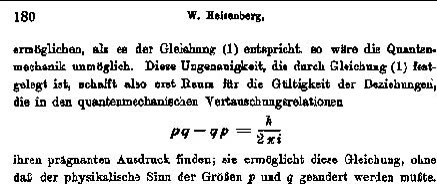
In 1927 Heisenberg published the relation that carries his name: Δx · Δp ≥ ħ/2 The spread in position times the spread in momentum has a floor. You cannot have both sharp. And in the same paper he offered an explanation of why — which is wrong, which Bohr told him was wrong before publication, and which has been in textbooks ever since.
Werner Heisenberg (1901-1976), 1927. Public domain
The explanation is the gamma-ray microscope. To see where an electron is, you must bounce something off it — there is no other way to look. To locate it precisely you need short-wavelength light, because you cannot resolve detail finer than the wavelength you are using. But short wavelength means high momentum — that is de Broglie — so the photon you bounce off the electron delivers a substantial kick. The more precisely you locate it, the harder you hit it, and the less you know about its momentum afterwards. It is a vivid argument. It feels like an explanation. And it gets the physics backwards.
Bohr read the draft and objected immediately and forcefully. The two argued for weeks — Bohr had a well-earned reputation for wearing people down, and by several accounts Heisenberg was reduced to tears at one point. Bohr's objection was that the microscope story describes a disturbance: a physical kick delivered by an act of measurement. And that is not what the mathematics says. Heisenberg was made to add a note in proof, acknowledging Bohr's criticism and conceding that the relation follows from the formalism rather than from the microscope. The note is in the published paper. Almost nobody reads it. The microscope has been taught for a century.
Uncertainty arises because measuring a particle inevitably disturbs it — our instruments are too clumsy to catch both quantities at once.
This says the electron has a definite position and a definite momentum, and we are prevented from learning both. That is a claim about ignorance, and it is not what the theory says. The theory says a state with definite momentum does not have a position — not unknown, absent; there is no value there to be ignorant of. Three things show the disturbance story is the wrong account. It is a property of the state, computable from ψ with no measurement anywhere in the calculation. It is not confined to quantum mechanics — the identical relation holds for sound and radio waves, where nobody invokes disturbance. And measurement disturbance is a real but separate effect, with its own relation, first properly formulated by Ozawa in 2003 and measured in 2012; the two can be distinguished experimentally, and they are different.
Squeeze the position spread and watch the momentum content broaden. Nothing here is being measured.
Squeeze the atom and watch the confinement cost explode. Then find the minimum.
The liquid that will not freeze
- The question
- Uncertainty forbids a confined particle from being perfectly at rest, since zero momentum is a perfectly definite momentum. Is that residual motion real enough to have macroscopic consequences?
- The apparatus
- Helium cooled towards absolute zero at ordinary pressure. Every other substance known solidifies when cooled far enough — thermal motion ceases and the atoms lock into a lattice. Helium is the test case because it is very light and very weakly bound, so its zero-point motion is unusually large compared with the forces holding it together.
Classically, cooling removes kinetic energy; at absolute zero there is none left and any substance must be solid. Helium should freeze like everything else.
It does not. Helium remains liquid all the way to absolute zero at atmospheric pressure, and can only be solidified by applying about 25 atmospheres. The residual motion that keeps it liquid is not thermal — it persists when there is no thermal energy left to remove.
How sure could they be? Unambiguous rather than precise: the substance is either solid or it is not. The quantitative test is the pressure required to solidify it, which agrees with calculations of the zero-point energy for helium’s mass and interatomic potential — and with the fact that the heavier isotope ³He behaves differently from ⁴He, as its larger zero-point motion requires.
Zero-point motion is not a bookkeeping device. It is the reason a bottle of liquid helium stays liquid at temperatures where nothing else could, and it is a direct macroscopic consequence of the uncertainty relation — a confined particle cannot be at rest, because being at rest would mean having an exactly defined momentum.
- 1807Fourier’s analysis establishes the width–bandwidth relation for waves. No physics of particles involved.
- 1927Heisenberg publishes the uncertainty relation, with the microscope argument.
- 1927Bohr objects; Heisenberg adds a note in proof conceding the point.
- 1929Robertson derives the general relation from the commutator, for any pair of observables.
- 1930sZero-point motion explains why helium does not freeze.
- 2003Ozawa formulates the separate measurement–disturbance relation.
- 2012Experiments confirm that measurement disturbance and the uncertainty relation are distinct, and can be violated independently.