The wavefunction
Two men produced quantum mechanics eighteen months apart, in mathematics so different that each found the other’s repellent. Then a footnote added in proof explained what the answer meant, and its author waited twenty-eight years for the prize.
- Explain why quantisation is a boundary condition rather than a postulate
- State the Born rule and say why ψ itself cannot be a physical density
- Say what Schrödinger’s equation achieved that Bohr’s model could not
Quantum mechanics arrives twice, about eighteen months apart, from two people who could hardly have differed more in method. June 1925. Werner Heisenberg, aged 23 and suffering badly from hay fever, retreats to Helgoland — a treeless island in the North Sea, chosen for having almost no pollen. There he builds a scheme from observable quantities only: no orbits, no trajectories, nothing picturable. Just arrays of numbers relating the transitions you can actually measure. He notices the arrays do not commute: A × B ≠ B × A. He finds this deeply disturbing, writes to a friend that he is not sure whether he has produced physics or nonsense, and hands the manuscript to Born to decide. Born recognises the arrays as matrices — a piece of mathematics most physicists of the period had never met — and with Pascual Jordan turns it into matrix mechanics.
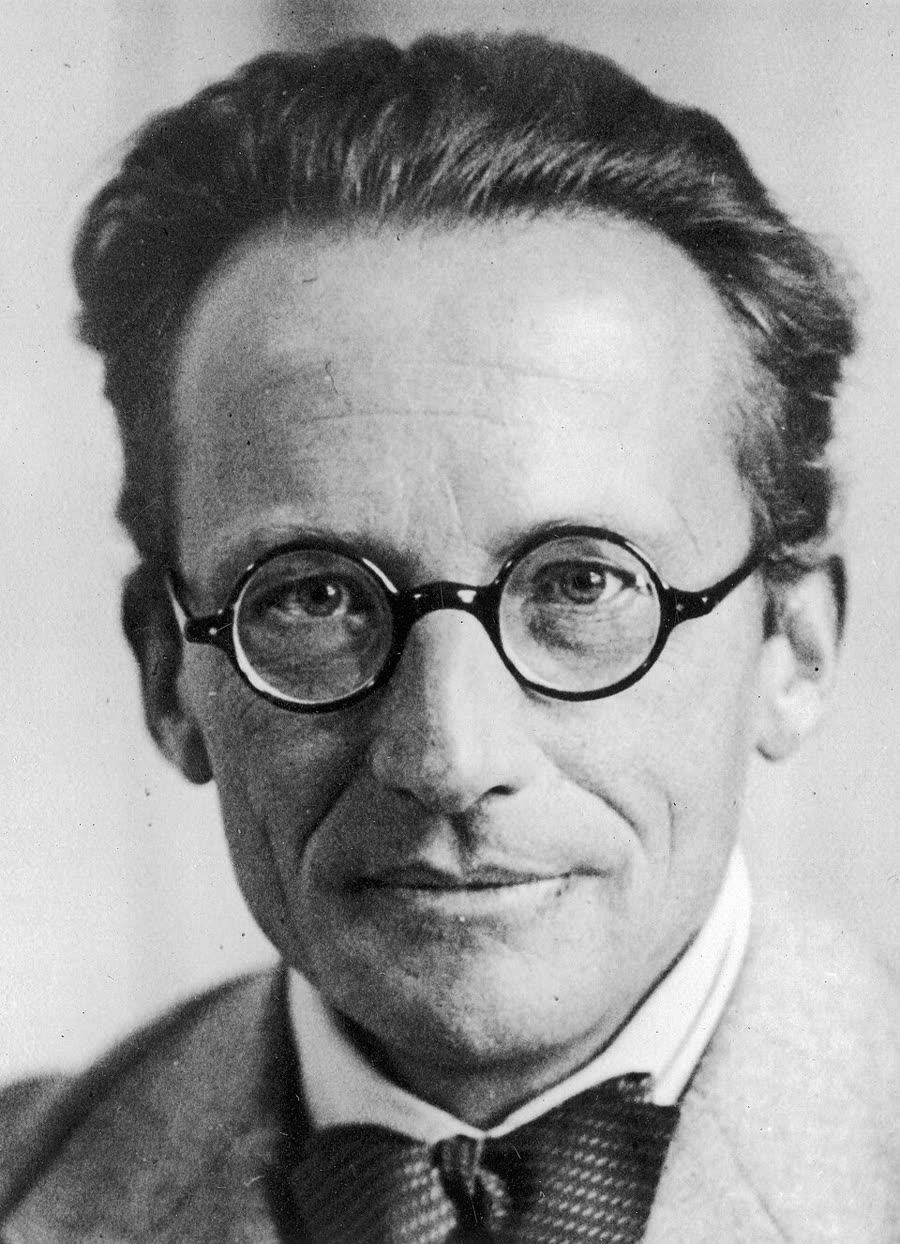
1933. Public domain
Christmas 1925. Erwin Schrödinger — 38, established, and by all accounts enjoying himself at a resort in Arosa, in company his biographers have never managed to identify — produces something entirely different. A wave equation. The prompt is unusually well documented. Schrödinger had given a seminar in Zurich on de Broglie's thesis. Peter Debye, chairing, remarked afterwards that talking about waves without a wave equation was rather childish, and that if there is a wave, someone ought to write down the equation for it. Schrödinger went away and did.
Drag n away from a whole number and look at the far wall. Nothing breaks — the wave simply fails to arrive at zero.
Apply it to hydrogen and you recover the Bohr levels exactly — the same −13.606/n² eV. Which by itself proves little, since Bohr already had them. But you get a great deal Bohr could not give: The degeneracies. How many distinct states share each energy — n² of them, which Bohr's model has no way to express. Angular momentum properly. Including that the ground state has zero orbital angular momentum, which Bohr's own rule forbids, and which is correct. Selection rules. Which transitions actually occur and which do not, explaining why some spectral lines are strong, some weak, and some entirely absent. The shapes. Orbitals — probability distributions with lobes and nodes, nothing like orbits. And helium. Two electrons, needing numerical solution, but giving the right answer. Bohr's model failed outright on helium and a decade of patching had never fixed it. That failure was the clearest sign the old model was a scaffold rather than a theory.
Which leaves the question that nobody could answer, and which the equation itself does not settle. What is ψ? Schrödinger had a firm and appealing view: it is a real physical thing — a smeared-out density of electric charge, the electron genuinely spread through space, with |ψ|² giving how much of the electron is where. He defended this hard, and part of why he found the theory attractive was precisely that it restored a continuous, visualisable picture after Heisenberg had abolished pictures entirely. It has two fatal problems.
Compare the two curves. One goes negative; the other cannot. Then look at what happens at a node.
The footnote that interpreted quantum mechanics
- The question
- Schrödinger’s equation gives a function ψ that predicts atomic spectra correctly. What physical quantity does ψ actually represent?
- The apparatus
- None — this is a theoretical proposal, made in a paper on the quantum mechanics of collision processes. Born was analysing scattering, where the incoming and outgoing states are separated in space, and where Schrödinger’s charge-density reading gives an obviously wrong picture: a scattered electron would have to be a spherical shell of charge expanding away from the target, and it is not.
Schrödinger’s interpretation: |ψ|² is a density of electric charge, so the electron is genuinely spread out. This must reproduce the observed single, localised arrivals in every scattering experiment ever performed.
It does not. Scattered electrons arrive as individual particles in individual directions. Born proposed instead that |ψ|² gives the probability of the particle being found at that place — stated in the original paper only in a footnote added in proof, after he had written a weaker claim in the main text.
How sure could they be? The rule has been tested continuously for a century, everywhere quantum mechanics is used, and no deviation has ever been found. It is also the only part of the theory that connects the mathematics to any observation at all — without it, ψ predicts nothing.
This is the moment physics becomes irreducibly probabilistic. Einstein’s "God does not play dice" comes from a letter to Born later that year, about precisely this. Schrödinger never accepted it. Born received the Nobel Prize in 1954 — twenty-eight years later, and long after Heisenberg (1932), Schrödinger and Dirac (1933), and Pauli (1945) — for a footnote that turned out to be the interpretation of the entire theory.
Look at what the nodes do under each reading. In the n = 2 state there is a point exactly in the middle of the box where |ψ|² is zero — and the particle is found on both sides of it. As a description of a spread-out substance, that is very strange: a fluid present on the left and on the right and absent along a plane between them, with nothing flowing across. As a probability distribution it is entirely ordinary. There are simply places the particle is never found. Nothing has to travel through the node, because nothing is spread out in the first place.
Quantum mechanics is very impressive. But an inner voice tells me that it is not yet the real thing. The theory produces a good deal but hardly brings us closer to the secret of the Old One. I am at all events convinced that He does not play dice.
Matrix mechanics and wave mechanics were rival theories, and wave mechanics won.
They are the same theory. Schrödinger proved the mathematical equivalence in 1926, and Dirac and Jordan then produced a formulation containing both as special cases. What differed was language and taste, and the personal reaction was strikingly hostile on both sides: Heisenberg wrote privately that the more he thought about the physical portion of Schrödinger’s theory, the more repulsive he found it; Schrödinger wrote in print that he had been discouraged, if not repelled, by matrix mechanics, with its want of visualisability. Wave mechanics became dominant because it was easier to calculate with and used mathematics physicists already knew — not because it was more correct. Modern quantum mechanics uses both freely, and Dirac’s notation deliberately commits to neither.
- Jun 1925Heisenberg, on Helgoland, produces non-commuting arrays and doubts they are physics.
- Sep 1925Born and Jordan identify them as matrices and formalise matrix mechanics.
- Dec 1925Schrödinger, at Arosa, writes down the wave equation.
- Mar 1926Schrödinger proves the two formulations equivalent.
- Jun 1926Born’s footnote: |ψ|² is a probability.
- Dec 1926Einstein writes to Born about dice.
- 1954Born receives the Nobel Prize, twenty-eight years later.
The ground state of a smaller box
The simulation uses a well 1 nanometre across. Confine the same electron to half that — a well 0.5 nm wide — and find the energy of its ground state, n = 1.
- Well width
- L = 0.5 nm
- Electron mass
- m = 9.109 × 10⁻³¹ kg
- Reduced Planck constant
- ħ = 1.055 × 10⁻³⁴ J·s