Two spots
A beam of silver atoms through a magnet, and a photographic plate that stayed blank until a man with a cheap cigar breathed on it. They were testing the wrong theory and got the right answer for a reason nobody would understand for three more years.
- Say what the classical prediction was and why two spots refuted it
- Explain the cos²(θ/2) law and why the half-angle matters
- Describe what the sequential experiment shows that a single measurement cannot
By 1922 there was a peculiar claim in circulation called space quantisation. Sommerfeld had extended Bohr's model so that an atom's angular momentum could not point in arbitrary directions: relative to an external magnetic field, only certain discrete orientations were allowed. Not merely a quantised magnitude — a quantised direction. It sounds like nonsense, and Otto Stern thought so. He is reported to have said that if this business turned out to be right, he would give up physics. He then designed the experiment that would settle it, which is the correct response.
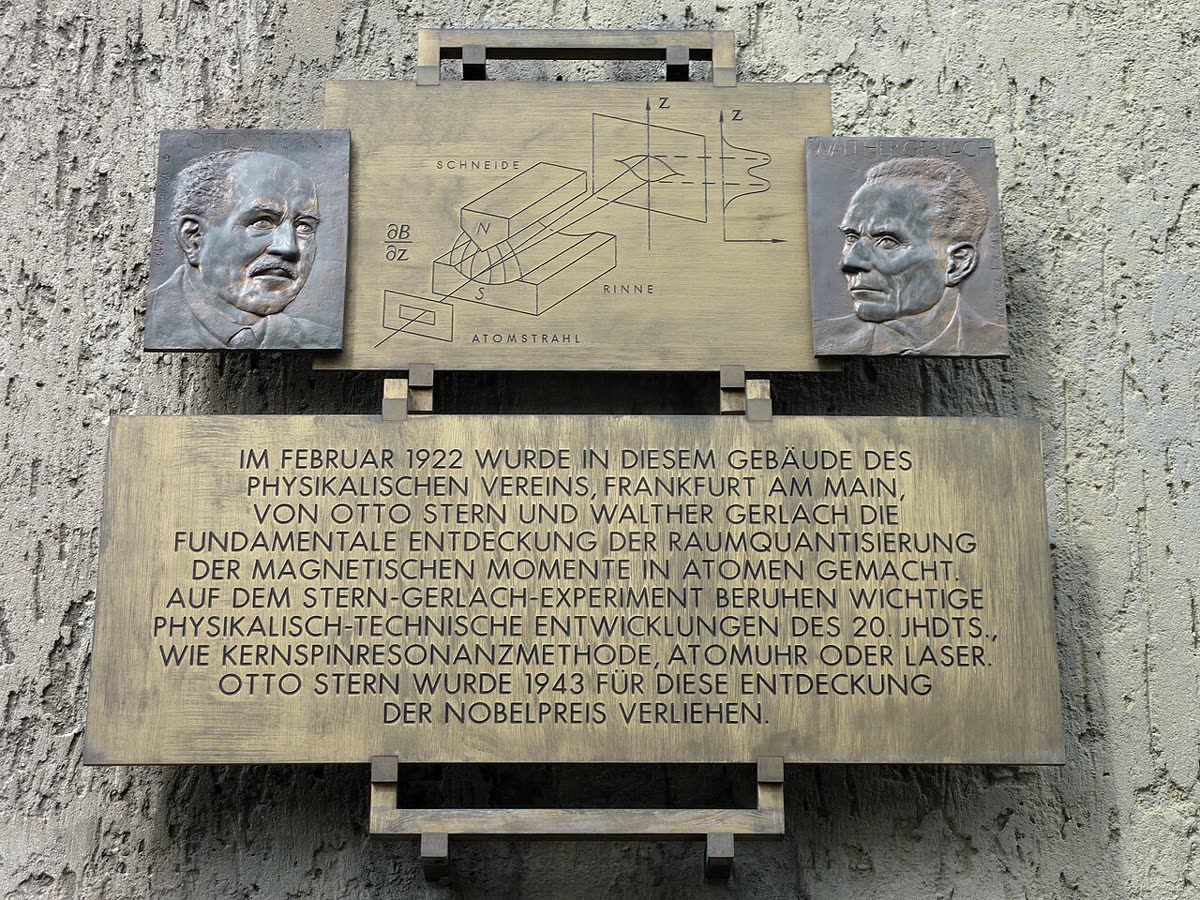
Frank Behnsen, 2010-05-01. CC BY-SA 3.0
Silver was chosen carefully, and the reasons are worth stating. It has 47 electrons, of which 46 pair up and cancel, leaving exactly one unpaired in the outer 5s shell. So the entire atom carries the magnetic moment of a single electron and behaves as one — no complicated internal bookkeeping. It evaporates at a manageable temperature, giving a usable beam from a simple oven. And it blackens on a photographic plate, so you can see where it landed. That last property is about to matter more than they expected.
Compare the classical band against what actually lands on the plate.
Silver atoms through a lopsided magnet
- The question
- Can an atomic magnetic moment point in any direction relative to an applied field, as classical physics requires — or only in certain discrete orientations, as Sommerfeld’s space quantisation claims?
- The apparatus
- Silver evaporated in an oven at about 1300 K, collimated by slits into a beam roughly 0.03 mm wide, passed through a 3.5 cm magnet with one knife-edge pole and one grooved pole to produce a strongly non-uniform field, then flown about 10 cm to a glass plate. The whole apparatus ran under vacuum and required exposures of around eight hours; the resulting traces are about 0.2 mm apart and were measured under a microscope.
Classically, a continuous band: thermal atoms emerge at every orientation, deflection varies smoothly with orientation, so the beam simply broadens with the greatest density at the centre. Sommerfeld’s theory predicted a discrete pattern — for the state silver was believed to be in, three lines.
Two distinct traces, separated by about 0.2 mm, with no trace of atoms in between. Not a band, not three lines. Two spots and a clean gap where the undeflected beam would have been.
How sure could they be? The separation is a fifth of a millimetre from a beam initially 0.03 mm wide, which is why the result is unambiguous rather than marginal — the gap is far wider than the beam. The initial plate appeared blank, and the image emerged only when Stern leaned in to look at it.
The classical picture is refuted outright: no distribution of orientations produces a gap in the middle. But the experiment also refuted the theory it was testing. Silver’s ground state has zero orbital angular momentum, so there was nothing there for space quantisation to quantise, and two is not a possible number of orientations for any orbital angular momentum — those always give an odd number. What Stern and Gerlach had measured was electron spin, which would not be proposed until 1925.
Stern and Gerlach set out to test space quantisation, and confirmed it.
They confirmed something, and it was not the theory under test. Silver’s ground state has zero orbital angular momentum — there was nothing there for space quantisation to act on, and the observed splitting should not have happened at all on Sommerfeld’s account. Worse, orbital angular momentum ℓ always gives 2ℓ+1 orientations, which is an odd number: 1, 3, 5. Two is not on the list. Sommerfeld predicted three lines for the state he assumed silver occupied; two lines is a result his theory cannot produce. What the plate recorded was electron spin, a property with two orientations that nobody proposed until Uhlenbeck and Goudsmit in 1925, three years later. The experiment is rightly regarded as one of the most important of the century, and essentially nobody involved understood what it had shown until well after the fact.
Sweep the angle. Only ever two outcomes — and watch the split follow cos²(θ/2), not cos θ.
Step through z→z, then z→x, then z→x→z. Then check the control, z→z→z.
- 1916Sommerfeld proposes space quantisation. Stern says he will quit physics if it is right.
- 1922Two spots. The plate is blank until a cheap cigar develops it.
- 1925Uhlenbeck and Goudsmit propose electron spin — the thing actually measured three years earlier.
- 1927Phipps and Taylor repeat it with hydrogen, ruling out any residual orbital contribution.
- 1943Stern receives the Nobel Prize. Gerlach, who had worked on the German nuclear programme, does not.
- 1975Neutron interferometry detects the 720° sign flip directly.