The measurement problem
Quantum mechanics has two rules that contradict each other, and no rule for which to apply. A hundred years on this is not settled, and the lesson that says otherwise is lying to you.
- State the two rules precisely and say why they cannot both be fundamental
- Explain what decoherence does explain and what it does not
- Compare the main interpretations on what each one gives up
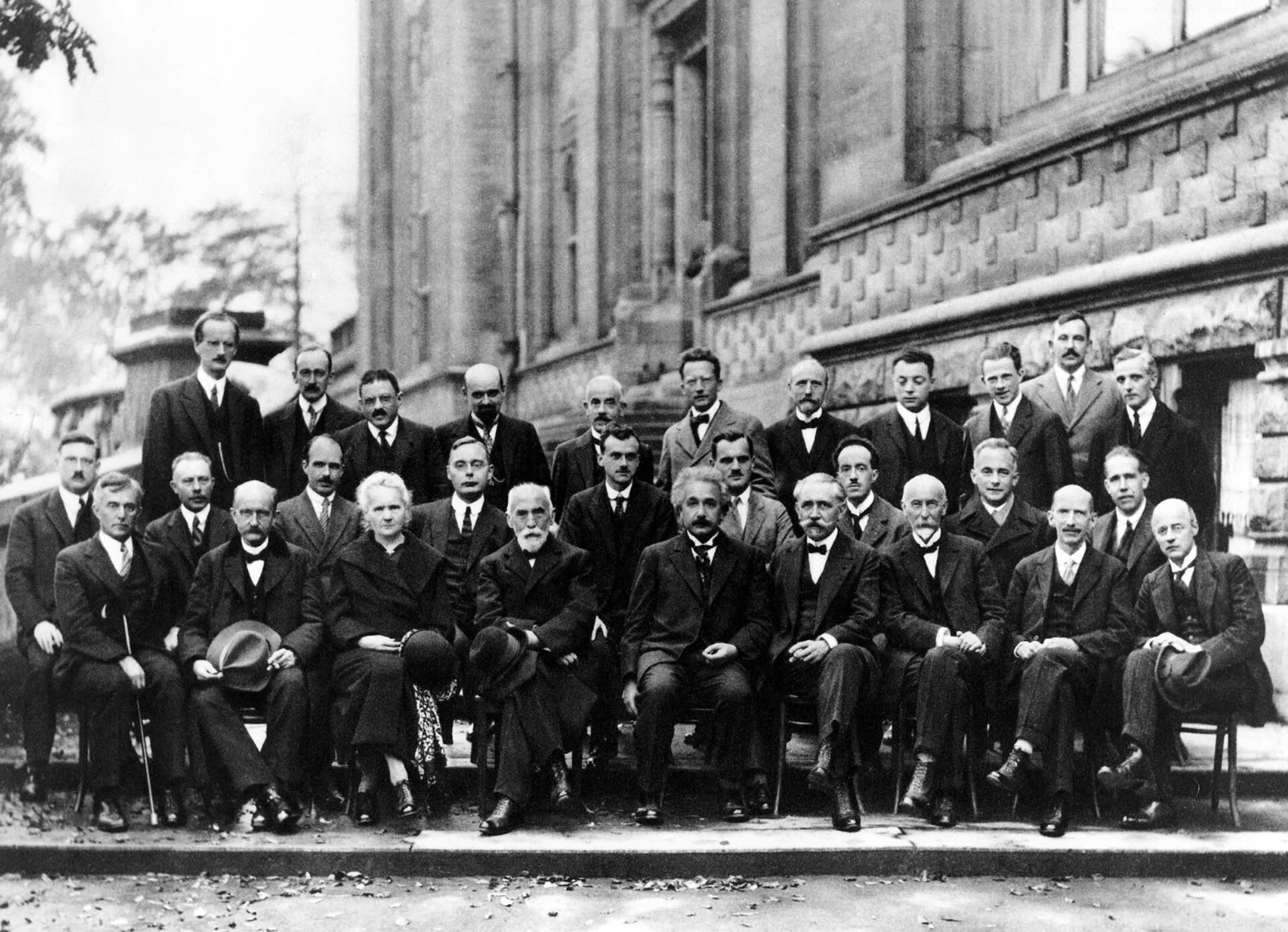
Benjamin Couprie, 1927. Public domain
Slide the cut up and down the chain. Watch the prediction while you do it.
Follow the chain and the problem is unavoidable. An atom in a superposition of up and down enters the magnet. The magnet is made of atoms, so the equation describes it too — and what the equation says is that the magnet becomes correlated with the atom. It is now in a superposition of having deflected the atom up and having deflected it down. So is the detector. So is the pointer. So are the photons leaving the display, the rhodopsin in your retina, and the firing pattern in your brain. At no point does the equation produce a single outcome. It is linear: feed it a sum of possibilities and it returns a sum of possibilities, forever. So somewhere you have to stop and say an outcome has occurred. That dividing line is the cut — sometimes the Heisenberg cut — and it is not in the mathematics. You put it there.
Schrödinger’s cat is an illustration of how strange quantum superposition is.
Schrödinger constructed it in 1935 as a reductio ad absurdum — an argument that the prevailing interpretation leads to nonsense and must therefore be incomplete. His paper calls the resulting situation burlesque. The point was: if you take the standard account seriously and apply it consistently, since the detector and the flask and the cat are all made of atoms, you are committed to a cat in superposition — and that is absurd, so the account is wrong somewhere. He was arguing against the position his cat is now routinely used to illustrate. Einstein, who had prompted the exchange with a similar example about unstable gunpowder, agreed entirely. Using the cat as a colourful demonstration of quantum weirdness inverts its purpose.
Decoherence solves the measurement problem.
It does not, and this is where popular accounts most often overreach. Decoherence turns a superposition into something indistinguishable from a list of possibilities with probabilities attached. It does not tell you why one of them happens. The mathematics still contains every branch — what has changed is that they no longer interfere, so you cannot detect the others. You have gone from a state that says up and down to a state that says up and down, in a form that cannot be told apart from up or down. That is enormously useful. It is not the same thing. The "and" has not become an "or". Decoherence explains the appearance of classicality; the question of why a single outcome occurs is untouched by it, and the physicists who developed decoherence said so themselves.
So there are interpretations. It is worth stating what each one gives up, because none of them is free. Copenhagen, roughly. The cut goes wherever is convenient; quantum mechanics describes measurement outcomes rather than an underlying reality; asking what is happening in between is a misuse of the theory. Coherent, widely held, and it gives up any account of what is going on. Its defenders regard that as a virtue rather than a cost. Many worlds (Everett, 1957). Delete Rule 2 entirely. There is only Schrödinger evolution, nothing ever collapses, and every branch continues — including branches containing a version of you who saw the other result. Extremely economical in axioms, extremely extravagant in what exists. Its main technical difficulty is probability: if everything happens, it is genuinely hard to say what the numbers in the Born rule are numbers of. Pilot wave (de Broglie 1927, Bohm 1952). Particles have definite positions at all times, guided by a real physical wave. Reproduces every prediction exactly, restores determinism, and has no measurement problem at all. The price is that it is explicitly and unavoidably non-local — and after Act 7 you may find that price lower than it sounds. Objective collapse (GRW 1986, and successors). Modify the equation so that collapse is a real physical process: each particle spontaneously localises very rarely, but a macroscopic object contains so many particles that one of them localises almost immediately, dragging the rest with it. No cut, no observer, no ambiguity.
Looking for collapse that is not there
- The question
- Objective collapse models are the only interpretations that make different predictions. If collapse is a real physical process, it must deposit a tiny amount of energy in everything, and it must destroy interference in large objects even under perfect isolation. Does it?
- The apparatus
- Three lines of attack. Spontaneous collapse would heat matter continuously, so ultra-low-noise systems become detectors: LISA Pathfinder’s free-falling test masses, and cryogenic detectors deep underground where cosmic rays are screened out. Collapse also predicts spontaneous X-ray emission from accelerated charges, searched for in germanium detectors at Gran Sasso. And it predicts a mass threshold beyond which interference cannot survive, probed directly by interfering ever-larger molecules.
Standard quantum mechanics predicts no anomalous heating, no spontaneous radiation, and interference at any mass given sufficient isolation. Collapse models predict all three, with rates set by two free parameters — a collapse rate and a localisation length.
No anomalous heating, no spontaneous emission, and interference surviving to molecules above 25,000 amu. Large regions of the parameter space are excluded, including the original values Ghirardi, Rimini and Weber proposed in 1986.
How sure could they be? Sufficient to rule out the original GRW parameters, and pressing hard on the wider family. Not sufficient to exclude collapse models entirely — the parameters can be pushed to make the effect weaker, at the cost of making the model less motivated.
This is the part of the measurement debate that is genuinely empirical, and it deserves emphasis on a site about evidence. Copenhagen, many worlds and pilot wave agree on every number and cannot be distinguished by any experiment. Collapse models can, and are being squeezed. If one were confirmed, the measurement problem would be solved by physics rather than by argument.
- 1926Born’s rule introduces probability; the two-rule structure appears immediately.
- 1932Von Neumann formalises it, and shows the cut can be placed anywhere.
- 1935Schrödinger’s cat, as a reductio. Also the EPR paper — the subject of Act 7.
- 1952Bohm revives the pilot-wave theory, showing a deterministic account is possible.
- 1957Everett proposes dropping Rule 2 altogether.
- 1970s–80sZeh, Zurek and others develop decoherence.
- 1986Ghirardi, Rimini and Weber propose physical collapse — a testable alternative.
- 2020sOriginal GRW parameters excluded experimentally. The debate continues.