Einstein's objection
For three years Einstein tried to prove quantum mechanics inconsistent, and lost every round — the last one to an argument built out of his own theory of gravity. So he changed the charge. Not wrong, but incomplete. That version could be tested, though it took thirty years for anyone to notice.
- Say what Einstein was actually attacking at the 1927 and 1930 Solvay congresses
- Follow Bohr's photon-box rebuttal and see why it turns on gravitational time dilation
- Distinguish the charge of inconsistency from the charge of incompleteness, and say why only one of them can be tested
By 1927 the quantum theory worked. It gave the hydrogen spectrum. It explained the periodic table. It was being used, already, to work out how molecules bind and how metals conduct. Nobody serious doubted that it predicted correctly. Einstein did not dispute a single prediction. He disputed the claim that the predictions were all there was.
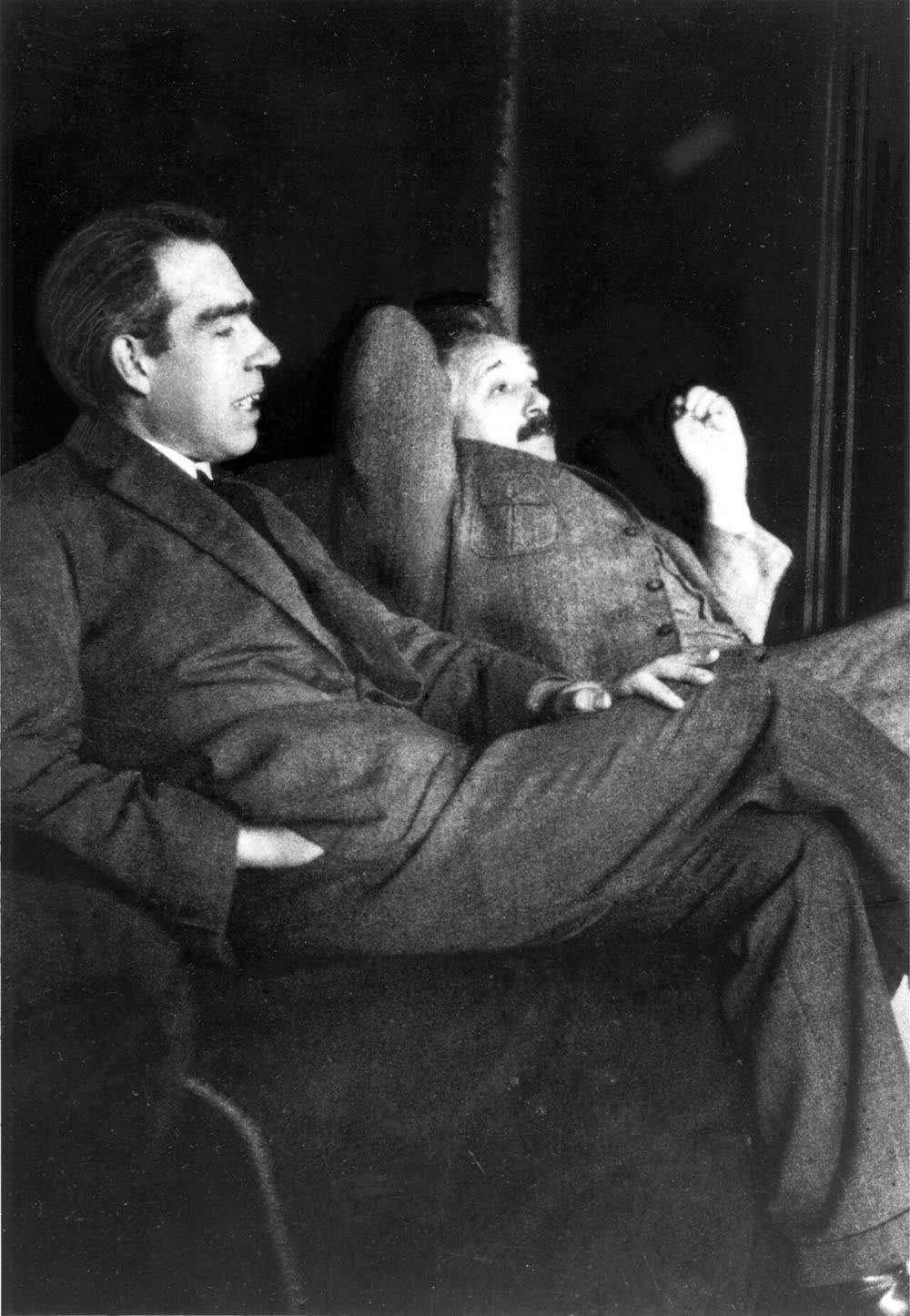
Paul Ehrenfest Original uploader was Graf at de.wikipedia, 1925-12-11. Public domain
The argument happened mostly at the Solvay congresses in Brussels — the fifth in October 1927, the sixth in 1930. Twenty-nine people attended the fifth; seventeen of them held or would go on to hold a Nobel prize. The formal sessions are not where it happened. By Bohr’s own account and Otto Stern’s, the pattern was domestic: Einstein would come down to breakfast with a thought experiment designed to break the uncertainty relation, the younger physicists would carry it around all day, and by dinner Bohr would have taken it apart. Then Einstein would build a better one.
Einstein rejected quantum mechanics because he could not accept that nature is random.
The dice line is real — it is from a letter to Max Born in December 1926, and the sentence is that the theory delivers much, but hardly brings us closer to the secret of the Old One. But randomness is not what the arguments are about. Neither of the two attacks below mentions probability. Both are attempts to show that a particle has definite properties the theory refuses to assign it. His later objection, in 1935, is about locality — whether what you do in one place can change what is true in another. Those are the two commitments he would not give up, and randomness was never really one of them.
Round one: the recoiling screen
The first attack goes straight at the uncertainty relation. Take the double slit. Now let the slitted screen hang freely, so it can recoil. A particle that passes through the upper slit and arrives at a given point on the far screen has been deflected downwards, so it must have kicked the screen upwards — and a particle through the lower slit kicks it downwards. The two paths leave different marks on the apparatus itself. So: measure the screen’s recoil and you know which slit. And the particle is still free to land wherever it lands, so the interference pattern should still build up. Which path and the fringes. Quantum mechanics says you cannot have both.
Bohr’s reply is the move he made every time, and it is the one worth learning: the apparatus is physical too. The screen is a quantum object. To read its recoil finely enough to separate the two cases, you must know its momentum that finely — and then its own position is uncertain by at least ħ divided by that momentum precision. The screen is no longer at a definite place. And the fringe pattern’s position on the far wall depends on where the slits are. So the very precision that tells you the path smears out the thing you were trying to keep.
Round two: the photon box
At the sixth Solvay Congress, in 1930, Einstein came back with something much better. A box, with mirrored walls, full of radiation. A clock inside, wired to a shutter in one wall. Hang the whole thing from a spring balance and weigh it. At a moment fixed by the clock, the shutter opens for an instant and one photon leaves. Weigh the box again. The mass has dropped by Δm, and the energy of the photon that left is Δmc². So you have the energy, from the weighing, and the time of emission, from the clock. Both to whatever precision you are willing to pay for. And the uncertainty relation insists that ΔE·Δt cannot be pushed below ħ. Einstein has apparently just pushed it to zero.
Set the energy to that of a visible photon, then drag the pointer-precision slider from one end to the other. The weighing time changes by seventeen orders of magnitude. Watch the bottom number.
Leon Rosenfeld was there, and his description of that evening is the reason this story gets retold: Bohr went from one person to another, trying to persuade them it could not be true, that it would be the end of physics if Einstein were right — and unable to produce any refutation. He did not sleep. By morning he had it. And the argument he came back with uses general relativity: Einstein’s own theory, the one thing in the room that Einstein could not disown.
Push both sliders to their extremes, in every combination. ΔE·Δt stays at 1.000 ħ — the mass, the pointer precision and the strength of gravity all cancel.
Gravitational redshift measured in a stairwell
- The question
- Do clocks at different heights really run at different rates, as Einstein predicted in 1907 — and as Bohr had assumed in 1930 in order to defeat the photon box?
- The apparatus
- Gamma rays from iron-57 sent up (and down) a 22.5 m shaft in the laboratory tower. The Mössbauer effect gives an emission line so sharp that a shift of a few parts in 10¹⁵ is detectable; the receiver was moved slowly to Doppler-tune it back into resonance, and the speed needed is the measurement.
A fractional frequency shift of gh/c² = 2.46 × 10⁻¹⁵ over 22.5 metres — about two parts in a thousand million million.
A shift agreeing with the prediction to within 10%; refined to 1% by Pound and Snider in 1964.
How sure could they be? The Doppler speed required to cancel the shift is 0.74 micrometres per second — three quarters of a millionth of a metre in a second. This is the same physics that the GPS lesson turns into 38 microseconds a day.
Bohr’s 1930 rebuttal leaned on an effect that had never been measured. It was not confirmed in a laboratory for another twenty-nine years. The argument was right, but at the time it was an appeal to a theory rather than to a measurement — which is worth sitting with, given that Einstein was the one who had supplied the theory.
- 1926Einstein to Born: the theory delivers much, but "He does not throw dice."
- Oct 1927Fifth Solvay Congress. The recoiling-screen arguments; Bohr answers each one.
- Oct 1930Sixth Solvay Congress. The photon box, and Bohr’s sleepless night.
- 1935Einstein, Podolsky and Rosen: the incompleteness argument, made precise.
- 1949Bohr publishes his account of the debates, twenty years after the fact.
- 1959Pound and Rebka measure the redshift Bohr’s 1930 argument had assumed.
- 1964Bell shows the 1935 argument has a testable consequence.
- 1988–96The duality relation D² + V² ≤ 1 makes round one quantitative.