Two postulates
Einstein kept two things that could not both be true, and gave up something nobody knew they were assuming.
- State the two postulates and say why they appear to contradict each other
- Explain how a clock made of light forces time itself to stretch
- Say what Einstein actually removed, given that Lorentz already had the equations
Here is where the last four lessons leave us. Light is a wave in the electromagnetic field. Every attempt to detect the medium it waves in has failed. And the only surviving theory requires matter to contract by exactly the amount needed to keep that medium permanently hidden.
A magnet and a coil
Einstein’s 1905 paper does not open with any of that. It opens with the experiment from the first lesson of this course. Move a magnet toward a coil and a current flows. Hold the magnet still and move the coil instead, and the same current flows. Same needle, same deflection — the observable result depends only on the relative motion of the two.
But Maxwell’s theory tells two completely different stories about why. In the first case, a changing magnetic field creates an electric field, and that field pushes the charges around the wire. In the second, there is no electric field at all — the charges are simply moving through a magnetic field and feel a force because of it. Two mechanisms, one observation, and which mechanism you invoke depends entirely on who you decide is moving.
It is known that Maxwell’s electrodynamics — as usually understood at the present time — when applied to moving bodies, leads to asymmetries which do not appear to be inherent in the phenomena.
That is the first sentence of the paper, and it is a remarkable place to begin. Not with a failed experiment, but with an aesthetic complaint about a theory that works perfectly. Einstein’s suspicion was that the asymmetry is not in nature but in our description of it — and that it disappears entirely if you stop believing there is a fact of the matter about who is really moving.
The two postulates
Now put the two together and you get something that sounds like nonsense. Chase a light beam at 90 per cent of the speed of light. Common sense says it should be drawing away from you at the remaining 10 per cent. But the first postulate says your laws are the same as everyone else’s, and the second says light travels at c. So you measure it receding from you at the full c — exactly as if you had never started chasing.
Your instruments are distorted by the speed, so you get the wrong answer and only think the light is doing c.
There is no correct answer you are failing to get. Both of you are right. What has to give is the assumption underneath the paradox — that you and the beam share a single time and a single ruler against which "how fast it is pulling away" has one true value. Drop that, and there is nothing left to be paradoxical.
If two people in relative motion both measure the same light to be doing the same speed, then something they assumed they agreed on cannot be shared between them. Speed is distance over time. So either distance or time — or both — must differ between them. The rest of this lesson is the demonstration that it is time.
A clock made of light
The simplest clock that can be built out of the second postulate: two mirrors, a pulse bouncing between them, one tick per round trip. Start with both at rest, then give the second one some speed and watch the counters separate.
The obvious objection is that light clocks are peculiar, and an honest clock — a pendulum, a spring, a heartbeat — would keep proper time. The first postulate is what forbids this. If a light clock disagreed with the wristwatch next to it, you could compare the two and deduce how fast you were really travelling, inside a sealed cabin, which is precisely what the first postulate says is impossible. So every clock must slow by the same factor. Including the chemical ones you are made of.
The patent clerk
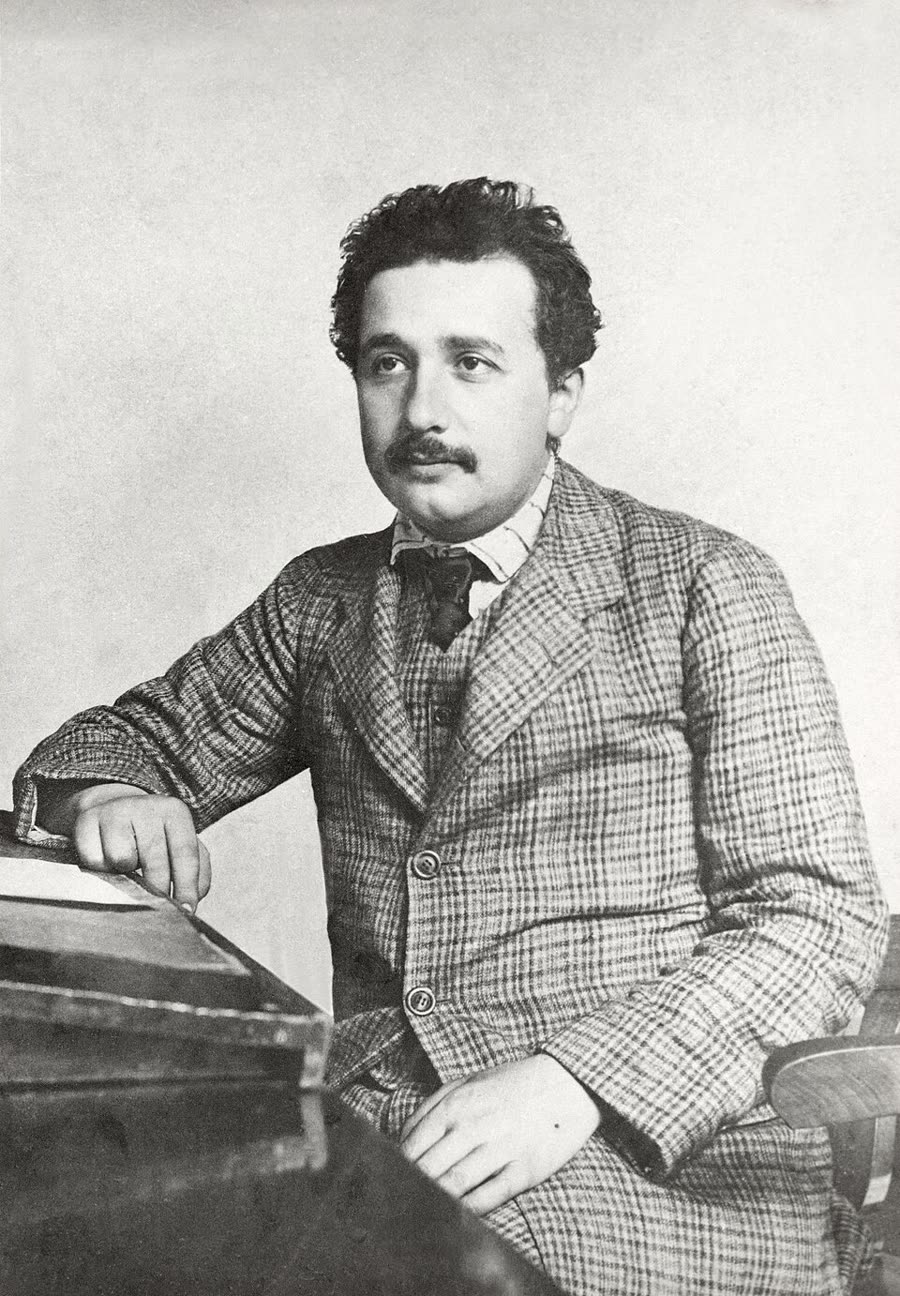
Lucien Chavan / ETH Zürich, 1905. Public domain
On the Electrodynamics of Moving Bodies
- The question
- Why does Maxwell’s theory give two different explanations for one observed current, depending on which body you say is moving?
- The apparatus
- None. This is the exception in this course: a paper with no experiment in it, arguing from two assumptions and the requirement that they be consistent. Its predictions were testable, but Einstein tested nothing — he had no laboratory and no budget.
The prevailing view was Lorentz’s: real contraction and a mathematical "local time", both measured against a stationary aether that had so far escaped every attempt to detect it.
Not an observation but a derivation — that the same equations follow from the two postulates alone, with no aether, no contraction of matter against a medium, and no privileged observer. Simultaneity, duration and length all become relative to the observer.
How sure could they be? The paper carried no error bars because it carried no measurements. Its confirmation came later and from many directions: muon lifetimes in 1941, atomic clocks flown around the world in 1971, and the daily operation of every particle accelerator since.
It removed the aether by making it unnecessary rather than by disproving it, and in doing so converted the Lorentz transformations from a description of how matter is distorted into a description of how space and time relate. The equations did not change. Everything they meant did.
It is worth being precise about the contribution, because it was not the mathematics. Lorentz had the transformations by 1904. Poincaré had named them, found their group structure, and speculated publicly about a mechanics in which nothing exceeds the speed of light. What Einstein removed was the aether — and with it the idea that there is any fact about who is really moving, whose clock is really right, and whose ruler is really the correct length.
- 1632Galileo argues that no experiment below decks reveals whether the ship is moving.
- 1865Maxwell’s equations contain a speed, and do not say relative to what.
- 1887Michelson and Morley fail to find the aether wind.
- 1904Lorentz publishes the full transformations, still with an aether behind them.
- 1905Einstein, June: two postulates, no aether. The paper runs about thirty pages and cites nothing.
- 1905Einstein, September: a three-page sequel notices that E = mc².
- 1908Minkowski recasts it all as geometry, and calls space and time separately "doomed to fade away".