The end of simultaneity
"At the same time" turns out not to be a fact about the universe. It is a fact about you.
- Explain why two observers can disagree about which of two events happened first
- Say why this is not an illusion caused by signal delay
- Describe a working instrument that depends on simultaneity being frame-dependent
Before any of the famous results, Einstein does something in the 1905 paper that looks like throat-clearing. He spends the whole first section defining what it means for two things to happen at the same time. On a first reading it seems like pedantry about a word everybody understands. It is the most important part of the paper.
Ask yourself how you would actually check it. Two events happen a hundred kilometres apart. Did they happen at the same moment? You cannot stand in both places. You need clocks at each end — and to trust those clocks you must have synchronised them, which means sending a signal between them, which takes time. There is no way to establish simultaneity that does not route through something travelling at a finite speed.
The train
Lightning strikes both ends of a moving train. M stands on the platform, exactly midway between the strike points. M′ rides the train, exactly midway along it. Watch it once in the platform frame, then press Switch to the train frame and watch the same events again.
In the platform frame, none of this is surprising yet. The strikes are simultaneous; M is midway and gets both flashes together; M′ is rushing toward one flash and away from the other, so of course they arrive at different times. That looks like a mere artefact of motion — a delivery problem, not a physics problem.
The train observer only thinks the strikes were at different times, because they moved toward one flash. Correct for the travel time and the illusion goes away.
Switch to the train frame and the escape closes. There, M′ is not moving at all: they sit exactly halfway between two fixed points of their own train, so both flashes travel equal distances at equal speed to reach them. The flashes still arrive at different times. Correcting for travel time does not remove the difference, because there is no travel-time difference to correct for.
And both observers are right. There is no further fact about which strike really came first, in exactly the way there is no fact about who is really moving. Simultaneity is not a property of a pair of events. It is a relationship between a pair of events and an observer.
An instrument that depends on it
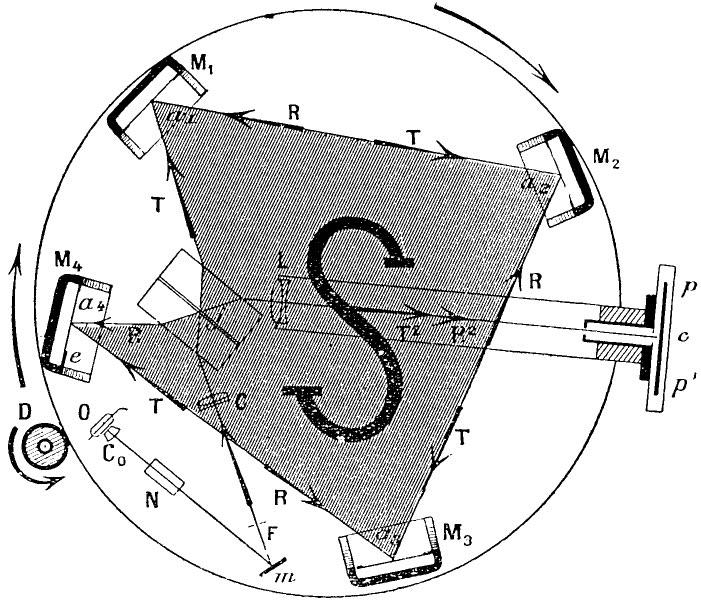
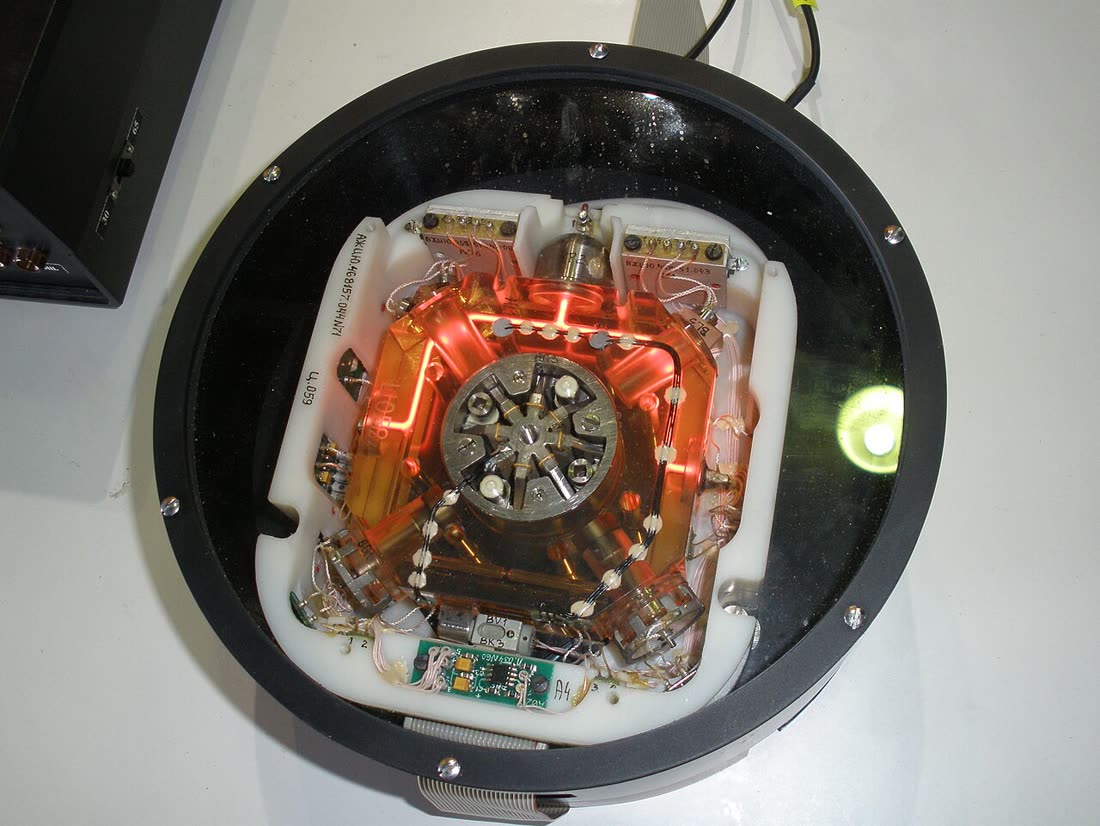
All of this sounds like philosophy until you try to build something that depends on it. In 1913 Georges Sagnac mounted an interferometer on a turntable and sent two beams of light around the same loop in opposite directions.
The rotating interferometer
- The question
- If light is split and sent both ways around a closed loop on a rotating platform, do the two beams return together?
- The apparatus
- A complete interferometer — source, beam splitter, four mirrors and a photographic plate — mounted on a turntable about a metre across and spun at a couple of revolutions per second. Both beams traverse identical paths in opposite directions, so anything affecting them equally cancels out and only the rotation remains.
Sagnac, who supported the aether, expected a shift and read it as evidence for a medium that the apparatus rotates through.
A fringe shift proportional to the rotation rate and to the area enclosed by the loop, reversing when the turntable was spun the other way.
How sure could they be? Modest by the standards of the era, but the effect is now measured routinely to extraordinary accuracy. Michelson, Gale and Pearson used a rectangular loop of evacuated pipe two kilometres around in 1925 to detect the rotation of the Earth itself by the same method.
Sagnac believed his result refuted relativity. It does the opposite: the shift is precisely what relativity predicts for a rotating frame, where no single global synchronisation of clocks around the loop is possible. Every commercial airliner now carries a ring laser gyroscope that finds its heading this way — an instrument whose working principle is that simultaneity is not global.
It is worth dwelling on that irony, because it recurs throughout this course. Sagnac designed the experiment to defeat relativity, got a real and repeatable result, and misread what it meant. Fizeau’s moving water was the same story sixty years earlier. Being right about the measurement and wrong about the meaning is the normal condition of physics, not an aberration.
- 1905Einstein opens the relativity paper by defining simultaneity operationally, before deriving anything.
- 1908Minkowski recasts it geometrically: simultaneity is a slice through spacetime, and moving observers slice at a different angle.
- 1913Sagnac measures the effect, and concludes it disproves relativity.
- 1925Michelson, Gale and Pearson detect the Earth’s rotation with a two-kilometre light loop in Illinois.
- 1963The first practical ring laser gyroscope is demonstrated.
- todayRing laser and fibre-optic gyroscopes navigate aircraft, submarines and spacecraft.
The reassuring part, buried in that checkpoint: the order of events can only be reversed for observers when the events are too far apart for light to have travelled between them. If one event could possibly have caused the other, every observer agrees on which came first. Relativity dismantles the shared present without ever letting an effect precede its cause.