Saving the aether
They proposed that moving objects are squashed by exactly the amount needed to hide the effect. It sounds like cheating. The formula was right.
- Explain how the contraction hypothesis cancels the Michelson–Morley result
- Say why a theory that survives by becoming undetectable is in trouble
- Describe how Lorentz had all the equations of relativity while still believing in the aether
Michelson and Morley had gone looking for the wind and found nothing. That left physics not with a mystery but with a contradiction, and it is worth stating precisely. Bradley’s aberration says the Earth moves through an aether that stays put. The interferometer says there is no aether wind at the Earth’s surface. Both measurements were solid, repeatable, and made by careful people.
In 1889 George FitzGerald, professor of natural philosophy at Trinity College Dublin, sent a letter of about three hundred words to the American journal Science. He suggested that the length of a body might alter, by a very small amount, according to how fast it is moving through the aether. It attracted no attention at all. For years afterwards FitzGerald was not certain the journal had ever printed it.
The interferometer again, at an exaggerated speed so the predicted shift is obvious. Set it turning, then press Apply FitzGerald–Lorentz contraction and watch the bands.
Which should make you uncomfortable, and it made people at the time uncomfortable too. The hypothesis has exactly one job: to cancel exactly one experiment. On its own it predicts nothing else, forbids nothing else, and cannot be checked independently — because any ruler you use to measure the contraction is contracted too. You have rescued the aether by making it undetectable in principle, which is a strange kind of rescue.
FitzGerald and Lorentz were making things up to protect a theory they were attached to.
That is the caricature, and the second half of the story refutes it. Lorentz derived the contraction from a detailed electron theory rather than assuming it: if the forces holding matter together are electromagnetic, and the aether affects electromagnetism, then moving matter genuinely should be squashed. The reasoning was principled. The conclusion was correct. Only the picture underneath it was wrong.
Lorentz goes further
Hendrik Lorentz arrived at the same contraction independently in 1892, and unlike FitzGerald he kept going for a decade. He had a full theory of electrons moving through a stationary aether, and he wanted it to explain not just Michelson–Morley but every null result that was accumulating.
To make that work he needed a second ingredient. For his equations to take the same form for an observer moving through the aether, he had to introduce a modified time coordinate — what he called local time. He was explicit that this was a mathematical convenience with no physical meaning. Clocks did not really run differently. It was a device for making the algebra come out.
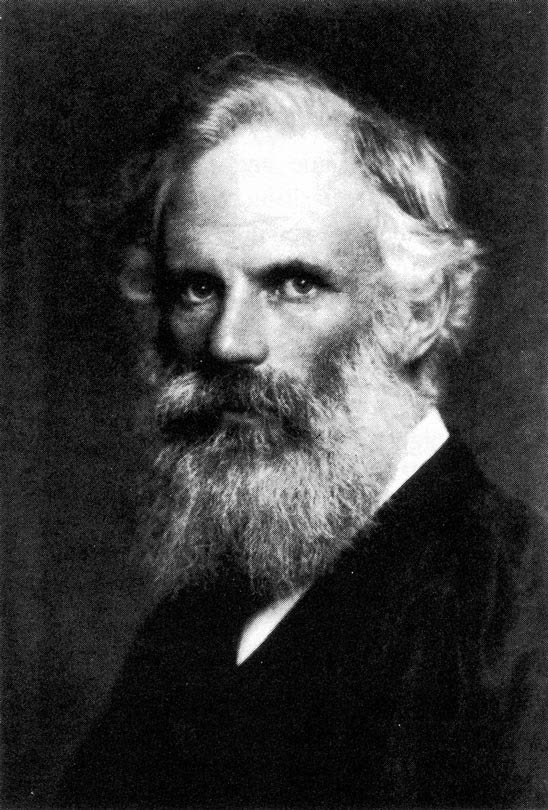
Hollinger and Rockey photographers, New York., Unknown date, but between 1890. Public domain
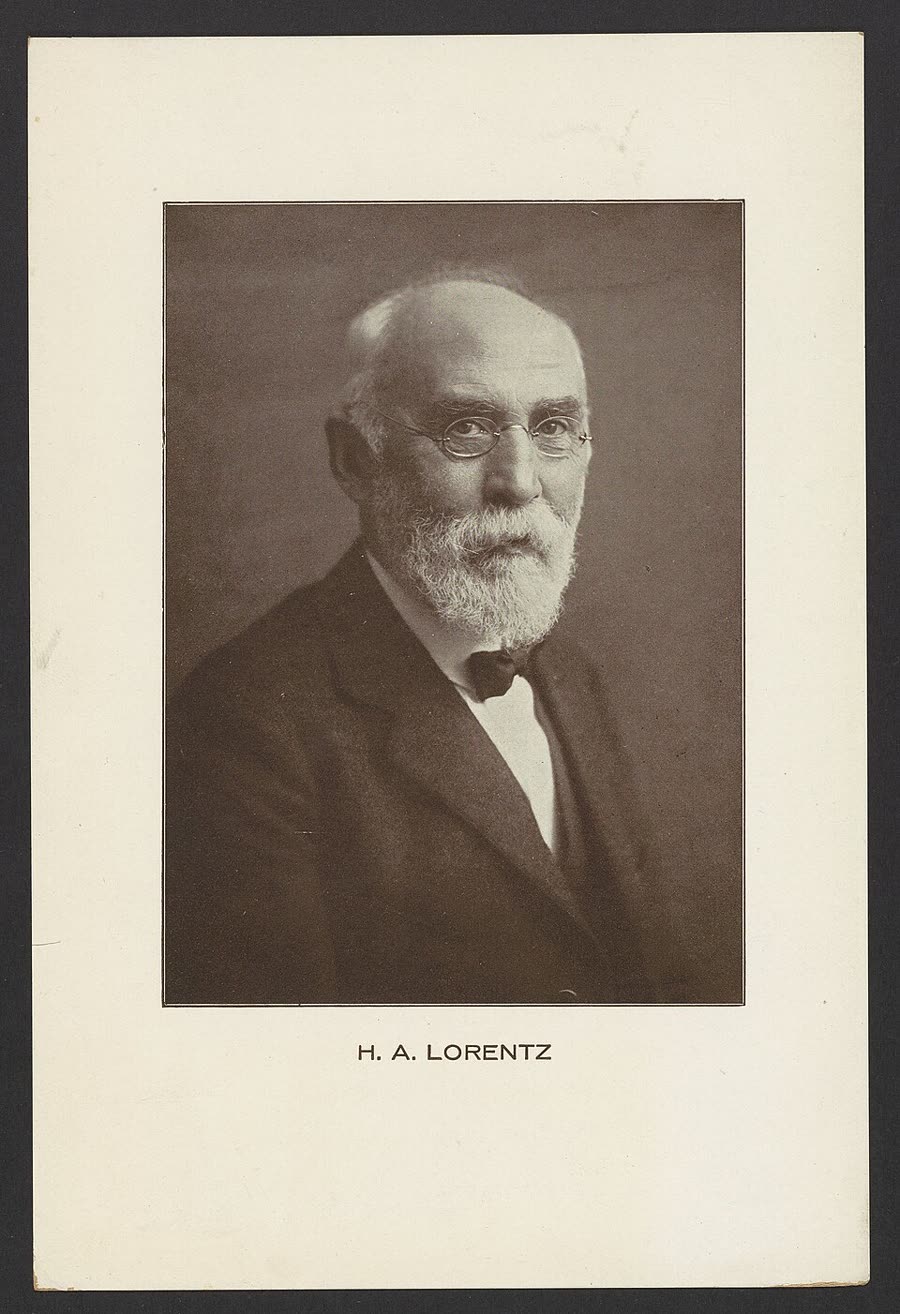
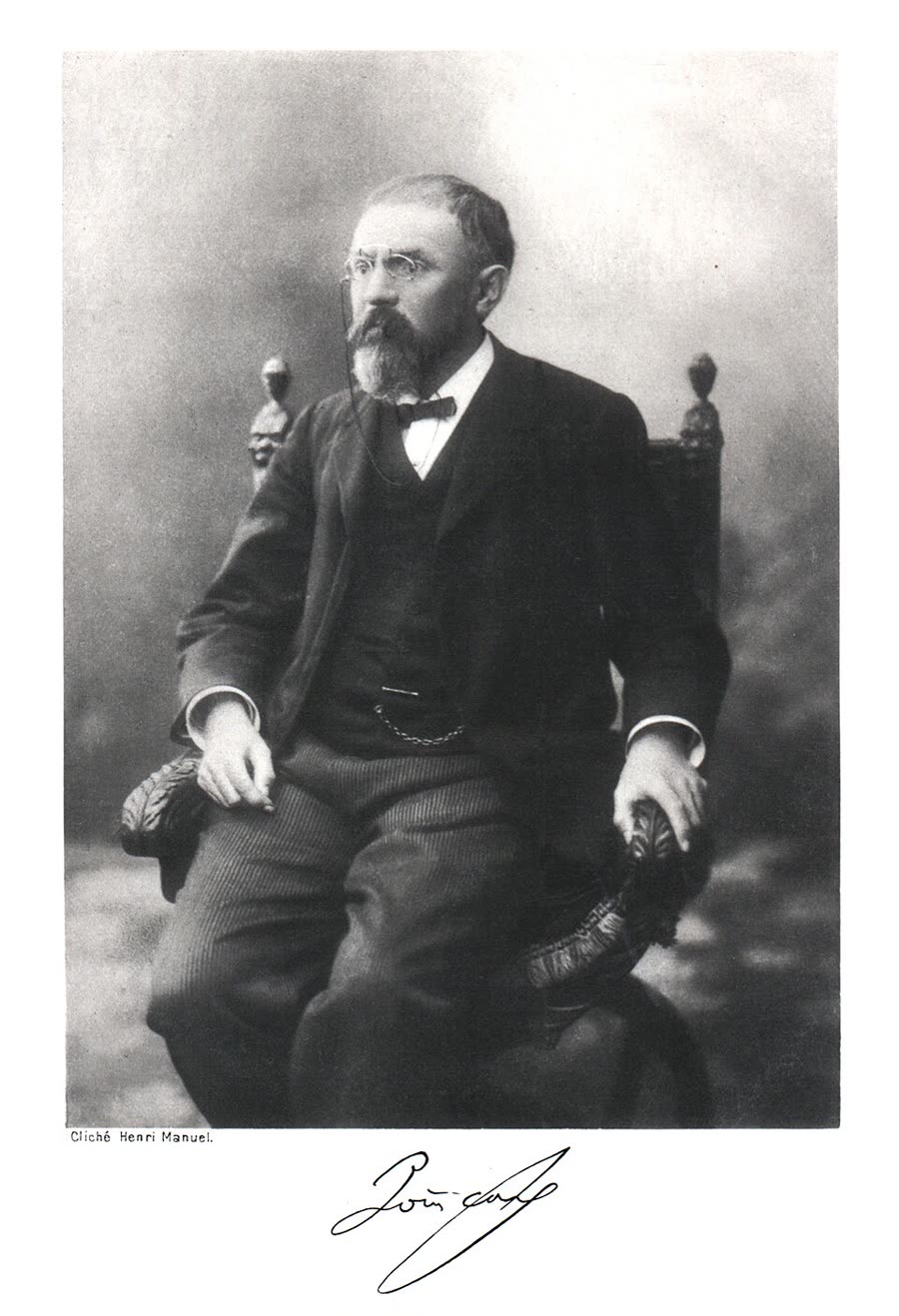
Henri Manuel, before 1912. Public domain
What they did not have was any willingness to abandon the aether. So each equation had to be read as a distortion: real rods really shrinking, real clocks really being disturbed by their motion, all measured against a substance that could never, even in principle, be detected. The mathematics was correct. The story attached to it was baroque.
The null results keep coming
And the patches kept accumulating. Every new experiment designed to catch the aether by some second-order effect came back empty, and each empty result needed its own explanation bolted on. This is what a theory looks like while it is dying: not refuted in one blow, but slowly buried in exceptions.
The Trouton–Noble experiment
- The question
- A charged capacitor moving through the aether should feel a turning force. Can we detect the Earth’s motion by watching one twist?
- The apparatus
- A parallel-plate capacitor charged to several kilovolts and hung from a fine torsion fibre inside an earthed case, free to rotate. As the Earth carried it through the aether, the interaction between its charges and their own motion was expected to produce a couple, turning the capacitor to a preferred orientation.
A measurable torque varying through the day and the year as the apparatus’s orientation relative to the Earth’s motion changed.
No torque. The capacitor hung exactly as it did uncharged, to the limit of the instrument.
How sure could they be? Sensitive enough to have detected a fraction of the predicted effect for the Earth’s known orbital speed. Trouton had previously tried a related experiment with Lodge’s encouragement, also without result.
Another second-order test, another nothing. Lorentz could absorb it — his theory, with contraction and local time together, predicts exactly this null result. But each absorption made the theory harder to falsify and easier to doubt. Rayleigh in 1902 and Brace in 1904 looked for the double refraction that squashed matter ought to display, and found nothing either.
The deletion
In 1905 a 26-year-old examiner in the Swiss patent office took essentially the same equations and made one deletion. There is no aether. Nothing is contracting relative to a hidden standard. The speed of light is simply the same for every observer, and the transformations do not describe distortions of matter — they describe how space and time themselves relate between people in relative motion.
The introduction of a “luminiferous ether” will prove to be superfluous, inasmuch as the view here to be developed will not require an “absolutely stationary space”.
- 1887Michelson and Morley find no aether wind.
- 1889FitzGerald’s three-hundred-word letter proposes contraction. Nobody notices.
- 1892Lorentz reaches the same idea independently, from electron theory.
- 1902Rayleigh looks for double refraction in contracted matter. Nothing.
- 1903Trouton and Noble look for a torque on a charged capacitor. Nothing.
- 1904Lorentz publishes the full transformations. Poincaré names them and finds the group structure.
- 1905Einstein removes the aether and keeps the mathematics.
- 1932Kennedy and Thorndike show contraction alone was never enough — time dilation is needed too.