Pattern-hunting that half worked
Fifty years of nearly-right arrangements, including one its author was laughed at for. Döbereiner found a rule that works to one per cent and fails by forty; Newlands found an eight-element rhythm that holds for nine elements and then never again.
- State Döbereiner’s triad rule, and the families where it holds to about one per cent
- Explain why the same rule fails badly on families that are just as real
- Say what Newlands claimed, and exactly how far his octaves get
- Distinguish spotting a pattern from being able to predict with one
Start in 1817, and be honest about what a chemist actually had. About fifty substances that nobody could break down, arrived at over two centuries by a mixture of assay, accident and electrolysis. No reason to think that was all of them, and no reason to think it was not. Atomic weights, but contested ones. Dalton had given chemistry a way to weigh atoms relative to one another, and it worked — except that the answer depends on a formula you have to assume before you start. Is water HO or H₂O? Get that wrong and oxygen’s weight is out by a factor of two. Different laboratories used different assumptions and got different tables, and this stayed unresolved for forty years. No atom in the physical sense at all. No electron, no nucleus, no shells. An atom is a piece of stuff with a weight and a set of habits. So the question of the act is not "why is the table shaped like that". It is much more basic: is there any order here at all, or is this simply a list of the things the Earth happens to be made of? In 1817 that is a completely open question, and a serious chemist could reasonably have answered no.
Johann Wolfgang Döbereiner was professor of chemistry at Jena — a practical man whose best-known invention was a pocket lighter that ignited hydrogen on a sponge of platinum, and whose lectures Goethe used to attend. In 1817 he noticed something about three substances. Lime, strontia and baryta behave alike; that was already known. What he added was that the weight of strontia sits almost exactly halfway between the other two. He published it, and nothing happened. One coincidence about three substances is not an argument, and he knew it. Twelve years later, in 1829, he came back with a paper offering several more of them, and gave the rule a name that has stuck: triads.
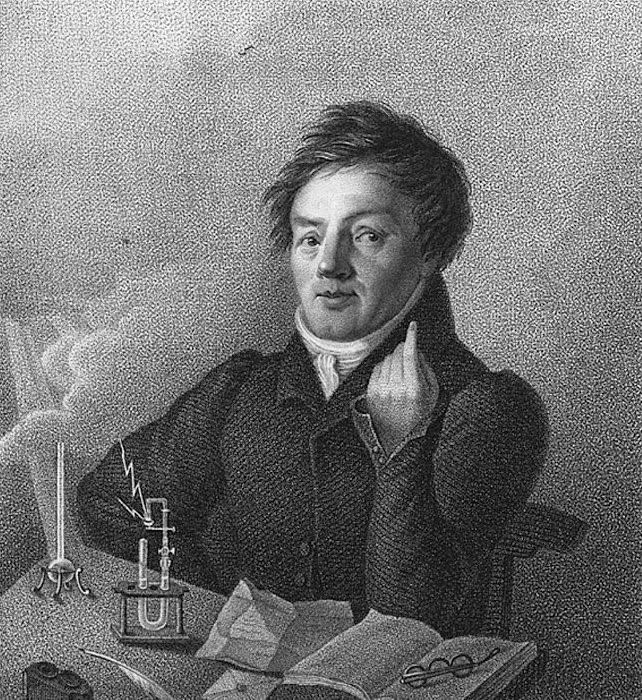
Carl August Schwerdgeburth, 1785-1878 (engraver), and Fritz Ries, 1826-1857 (painter), 2005-05-14 22:06:46. Public domain
The arithmetic of the triads
- The question
- Three elements that behave alike have three atomic weights. Is there any relation between the three numbers, or is the chemical resemblance the only thing they have in common?
- The apparatus
- A balance, a table of equivalent weights, and division by two. There is no apparatus here beyond what every laboratory already had — this is a claim about numbers other people had measured, which is exactly why it could be checked immediately.
Nothing in particular. On any view available in 1829, atomic weight is a brute fact about a substance and there is no reason for the weights of chemically similar substances to stand in any arithmetical relation at all.
Put the three in weight order and the middle one is close to the mean of the outer two. Lithium, sodium and potassium: the mean is 23.02 against sodium’s 22.99. Calcium, strontium, barium: 88.70 against 87.62. Sulphur, selenium, tellurium: 79.83 against 78.97. Chlorine, bromine, iodine: 81.18 against 79.90.
How sure could they be? Between 0.13% and 1.6%, on weights that were themselves uncertain at about the one per cent level. That is the difficulty in a sentence: the effect and the error bars are the same size, so it is impossible to tell whether the rule is exact and the weights are rough, or the rule is approximate.
A real regularity, found in data that everyone had, and it covered about a dozen elements out of fifty. Two things kept it from convincing anyone. It applied to too little of the list to look like anything but coincidence — and, worse, it failed on families just as good as the ones it worked on, with no way to tell in advance which was which.
Step through Döbereiner’s four triads, then press the two dashed buttons — the families the rule ought to work on and does not.
Then thirty years pass, and the reason is more embarrassing than mysterious. Nobody could agree on the atomic weights. If you sort a list by a quantity that half the profession disputes, you produce an arrangement that half the profession rejects — and you cannot even tell whether a discrepancy is a fact about nature or a fact about your neighbour’s assumptions. That logjam broke in September 1860, at a congress in Karlsruhe called specifically to sort it out. It did not, quite, in the room; but a pamphlet handed out at the door as the delegates left set out one consistent system of weights so plainly that people went home and adopted it. Lothar Meyer said later that the scales fell from his eyes. And then, within six years, four independent people arranged the elements: Alexandre-Émile Béguyer de Chancourtois wound them round a cylinder in 1862, William Odling tabulated them in 1864, Newlands published his octaves in 1865, and Lothar Meyer plotted atomic volume against weight in 1864 and got a curve with peaks in it. Four at once is what usually happens when a blockage clears. The idea was not waiting on a genius. It was waiting on the numbers.
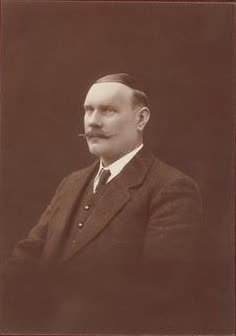
John Alexander Reina Newlands was an analytical chemist in London, mostly employed by the sugar trade. His mother was Italian, and in 1860 he went and fought with Garibaldi before coming home and getting on with it. His move was this. Put every known element in order of increasing atomic weight, and number them 1, 2, 3, 4. Then: the eighth resembles the first. The ninth resembles the second. He called it the law of octaves, and he meant the musical analogy seriously — in a note to Chemical News in 1865 he compared it to the eighth note of a scale. The numbering is the part worth pausing on. Newlands assigned every element an ordinal, and those ordinals are, for the light elements, exactly the atomic numbers. He had no idea what they counted, and neither did anyone else for another forty-eight years. But he wrote them down.
Lay the elements known in 1865 out seven to a row, in weight order. Green means an element belongs to the same family as the one directly above it — which is precisely Newlands’ claim. Then drag the row length and see whether any other number does better.
Look at where it breaks, because the reason is the whole shape of the modern table. Rows of seven work because the second and third periods hold eight elements each. Lithium to neon is eight; sodium to argon is eight. Step eight places along and you land in the same family, necessarily. The fourth period holds eighteen. So after calcium the rhythm changes, and an arrangement built on a fixed step of eight cannot follow it. What is filling those extra ten places is a row of transition metals — which is the same ten elements that broke Döbereiner’s nitrogen triad, showing up again in a different disguise. Newlands could not know that. Nothing in an atomic weight announces that the period is about to get longer. His rule is right, over the range where the period is eight, and he had no way to find out that the range ends. There is one more thing the simulation shows, and it is not something Newlands could have used but it is worth noticing. In the fourth row, sorted honestly by weight, nickel comes before cobalt. Later in the table, iodine comes before tellurium. Both of those are wrong, and it will take until 1913 to prove they are wrong.
Professor G. C. Foster humorously inquired of Mr. Newlands whether he had ever examined the elements according to the order of their initial letters.
Newlands was ignored because science resists new ideas.
He was ignored, and then he was honoured, by the same institutions, and the thing that changed in between was the evidence rather than the temperament. The Royal Society awarded Newlands the Davy Medal in 1887, five years after giving it jointly to Mendeleev and Lothar Meyer, and his own priority campaign in the pages of Chemical News is part of why. What made periodicity respectable in the interval was not that anyone became more open-minded — it was gallium in 1875 and germanium in 1886, two elements found where a table said they would be, with the properties the table said they would have. An arrangement that only summarises is a filing system, and filing systems are a matter of taste. An arrangement that tells you to go and look in a particular Pyrenean zinc ore is not.
Döbereiner’s rule, applied
The halogens chlorine, bromine and iodine are a triad. Chlorine weighs 35.45 and iodine 126.90. What atomic weight does the triad rule predict for bromine? Then compare it with the measured value of 79.904.
- Atomic weight, chlorine
- 35.45
- Atomic weight, iodine
- 126.90
- The rule
- the middle element is the mean of the outer two
- 1817Döbereiner notices strontia’s weight sitting halfway between lime and baryta. Nobody follows it up, including him, for twelve years.
- 1829The triads paper: the alkali metals, the alkaline earths, the halogens and the sulphur family, all obeying the same arithmetic.
- 1860Karlsruhe. One consistent set of atomic weights, handed out as a pamphlet at the door.
- 1862De Chancourtois winds the elements round a cylinder — the telluric screw, published without its diagram, and consequently unreadable.
- 1864Odling tabulates; Lothar Meyer plots atomic volume against weight and gets a curve with peaks.
- 1865Newlands numbers every element and states the law of octaves in Chemical News.
- 1866The Chemical Society hears the paper, jokes about alphabetical order, and declines to print it.
- 1869Mendeleev leaves the boxes empty.
- 1887The Royal Society awards Newlands the Davy Medal.