From grams to counts
A chemical equation is a statement about numbers of particles. A balance reads grams. The mole is the unit that converts between them — and in 2019 its definition was turned inside out, so that the count is now exact by decree and the mass of twelve grams of carbon is the thing being measured.
- Explain why chemistry needs a unit that is neither a mass nor a pure number
- Convert between grams, moles and numbers of particles, and say which step needs a measured constant
- Describe how the atoms in a silicon sphere were counted, and why that made the 2019 redefinition possible
- State what the 2019 redefinition changed, and the one familiar sentence it quietly stopped being exactly true
A chemical equation is a statement about numbers. 2H₂ + O₂ → 2H₂O says that molecules of hydrogen are consumed two at a time for every one of oxygen. Not two grams. Two things. Every reaction in chemistry works like this, because a bond forms between particular atoms and does not care what they weigh. And there is no instrument that counts molecules. There never has been, there is no prospect of one, and the numbers involved would defeat it anyway. The only operations a chemist can actually perform on a quantity of matter are weighing it and measuring its volume. So there is a gap in the middle of the subject: the theory speaks in counts and the laboratory speaks in grams. Everything in this lesson is about the unit built to bridge that gap, and about what it takes to fix the size of the bridge.
The bridge is two steps, and it is worth separating them, because they are different kinds of thing.
Grams to moles. Divide by the molar mass. This is a property of the substance in front of you: 18.02 g/mol for water, 63.55 for copper, 342.30 for sugar. It comes ultimately from Cannizzaro — the relative weights are exactly what Karlsruhe settled.
Moles to particles. Multiply by Avogadro’s number, 6.02214076 × 10²³ per mole. This is the same for everything in the universe. It is not a property of water or copper or anything else; it is the size of the unit itself.
That is the whole apparatus. grams ÷ molar mass × N_A = particles. The interesting question is not how to use it — it is arithmetic — but where the second number came from, and what kind of statement it is. That turns out to have a surprising answer, and the answer changed in 2019.
A teaspoon of water on the pan. Read the count, then find it on the axis below. Now drag the mass down as far as it will go, and watch how little difference it makes.
Counting the atoms in a silicon sphere
- The question
- How many atoms are there in a macroscopic object? Not an estimate from a theory — an actual count, of an object you can hold.
- The apparatus
- A boule of silicon enriched to better than 99.99% ²⁸Si, ground into a sphere about 93.7 mm across and one kilogram in mass, and polished until it is the roundest object ever manufactured. Its diameter is measured in hundreds of directions by optical interferometry; the spacing of its crystal lattice is measured by X-ray interferometry; its mass is compared against the kilogram; and its molar mass is determined from the isotope ratios by mass spectrometry. The surface oxide layer, a few nanometres thick, is measured separately and subtracted, because at this precision it is not negligible.
Nothing was in dispute about the answer. What was in dispute was whether the count could be made accurate enough — to a few parts in a hundred million — to serve as a definition, and whether it would agree with the entirely independent watt-balance route to the same constants.
Silicon’s lattice is cubic with eight atoms to a cell, so the count is a division: the volume of the sphere over the volume of one cell, times eight. It comes to about 2.151 × 10²⁵ atoms. The best determinations gave N_A = 6.02214076 × 10²³ mol⁻¹ with a relative uncertainty around 2 × 10⁻⁸, and they agreed with the entirely independent watt-balance route.
How sure could they be? A few parts in a hundred million, which is the whole point — it is the level at which a count can replace a mass as a definition. The diameter has to be known to a fraction of a nanometre and the lattice spacing to about a part in a thousand million. Almost all the remaining uncertainty is in the surface layer and the isotopic composition, not in the geometry.
Avogadro’s number stopped being a thing to measure. Once two independent routes agreed to a few parts in a hundred million, the CGPM could fix the value by definition and let the laboratories go on measuring what they had previously defined. That is the 2019 redefinition in one sentence, and this sphere is the reason it was possible.
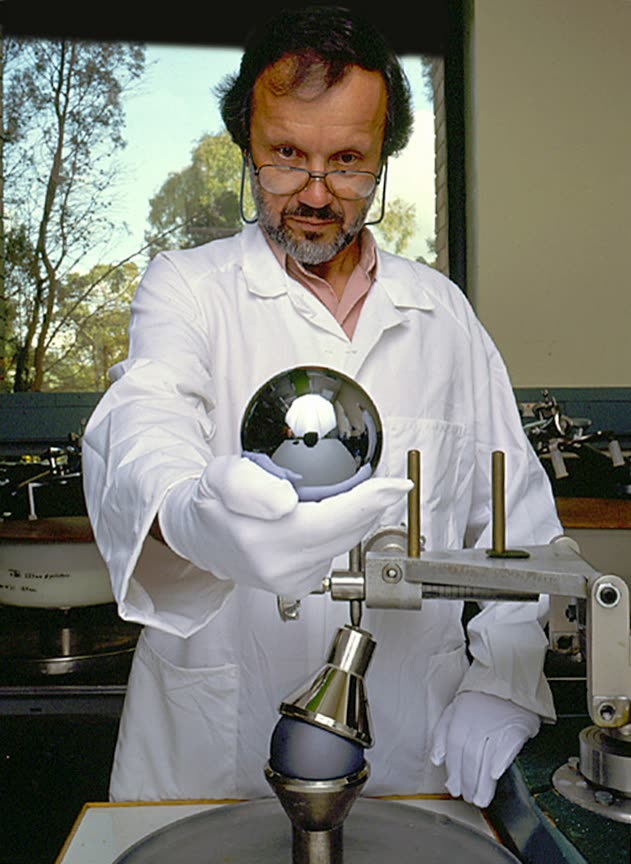
The Commonwealth Scientific and Industrial Research Organisation of Australia, 2008-01-11. CC BY-SA 3.0
On 20 May 2019 that measurement was used to abolish itself. Before. One mole is the amount of substance containing as many elementary entities as there are atoms in 0.012 kg of carbon-12. On this definition, 12 g of carbon-12 is exactly one mole — it is true by construction, and no experiment could ever disturb it. Avogadro’s number was the unknown: a quantity to be measured, with an uncertainty, revised every few years as the measurements improved. After. One mole contains exactly 6.02214076 × 10²³ elementary entities. The count is now the definition. And the mass of a mole of carbon-12 has become the measured quantity, with an uncertainty of its own. Read those two paragraphs again in order. The definition was turned inside out. The thing that used to be exact is now measured; the thing that used to be measured is now exact. Not one number in any laboratory changed, because the value was chosen so that nothing would — but which sentence is a decree and which is a result swapped places, and that is a real change even though nothing moved.
Twelve grams of carbon-12 contains exactly Avogadro’s number of atoms.
Not since 2019. It is now a measured statement rather than a definition, and the measurement does not come out exactly right: the molar mass of carbon-12 is 11.9999999958 g/mol, short of 12 by about three parts in ten thousand million. The same applies to the rule you were taught alongside it — that the molar mass in grams per mole equals the relative atomic mass in daltons. That is now an approximation too, accurate to the same three parts in ten thousand million. Both remain true far beyond any precision a chemist will ever work at; a balance reading to a microgram is eleven orders of magnitude coarser. But "exactly" is a strong word, and it is no longer the right one. Notice also which way round this is: the redefinition did not make chemistry less certain. It moved the uncertainty out of the constant, where it was a nuisance to everybody, and into a mass measurement, where it belongs.
A teaspoon of water
A teaspoon holds 5.00 g of water. How many water molecules is that? (These are the simulation’s starting values, so you can check yourself against it.)
- Mass of water
- 5.00 g
- Molar mass of water
- M(H₂O) = 18.02 g/mol
- Avogadro constant
- N_A = 6.02214076 × 10²³ mol⁻¹
The mole, symbol mol, is the SI unit of amount of substance. One mole contains exactly 6.02214076 × 10²³ elementary entities. This number is the fixed numerical value of the Avogadro constant, N_A, when expressed in the unit mol⁻¹ and is called the Avogadro number.
- 1811Avogadro: equal volumes of gas hold equal numbers of particles. Nobody can say how many.
- 1865Loschmidt makes the first real estimate of the number of molecules in a volume of gas, from kinetic theory. He is within a factor of ten.
- 1900Planck, fitting the blackbody curve, gets a value for the number within a per cent — from a problem that has nothing to do with chemistry.
- 1909Perrin measures it four independent ways from Brownian motion and gets the same answer each time. Ostwald concedes that atoms are real.
- 1971The mole becomes an SI base unit, defined as the number of atoms in 0.012 kg of carbon-12.
- 2011The Avogadro Project’s silicon-28 spheres reach a relative uncertainty of 3 × 10⁻⁸.
- 2018The CGPM votes to fix N_A, h, e and k by definition. The vote is unanimous.
- 2019On 20 May the new definitions take effect. The mole is a count; the kilogram is a constant; the cylinder at Sèvres is a museum piece.