Proof that atoms are real
Pollen grains jitter under a microscope. Counting how they settle gives the number of molecules in a gram, and three unrelated methods agree.
- Explain why a granule in a perfectly continuous fluid would not jitter at all
- State Einstein’s displacement law and say why it is the mean square rather than the velocity
- Describe how counting granules at four heights yields the number of molecules in a mole
- Say what actually convinced the holdouts, and why it was convergence rather than accuracy
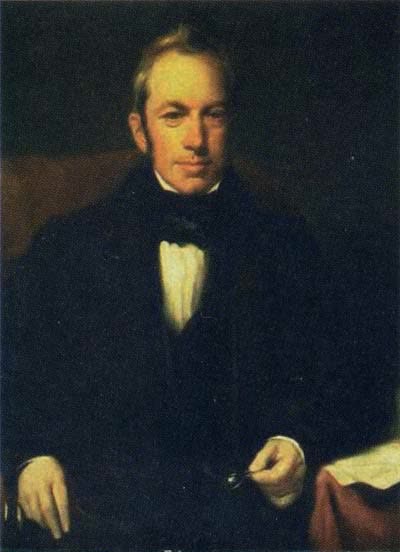
In the summer of 1827, Robert Brown put pollen from the wildflower Clarkia pulchella under a microscope and saw specks jiggling. They did not drift in any particular direction. They did not settle. They did not slow down while he watched, and they had not slowed down when he came back to them. They simply jittered, indefinitely. The obvious reading was that they were alive. Brown was the best microscopist in Britain — he had a lens of his own grinding that outperformed most compound instruments of the period — and he was studying plant fertilisation. A self-moving particle inside a pollen grain was very close to what he was hoping to find. He was also not the first to see it. Jan Ingenhousz appears to have described something very similar in coal dust on the surface of alcohol in 1785, and there are earlier hints. What Brown did that nobody had done was try to destroy his own best hypothesis.
The list of things he tested is the reason his name is on the phenomenon. Pollen from herbarium specimens a century dead. Still jiggling. Soot, and ground glass. Jiggling. Powdered rock, from, in his words, rocks of all ages. Jiggling. Volcanic ash. Meteorites. Jiggling. A fragment chipped from the Sphinx. Jiggling. Some of these had had nothing living within them for a hundred million years. Brown concluded that the motion belonged to sufficiently small particles of matter of any kind whatsoever, organic or not — and, with a candour worth copying, that he was unable to account for it. Then the subject sat. There was systematic work — Wiener in 1863, and Louis Georges Gouy in the 1880s, who established that the motion is unaffected by light, by vibration, by electric fields and by the passage of a year, and is stronger for smaller particles and thinner liquids. Gouy said out loud that it looked like molecular agitation. But nobody could turn a qualitative resemblance into a number, and without a number it changed nobody’s mind.
Watch the trace build, then read the plot on the right. Then drag the granule radius and watch the line change slope.
The formula arrived in May 1905, from a patent examiner in Bern, in the second of the four papers he published that year. It is worth knowing that Einstein was not trying to explain Brownian motion. He was hunting for an observable consequence of molecules sharp enough to settle the question, and he was not sure his prediction described the known phenomenon. His own sentence: it is possible that the movements to be discussed here are identical with the so-called Brownian molecular motion; however, the information available to me regarding the latter is so lacking in precision that I can form no judgement in the matter. The title of the paper says what he thought he was doing: on the motion, required by the molecular-kinetic theory of heat, of small particles suspended in stationary liquids. Required. He was not accounting for an observation. He was issuing a demand that the world could refuse.
Switch to the settling column and let it run. Watch the granules arrange themselves — and notice that they do not all end up on the floor.
The vertical distribution of granules in an emulsion at equilibrium
- The question
- If granules in water really are being jostled by molecules, they should form an atmosphere rather than a sediment — and the height of that atmosphere should give the number of molecules in a mole. Does it?
- The apparatus
- A cell about 100 µm deep, sealed, holding an emulsion of gamboge in water. A microscope with a very shallow depth of focus, so that only granules within a thin horizontal slice are in view at once, and the count can be taken slice by slice up the cell. The granules had to be identical: Perrin ground the resin, then centrifuged it repeatedly over months, discarding almost everything, because the radius enters the formula cubed. A kilogram of gamboge yielded a few decigrams of usable emulsion.
Under a continuum view of water, granules denser than water sink and stay sunk: a sediment on the floor and clear liquid above. Under kinetic theory, an exponential distribution with a scale height set by the granule’s effective weight and the temperature.
An exponential. The counts at four heights — roughly 100, 47, 23 and 12 granules at 5, 35, 65 and 95 µm above the floor — thin out by half about every 29 µm, and fitting that decay gives a count near 7.5 × 10²³. From the complete series rather than these four summary numbers, Perrin published 7.05 × 10²³.
How sure could they be? Both of those are high: the modern value is 6.022 × 10²³, so Perrin’s published figure is about 17% out. Granules of the radius he states ought to halve every 37 µm, not 29 µm, and that gap is the error — the radius enters the formula as a cube, so a 5% error in it is a 16% error in the count, and 5% is about as well as anyone could measure a granule under a microscope in 1908.
Molecules are not a convenient way of talking about proportions. They are objects, of a definite size, in definite numbers, and one may count them by counting something else entirely. The result also gives Boltzmann’s constant — Perrin was the first to obtain a value for it, which is why the constant carries the name of a man who never measured it.
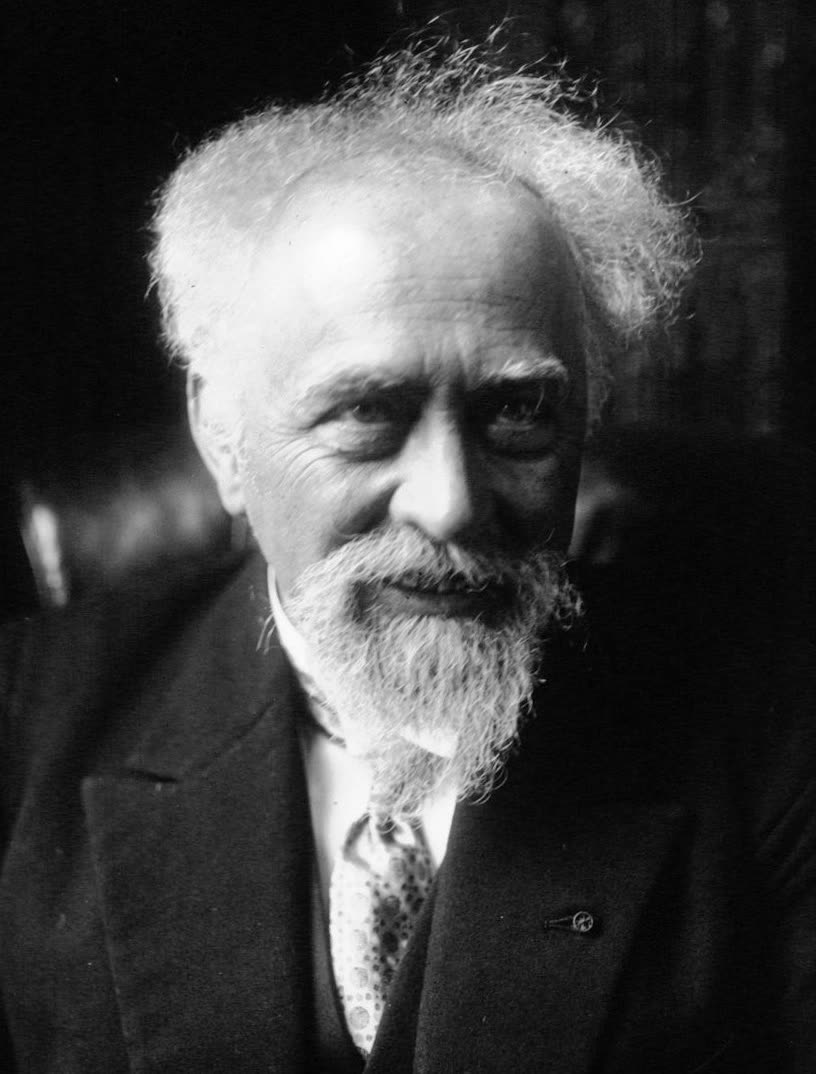
One measurement is a claim. What Perrin assembled was a coincidence too large to be one. He got the number four separate ways from the same emulsions: from the vertical distribution, from the mean displacement, from the rotation of larger granules — which have a Brownian angular jitter obeying an equation of the same form — and from diffusion. Then, in Les Atomes in 1913, he laid those beside determinations from phenomena that share no apparatus and no theory with any of them: the viscosity of gases, from kinetic theory; the charge on Millikan’s oil drops, divided into the Faraday constant; the blue of the sky, from Rayleigh scattering by air molecules; the spectrum of a hot body, from Planck’s radiation law; the helium given off by radium, counted atom by atom against the alpha particles emitted. Thirteen numbers. They land on top of one another. Perrin’s own comment is the right one: one is seized with admiration before the miracle of concordances so precise, starting from phenomena so different.
Brown watched pollen grains jiggling.
He watched something considerably smaller. A pollen grain of Clarkia pulchella is around 100 µm across — visible to the naked eye as a speck, and far too massive for molecular collisions to move it detectably. What Brown observed were particles released when the grains burst in water: amyloplasts and spherosomes, a few micrometres across, which is a thousand times less in each dimension and a billion times less in volume. The distinction is not pedantry, because the entire effect depends on the particle being small enough that the collisions on opposite sides fail to cancel. Scale it up and the fluctuation shrinks relative to the total force until it is unobservable — which is exactly why you do not see a dust mote in a sunbeam jitter, and why Perrin had to grind resin for months to get granules in the right size range. The size of the particle is not an incidental detail of the experiment. It is the variable the whole measurement turns on.
Counting molecules with a microscope
A modern repeat of Perrin’s displacement measurement. Granules of radius 0.212 µm are suspended in water at 20 °C and photographed every 30 s. Averaged over many granules, the root-mean-square displacement of one horizontal coordinate between exposures is 7.8 µm. How many molecules are there in a mole? (These are the simulation’s starting values, so you can check yourself against it.)
- Granule radius
- a = 0.212 µm
- Interval between exposures
- t = 30 s
- RMS displacement, one axis
- 7.8 µm
- Viscosity of water at 20 °C
- η = 0.001002 Pa s
- Temperature
- T = 293.15 K
- Gas constant
- R = 8.314 J mol⁻¹ K⁻¹
I am now convinced that we have recently become possessed of experimental evidence of the discrete or grained nature of matter, which the atomic hypothesis sought in vain for hundreds and thousands of years. The isolation and counting of gaseous ions, on the one hand, and the agreement of Brownian movements with the requirements of the kinetic hypothesis, established by many investigators and most conclusively by J. Perrin, justify the most cautious scientist in now speaking of the experimental proof of the atomic nature of matter.
- 1785Ingenhousz describes an irregular motion of coal dust on alcohol. It attracts no attention at all.
- 1827Brown sees the jitter in Clarkia pollen, then hunts it down in ground glass, volcanic ash, meteorites and a chip of the Sphinx.
- 1863Wiener argues the motion comes from the liquid rather than from the particle. Few agree.
- 1888Gouy shows it is unaffected by light, vibration or electric fields, and stronger in thinner liquids — and names molecular agitation as the cause.
- 1905Einstein derives ⟨x²⟩ = 2Dt and the Stokes–Einstein relation, unsure whether it describes the phenomenon Brown saw.
- 1906Smoluchowski publishes an independent derivation by a different route, and gets the same law.
- 1908Perrin measures the vertical distribution of gamboge granules and reports N ≈ 7 × 10²³.
- 1909Ostwald concedes the atomic nature of matter in print, citing Perrin and Thomson.
- 1913Les Atomes: thirteen determinations of N from unrelated phenomena, tabulated on one page.
- 1916Mach dies, still holding that atoms are an economy of thought rather than objects.
- 1926Perrin receives the Nobel Prize in Physics, for the discontinuous structure of matter.