The congress that fixed the numbers
By 1860 chemists could not agree on the formula for water, and Kekulé’s textbook listed nineteen formulae in use for acetic acid. A congress was called to settle it, agreed on nothing, and handed out a pamphlet at the door on the way out. The pamphlet settled it.
- Say what an equivalent weight is, and why preferring it to an atomic weight was good practice rather than obstinacy
- Work an atomic weight out of a table of vapour densities, the way Cannizzaro did
- Explain why the method gives an upper bound rather than a proof, and how it fails
- Say what Avogadro’s hypothesis supplies that the densities alone cannot
Start in 1860, seventy years after Lavoisier, with chemistry unable to agree on the formula for water. Not as a philosophical quibble. As a printing problem. Some chemists wrote HO, one atom of each. Others wrote H₂O. When August Kekulé published his Lehrbuch der organischen Chemie the following year, he set out nineteen different formulae that had been proposed for acetic acid — all in print, all by competent people, all incompatible. The consequences were exactly what you would expect. Two papers could describe the same reaction in symbols that did not match. A table of atomic weights was useless unless you knew which school had compiled it. Students learned one system and found the literature written in another. This is not a small mess at the edge of a healthy science. It is the central bookkeeping of chemistry, unreconciled, half a century after conservation of mass made bookkeeping possible.
And before enjoying the mess, it is worth being clear that the majority position was the cautious one, held for a good reason. An equivalent weight is something you measure. Burn hydrogen in oxygen, weigh the water, and you know that 7.94 grams of oxygen combine with every gram of hydrogen. No theory is involved. No invisible particle has been assumed. It is a ratio of two masses on a balance, and it is as solid as anything in the science. An atomic weight is a different kind of object. To get from that measured ratio to the weight of an atom, you have to know how many atoms of each kind are in the compound — and nobody had ever seen a molecule, or had any prospect of seeing one. So the equivalentists, who included Leopold Gmelin and much of the British establishment, said: use the number you can measure, and leave the atoms out of it. That is not obstinacy. It is the same instinct that makes a good experimentalist distrust a quantity that can only be reached through a model, and it was the respectable position right up until somebody found a way to measure the formula.
The people writing HO for water were being careless. H₂O had been established by Dalton and they had simply not caught up.
Dalton established nothing of the kind — he wrote water as HO himself, and for a stated reason. His rule of greatest simplicity said that where two elements form only one known compound, you should assume one atom of each. It is a tidy-sounding principle and it is a pure assumption: nothing in any measurement supports it, and it was wrong about water, wrong about ammonia, and wrong about the elementary gases. What is remarkable is not that people used it but that fifty years went by without anything being put in its place. Chemistry had a formula-assigning rule that everyone knew was a guess, and no procedure at all for checking it.
unknown. Scanned, image processed and uploaded by Kuebi = Armin Kübelbeck, prior 1907. Public domain
Smithsonian Institution from United States, 2008-05-20 19:10. No restrictions
The repair had been in print since 1811, and had been ignored for half a century. Amedeo Avogadro, professor at Turin, proposed two things at once. First, that equal volumes of any gas at the same temperature and pressure contain equal numbers of particles — which makes a vapour density directly proportional to a molecular weight, and turns a routine measurement into a molecular one. Second, that the particles of hydrogen and oxygen gas are pairs of atoms, not single ones, which is what lets two volumes of hydrogen and one of oxygen produce two volumes of steam. The second half is what sank it. Jöns Jacob Berzelius, the most authoritative chemist in Europe, held that atoms combine because they carry opposite electrical charges. On that theory two identical atoms binding to each other is not merely unlikely; it is a contradiction. So Avogadro was not ignored through carelessness. He was ignored because taking him seriously meant giving up the best available theory of why chemical combination happens at all, in exchange for a hypothesis that could not be tested directly. What Cannizzaro supplied, in 1858, was the test.
Three compounds are on the bench. Read off the atomic weight of carbon — then drag the slider and add the rest, one at a time, watching for the moment the answer changes.
Vapour density by the bulb method
- The question
- How heavy is one molecule of a substance, compared with one molecule of hydrogen gas — and can that comparison be made without assuming anything about what a molecule is?
- The apparatus
- A glass bulb of known volume with a fine drawn-out neck. A little of the liquid is put in, the bulb is heated in a bath above the boiling point until the substance’s own vapour has driven every trace of air out of the neck, and the neck is then sealed off with a flame. Weigh the sealed bulb, break it under mercury to find the volume, and compare with the mass of the same volume of hydrogen at the same temperature and pressure.
On its own, nothing but a density. The measurement was ordinary by 1858 and had been done for hundreds of substances by people who drew no atomic conclusions from it at all.
Densities good to a per cent or so, for every substance that could be vaporised without decomposing — which is most organic liquids and a useful number of chlorides, and almost no metals.
How sure could they be? Better than the argument needs. The quantities being compared differ by factors of two, three and six, and a density good to a few per cent separates them without difficulty. The weakness of the method is not precision but coverage — it says nothing whatever about an element with no volatile compounds, which is why Cannizzaro leant on Dulong and Petit’s specific heats for the metals.
Under Avogadro’s hypothesis, a density relative to hydrogen gas IS a molecular weight relative to hydrogen gas, and the whole of Cannizzaro’s argument follows from arithmetic on published tables. This is the unglamorous shape a great deal of scientific progress actually has: no new apparatus, no new measurement, one old hypothesis applied to everything at once.
All ten compounds, read with Avogadro. Now press "Assume the simplest formula" and look at what survives the change — and what does not.
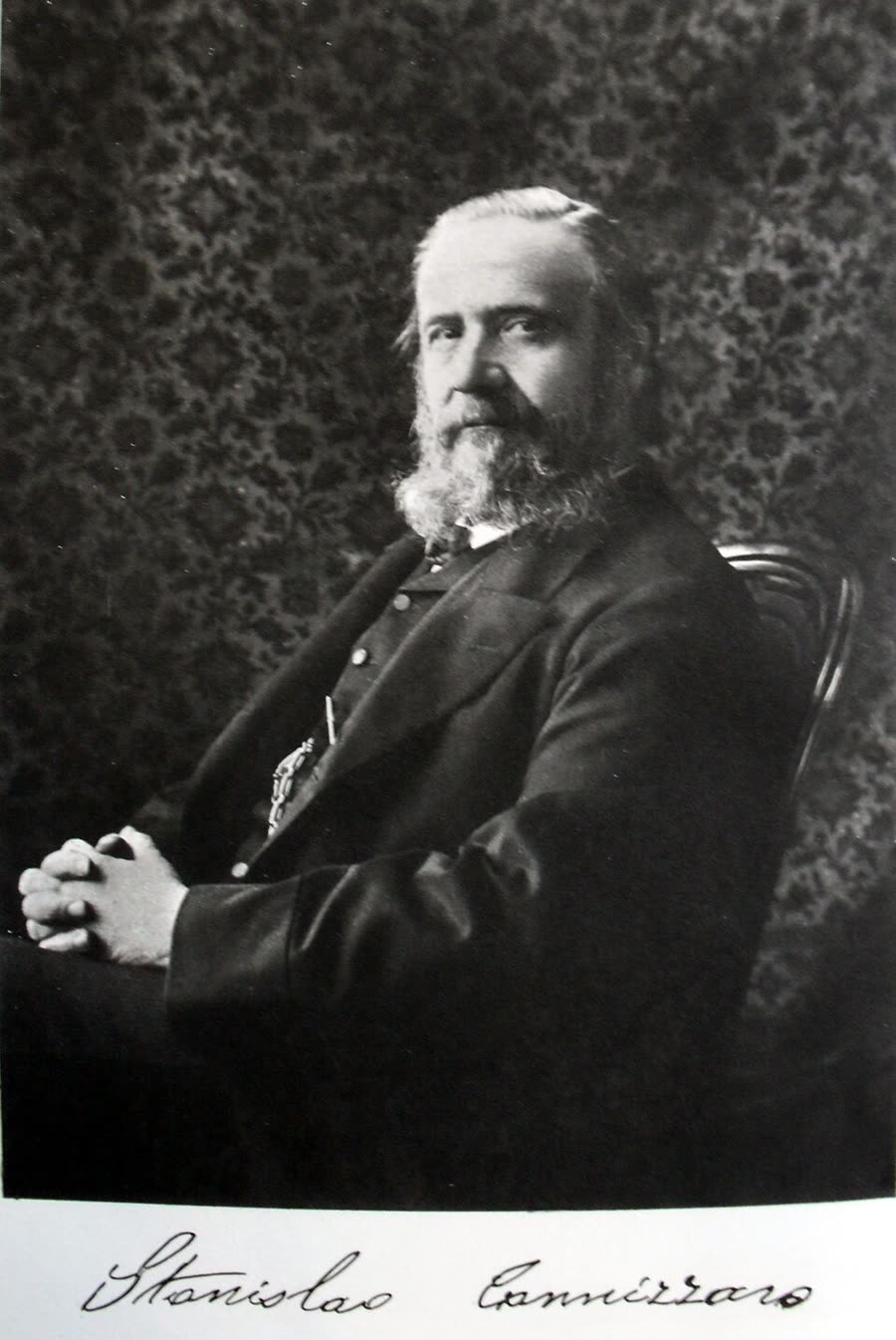
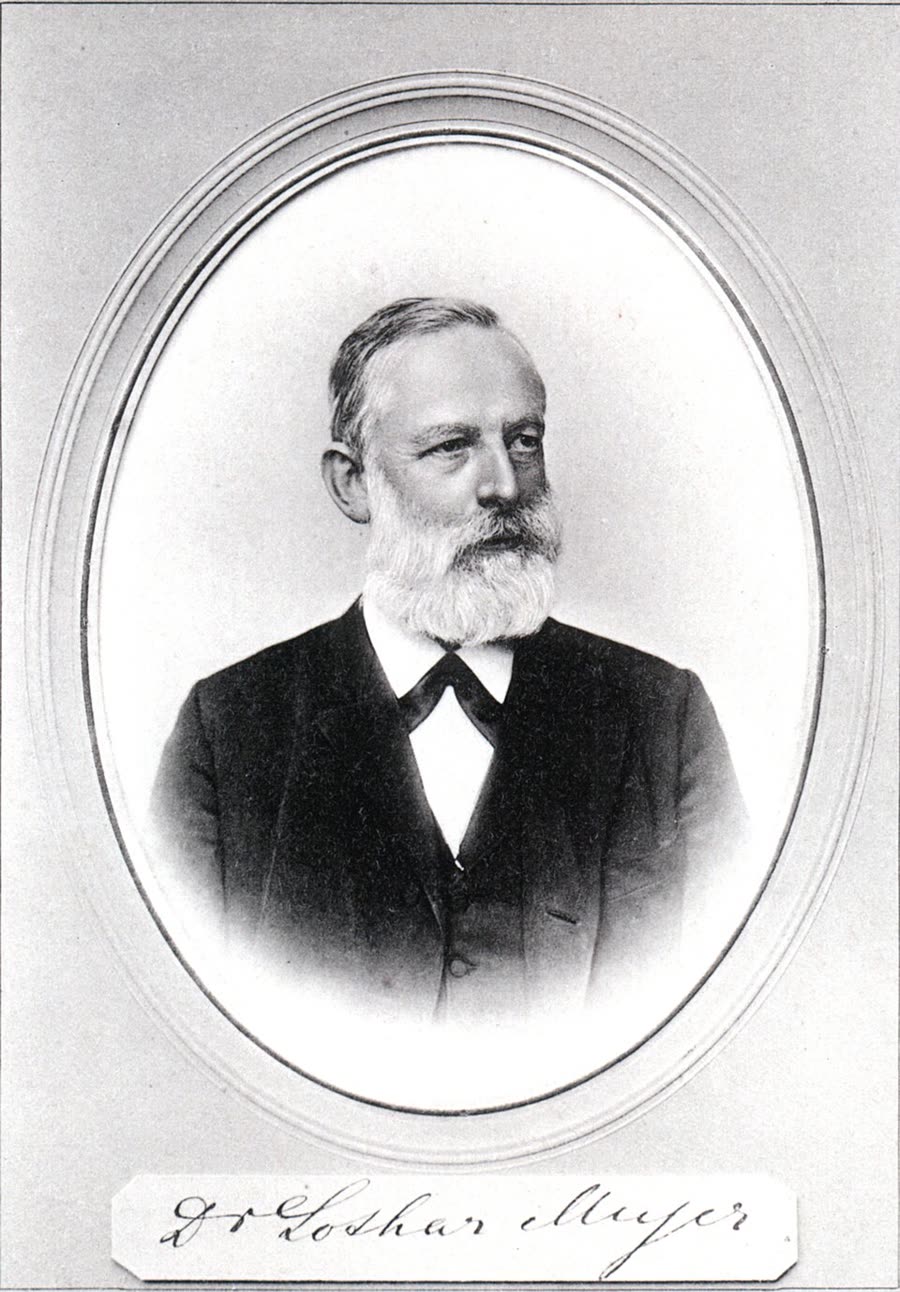
So to the congress. 3–5 September 1860, in Karlsruhe, in the Grand Duchy of Baden: the first international conference of chemistry ever held. Around 140 chemists, called together by Kekulé with Charles-Adolphe Wurtz of Paris and Carl Weltzien of Karlsruhe, for the explicit purpose of agreeing what the words atom, molecule and equivalent were to mean, and settling a notation everyone could use. The attendance list is remarkable. Bunsen. Dumas. Wurtz. Kekulé. Lothar Meyer, aged 30. Dmitri Mendeleev, aged 26, sent from St Petersburg. Cannizzaro came from Genoa and spoke — at length, and by every surviving account superbly. And then the congress adjourned, having agreed on nothing at all.
I read it repeatedly on my journey home, and was astonished at the clarity with which the little book illuminated the most important points at issue. It was as though scales fell from my eyes, doubts vanished, and a feeling of calm certainty took their place.
One row of Cannizzaro’s table
Marsh gas has a vapour density 7.96 times that of hydrogen gas at the same temperature and pressure. Combustion analysis makes it 74.87% carbon by mass. No compound of carbon that anyone has been able to vaporise gives a smaller quantity than this one, and every other gives a whole multiple of it. What is the atomic weight of carbon?
- Vapour density, relative to H₂
- d = 7.96
- Carbon by mass
- 74.87%
- Molecular weight of hydrogen gas
- M(H₂) = 2.016
- Avogadro’s hypothesis
- equal volumes, equal numbers
- 1803Dalton begins assigning atomic weights using the rule of greatest simplicity. Water is HO.
- 1808Gay-Lussac: two volumes of hydrogen and one of oxygen give two volumes of steam. Dalton refuses to believe it.
- 1811Avogadro publishes both halves of the answer — equal volumes, equal numbers; and elementary gases are pairs. Almost nobody reads it.
- 1826Dumas publishes the bulb method for vapour densities. The measurements pile up for thirty years without being interpreted.
- 1836Berzelius, whose electrochemical theory makes a molecule of two identical atoms impossible, is at the height of his authority.
- 1848Berzelius dies. The equivalent-weight school, which needs no atoms at all, gains ground rather than losing it.
- 1858Cannizzaro’s Sunto appears in Il Nuovo Cimento as a letter to a colleague. It is a set of lecture notes.
- 1860Karlsruhe, 3–5 September. The congress agrees nothing; Pavesi hands out reprints at the door.
- 1861Kekulé’s textbook prints nineteen rival formulae for acetic acid — a snapshot of the mess, taken as it ends.
- 1869Mendeleev and Meyer, both of whom were in that room, publish periodic tables built on Cannizzaro’s weights.