Electricity comes in portions
The same quantity of charge always deposits the same quantity of matter. A unit of charge is hiding in the result, fifty years before anyone finds it.
- State Faraday’s two laws of electrolysis and what each one is measuring
- Explain why the charge per mole is always 96,485 coulombs times a whole number
- Say why Faraday himself refused to read his own result as evidence for atoms
- Work out the charge required to deposit a given mass of a given metal
Start in 1833, and start with what nobody could do. Electricity was a fluid — or two fluids, depending on whose textbook you had — and there was a live argument about where the electricity in a voltaic pile came from. Alessandro Volta held that it arose from the mere contact of two dissimilar metals. Others held that it came from the chemical reaction going on in the liquid between them. The argument had run for thirty years without resolution. And nobody could measure a quantity of electricity. You could tell that one spark was fiercer than another, or that one pile drove a needle further round. You could not say by what factor, and you could not compare a spark from a rubbed glass rod against the steady output of a pile at all. There was no unit, because there was nothing reliable to found one on. That is the state of the subject when Faraday, a bookbinder’s apprentice who had talked his way into the Royal Institution, starts passing currents through liquids and weighing what falls out.
His first question was not about atoms. It was tidier than that. Is the electricity from a voltaic pile the same substance as the electricity from a friction machine? Or from a magnet turned near a coil, or from a thermocouple, or from the electric ray fish that had given the phenomenon its name? These came from utterly different sources and produced conspicuously different effects — a friction machine gives a violent spark and almost no heating; a pile gives no spark worth the name and will melt a wire. In the Third Series of his Experimental Researches, in 1833, Faraday showed they were all one thing, differing only in quantity and intensity. Which immediately made quantity the interesting word, and forced him to find something to measure it with. His answer was to make the chemistry do the counting. Pass the current through water and collect the gas. Twice as much charge, twice as much gas, and gas is a thing you can read off a graduated tube to a fraction of a cubic centimetre. He called the instrument a volta-electrometer, which shortened to voltameter, and it is the first practical measure of quantity of electricity anyone had.
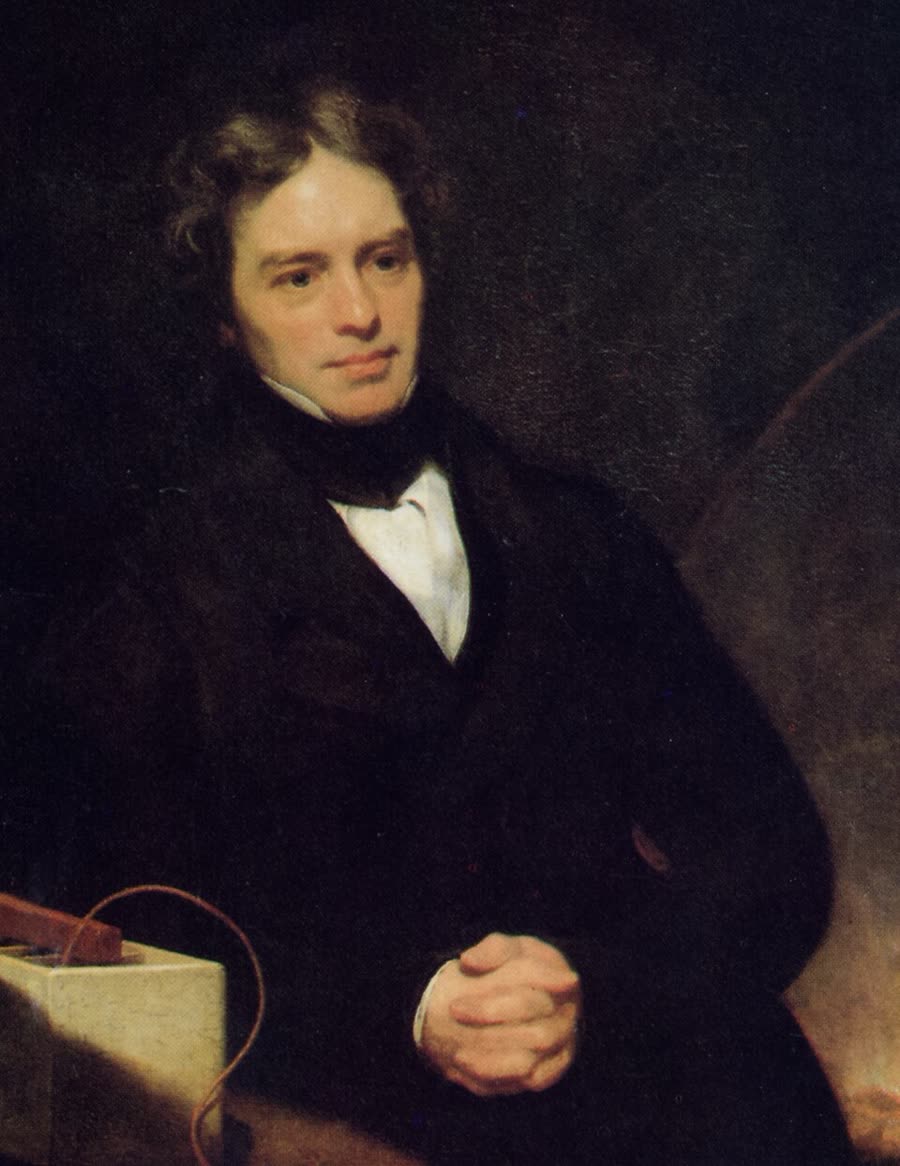
On electro-chemical decomposition, and the definite nature of electrolytic action
- The question
- Does a given quantity of electricity always produce the same amount of chemical change? And if two different substances are decomposed by the same current, how do the amounts compare?
- The apparatus
- Cells in series, so that the identical current passes through every one of them, with a water voltameter among them to measure the charge as a volume of detonating gas. Tin, lead, silver, copper, hydrogen, chlorine, iodine and oxygen were all put through it. Faraday had no ammeter and no coulomb — those units did not exist — so his measure of electricity was, literally, cubic centimetres of gas.
On the contact theory, nothing in particular: if the electricity is generated by the junction of the metals, the chemical action in the liquid is a side effect and need not be in any fixed proportion to it.
The chemical change is exactly proportional to the quantity of electricity, over every current and duration he could arrange. And with several cells in series — so identical charge through all of them — the masses liberated stood in the ratio of the substances’ chemical equivalents, the same ratios chemists had already established by weighing reagents into flasks.
How sure could they be? Faraday’s own figures were good to about one per cent, which was enough to establish proportionality but nowhere near enough to reveal how special the constant was. The modern value, 96,485.332 C/mol, is now exact by definition: since 2019 it is the product of two defined constants, the elementary charge and the Avogadro number.
It settles the contact-versus-chemical argument in favour of chemistry, and it hands electricity its first unit of quantity. But the second law does something larger and stranger, which Faraday did not press: it says that whatever is being exchanged between the current and the matter comes in a fixed portion per equivalent, and that the portion is the same for every substance in the world.
Close the circuit and watch two numbers: the charge that has gone through, and the mass on the cathode. Then change the current, or the time, and check that only their product matters.
He also had to invent the vocabulary, and it is worth noticing what the words commit you to. In 1834, with help from William Whewell of Trinity College — the same polymath who coined scientist — Faraday introduced electrode, electrolyte, electrolysis, anode and cathode, from the Greek for the way up and the way down. And ion, from ἰόν, a thing that goes, with anion and cation for the two directions of travel. That last choice is not decoration. The prevailing account of electrolysis had the liquid passing an influence along a chain of molecules, each handing on to its neighbour, with nothing crossing the vessel. Calling the participant a goer asserts that something actually travels — and Faraday chose the word knowing exactly what it claimed. He was, in other words, entirely willing to commit to migrating charged particles in a liquid. What he would not commit to was what those particles were made of.
Turn on the three-metal comparison and run each bath in turn. Ignore the milligrams; read the last column.
So who divided by it, and when? George Johnstone Stoney, in 1874, at the Belfast meeting of the British Association, in a paper called On the Physical Units of Nature. His arithmetic is a single line: take the charge that carries one mole of singly-charged ions, divide it by the number of particles in a mole, and what remains is the charge on one particle. His answer came out near 10⁻²⁰ coulombs, about a sixteenth of the true value — not because the method was wrong, but because the divisor was. In 1874 the count of molecules in a given volume of gas was known only to within a large factor, and the count Stoney divided by was some sixteen times too big, which is exactly how much too small his answer came out. In 1891 he gave the quotient a name. He called it an electron.
Faraday’s laws proved that electric charge comes in indivisible units.
They did not, and Faraday was right to say so. What the laws establish is that charge and matter are exchanged in a fixed ratio, and that the ratio for different substances stands in small whole-number proportions. A perfectly continuous electric fluid flowing into perfectly continuous matter would produce exactly that proportionality — the integers would then be facts about combining proportions in chemistry, which is where chemists had already found them, and would say nothing about the electricity. The quantisation of charge only follows if you already grant that matter is atomic. Faraday would not grant it: "I must confess I am jealous of the term atom; for though it is very easy to talk of atoms, it is very difficult to form a clear idea of their nature." Hermann von Helmholtz, drawing the conclusion in 1881, was careful to keep it conditional — if we accept that the elements are composed of atoms, then we cannot avoid concluding that electricity is divided into elementary portions. Charge was shown to be quantised in its own right only when Millikan measured individual oil drops and found their charges to be multiples of one value. What Faraday supplied was the number, waiting for someone with a reason to divide it.
The charge on a mole of silver
A silver voltameter is run at 0.500 A for 30.0 minutes. The cathode is dried and weighed, and has gained 1006.2 mg. How many coulombs are needed to deposit one mole of silver? (These are the simulation’s starting values, so you can check yourself against it.)
- Current
- 0.500 A
- Time
- 30.0 min
- Mass deposited
- 1006.2 mg
- Molar mass, silver
- M(Ag) = 107.8682 g/mol
- The ion in solution
- Ag⁺
If we accept the hypothesis that the elementary substances are composed of atoms, we cannot avoid concluding that electricity also, positive as well as negative, is divided into definite elementary portions, which behave like atoms of electricity.
- 1800Volta describes the pile. Within weeks Nicholson and Carlisle use one to split water, and electrochemistry exists.
- 1807Humphry Davy electrolyses molten potash and isolates potassium — then sodium, calcium, magnesium, barium and strontium within two years.
- 1813Faraday, a bookbinder’s apprentice, is hired by Davy as a laboratory assistant at the Royal Institution.
- 1833Third Series: electricity from piles, friction machines, magnets, thermocouples and fish is shown to be one thing.
- 1834Seventh Series: the two laws, and the words — electrode, electrolyte, anode, cathode, ion, anion, cation.
- 1874Stoney divides the Faraday constant by an estimated molecule count and gets a unit of charge, low by a factor of about sixteen.
- 1881Helmholtz, in the Faraday Lecture, states the conditional: atomic matter requires atomic electricity.
- 1886Hall and Héroult, independently and both aged 22, make aluminium cheap by electrolysing alumina in molten cryolite.
- 1891Stoney names the quotient. Electron.
- 1897J. J. Thomson measures the charge-to-mass ratio of cathode rays, and the particle stops being an accounting device.
- 1908The international ampere is defined by silver deposition: 0.00111800 g/s. It will hold until 1948.