Avogadro’s repair, ignored for fifty years
Equal volumes of any gas hold equal numbers of particles — and a particle of hydrogen gas is a pair of atoms, not one. Both halves are needed, both are correct, and the second one sounded to every chemist alive like special pleading. The bill for ignoring it takes half a century to come due.
- State both halves of Avogadro’s hypothesis, and show that neither half works alone
- Derive the atomic weight of oxygen from the composition of water and the combining volumes
- Explain why diatomic elemental molecules were rejected on principled grounds, not lazy ones
- Say what actually broke the deadlock in 1860, and what Cannizzaro added that Avogadro lacked
Hold the whole contradiction in view before anything is done to it, because the resolution is a single move and it is easy to miss what it costs. The combining volumes are simple. 2 : 1 : 2 for water, 1 : 3 : 2 for ammonia, 1 : 1 : 2 for nitrous gas, measured over water in a graduated tube to a fraction of a per cent — and, for water, to one part in two thousand. Simple volumes require half atoms. One volume of oxygen shared among two volumes of steam gives half an oxygen per particle of product. One volume each of nitrogen and oxygen giving two of nitrous gas requires both elements to split. Half atoms are forbidden. Not by taste. Indivisibility is the postulate that explains the law of multiple proportions, and if atoms can be halved then there is no reason for the oxides of nitrogen to run 1 : 2 : 3 : 4 : 5. Three solid-looking claims, and they cannot all be true. That is where chemistry sits at the end of 1810.
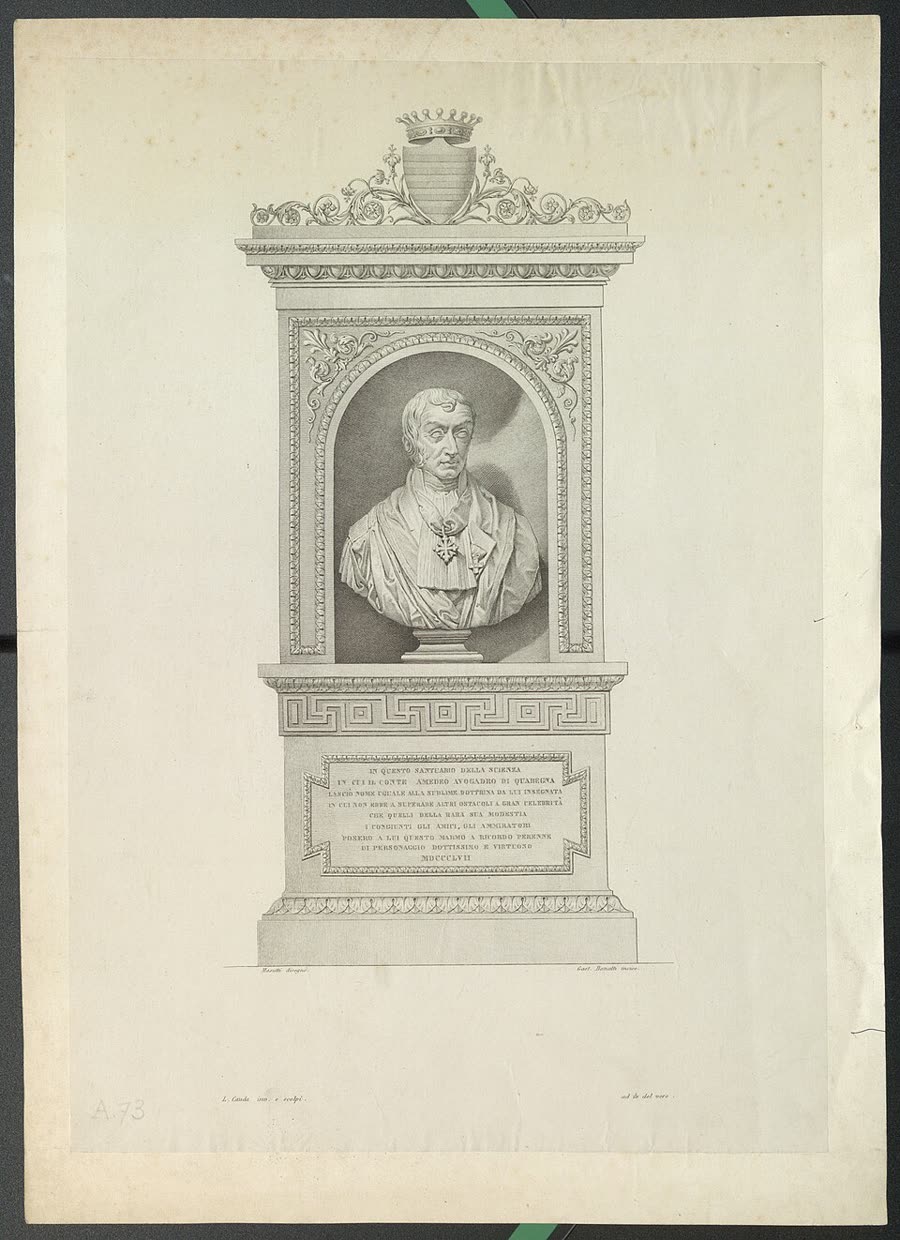
The person who resolves it is about as far from the centre of European chemistry as it is possible to be, in every sense. Amedeo Avogadro — Lorenzo Romano Amedeo Carlo Avogadro, Count of Quaregna and Cerreto — was born in Turin in 1776 into a family of lawyers, took a doctorate in ecclesiastical law at twenty, and practised for several years before turning to mathematics and physics in his mid-twenties. He held a chair of mathematical physics at Turin from 1820, lost it in 1822 when the government suppressed the post during political unrest, and got it back in 1834. He was not a chemist. He performed no analysis of consequence, ran no laboratory of note, and published in the Journal de Physique — a perfectly respectable journal that the people whose minds needed changing did not read with attention. He was writing in French, from Piedmont, about somebody else’s experiments. What he had was the ability to look at Gay-Lussac’s numbers and Dalton’s theory side by side and notice which assumption nobody had examined.
The same measured volumes as the last lesson. Switch between single atoms and pairs, and change nothing else. Then work through all three reactions with pairs selected.
The relative densities of the gases
- The question
- If equal volumes hold equal numbers of particles, then the ratio of two gases’ densities is the ratio of their particle masses, directly. Can that be measured, and does it agree with anything?
- The apparatus
- A globe of known volume, evacuated and weighed, then filled with each gas in turn at a measured temperature and pressure and weighed again. Simple in principle and fiddly in practice — the correction for the buoyancy of the air the balance itself sits in is not negligible.
Nothing, on Dalton’s picture: he denied that equal volumes hold equal numbers, so a density ratio tells you about particle mass and particle size tangled together, and is uninterpretable.
Oxygen is about 15.9 times as dense as hydrogen. On Avogadro’s hypothesis that is immediately the ratio of the particle masses — and since both are pairs, it is also the ratio of the atomic weights. Oxygen is about 16 times hydrogen.
How sure could they be? The densities of 1811 were good to perhaps a per cent, which put oxygen near 15 rather than 15.87. That is close enough to make the point and not close enough to end an argument. The value is not what convinced anybody; what should have convinced people is that the density route and the water-composition route give the same answer by completely different measurements.
Here is the second, independent handle at last. Composition by mass gives one equation. Vapour density gives another. Together they fix both the formula and the atomic weight, with no rule of thumb anywhere in the argument — which is exactly what Dalton needed and could not have.
So why did nobody take it? The honest answer is that the second half of the hypothesis contradicted the best theory of chemical bonding then available, and the man who held that theory was the most authoritative chemist in Europe. Jöns Jacob Berzelius had watched Davy pull sodium and potassium out of their compounds with a voltaic pile, and drew the obvious conclusion: chemical combination is electrical. Every element is inherently positive or negative; a compound is a positive part joined to a negative part; opposite charges attract, and a strong enough current pulls them apart again. This is electrochemical dualism, and around 1811 it was the most successful explanatory framework in chemistry. It accounted for electrolysis, it ordered the elements into a series, and it made sense of why some compounds were easy to decompose and others were not. And it makes H₂ impossible. Two atoms of the same element carry the same charge. Same charges repel. A molecule made of two identical atoms is not merely unobserved on this view — it is a contradiction in terms. So Avogadro was not asking for a small concession. He was asking chemists to accept a kind of molecule that their best theory said could not exist, on the strength of an argument about gas volumes, from a physicist in Turin. Read like that, the refusal stops looking like blindness and starts looking like ordinary scientific conservatism. It was still wrong. But understanding why a good objection was wrong needs quantum mechanics, and that is Act 6 of this path: two hydrogen atoms attract because their electrons can be shared between them, an effect with no classical analogue at all. Nobody could have supplied that answer in 1811, or in 1860.
It also did not help that the paper is genuinely hard to read. Avogadro never uses the word "atom". He has molécule intégrante for what we would call a molecule, molécule constituante for the molecule of an element, and molécule élémentaire for the atom — and he does not keep them rigorously apart. Translation made it worse. A reader in 1815 could put the paper down without being certain what had been claimed. And he was not the only one ignored. André-Marie Ampère published a closely related idea in 1814, from a different starting point, and it went the same way. Marc Antoine Gaudin restated the whole business in 1833 with clear diagrams — actual pictures of diatomic molecules splitting — and was ignored again. Gerhardt and Laurent used something very like it in organic chemistry through the 1840s and could not persuade the profession. That is four independent attempts across thirty years. This is not the story of one overlooked paper. It is the story of a conclusion the discipline had decided it did not want, and papers being overlooked is what that looks like from outside.
The bill arrives slowly, and then all at once. Without an agreed way to fix formulae, every laboratory chose its own. Some chemists used equivalent weights — the mass that combines with a fixed mass of hydrogen — which sidesteps atoms entirely and cannot be wrong, because it does not say anything. Some used Berzelius’s atomic weights, some Dalton’s, some Gmelin’s, and the same substance was written differently depending on who had made it. By 1860 Kekulé could list nineteen formulae in current use for acetic acid. Nineteen, for vinegar. Water was written HO by a good many chemists into the 1860s, which is Dalton’s formula surviving half a century after the measurement that refuted it. This is what a foundational ambiguity costs. Not spectacular error — the chemistry got done, the dyes got made, the analyses were accurate — but an accumulating inability of chemists to read one another, in a field whose entire method is comparing results. The Karlsruhe Congress of September 1860 was called to fix it: about 140 chemists, the first international scientific conference of its kind. Stanislao Cannizzaro spoke, and his colleague Angelo Pavesi handed out copies of a pamphlet at the door. Lothar Meyer read it on the journey home.
Avogadro determined Avogadro’s number.
He did not measure it, did not estimate it, and as far as anyone can tell never wondered what it was. His hypothesis says only that equal volumes hold equal numbers — it is a statement about two gases being the same, and it works perfectly well without anybody knowing what the number is. That is why it was useful: chemistry could compare masses and volumes for fifty years without ever counting a particle. The first actual estimate came from Josef Loschmidt in 1865, from the viscosity of air and an estimate of molecular size, and in German-speaking countries the related constant still carries his name. The number was christened "Avogadro’s number" by Jean Perrin in 1909, ninety-eight years after the paper and fifty-three years after Avogadro’s death, as a compliment. Perrin had just measured it — three unrelated ways, all agreeing — and that measurement is what finally made atoms undeniable. It is a lesson in Act 3 of this path, and Avogadro contributed nothing to it except the idea it rests on.
The same measurement, one assumption apart
Water is 88.809% oxygen by mass and 11.191% hydrogen — the identical figure used two lessons ago. Gay-Lussac’s volumes, read with Avogadro’s pairs, make water H₂O: two atoms of hydrogen to one of oxygen. Taking hydrogen as 1, what atomic weight does oxygen get now?
- Water, by mass
- 88.809% oxygen, 11.191% hydrogen
- Formula, from the volumes
- H₂O — two hydrogens per oxygen
- Scale
- hydrogen = 1
- For comparison
- Dalton’s answer, on HO, was 7.94
I too had received a copy, which I put in my pocket to read on the journey home. Once there I read it again and again and was astonished at the clearness with which the little book illuminated the most important points at issue. The scales seemed to fall from my eyes, doubts vanished, and a feeling of quiet certainty took their place.
- 1808Dalton publishes atomic weights built on the rule of greatest simplicity. Oxygen is 7.
- 1809Gay-Lussac publishes the combining volumes. Two of hydrogen, one of oxygen, two of steam.
- 1811Avogadro: equal volumes hold equal numbers, and the elemental gases come in pairs. Journal de Physique, volume 73.
- 1814Ampère proposes something very similar, independently, and is likewise ignored.
- 1819Berzelius’s electrochemical dualism is at its height. A molecule of two identical atoms is a contradiction in terms.
- 1833Gaudin restates the hypothesis with diagrams of diatomic molecules splitting. Ignored.
- 1856Avogadro dies in Turin, aged 79, with the question still open.
- 1860Karlsruhe, 3–5 September. Cannizzaro’s pamphlet is handed out at the door, and the atomic weights are settled within a few years.
- 1865Loschmidt makes the first estimate of how many particles a volume of gas actually holds.
- 1909Perrin measures the number three ways, and names it after Avogadro.