The volumes are simple too
Two volumes of hydrogen and one of oxygen give two volumes of steam; one of nitrogen and three of hydrogen give two of ammonia. Gay-Lussac found that gases combine in whole-number ratios of volume as well as of mass — and Dalton, who needed this result more than anyone alive, spent the rest of his life denying it.
- State the law of combining volumes, and say why it is a second handle on formulae rather than a repeat of the first
- Show that the measured volumes force half an atom of oxygen into every particle of steam, if a gas particle is a single atom
- Explain why Dalton’s rejection of the result was a valid deduction rather than obstinacy
- Say which of Gay-Lussac’s volumes were read off a tube and which were not
The last lesson ended with a hole in the method, and it is worth restating it precisely, because everything here is aimed at it. Analysis by mass gives one equation with two unknowns. The measured mass ratio is the number of atoms of one element, times the weight of one of them, divided by the same for the other. Fix the formula and you get the weights; fix the weights and you get the formula; measure the masses and you have neither. Dalton plugged the gap with a rule of thumb — assume the simplest formula — and the rule of thumb gave HO for water, which is wrong, and put a factor of two into every atomic weight in his table. What is needed is a second kind of measurement: one that gets at how many particles without going through how heavy they are. It arrives within a year of A New System, and from the laboratory of the man who had spent the previous decade arguing against fixed proportions altogether.
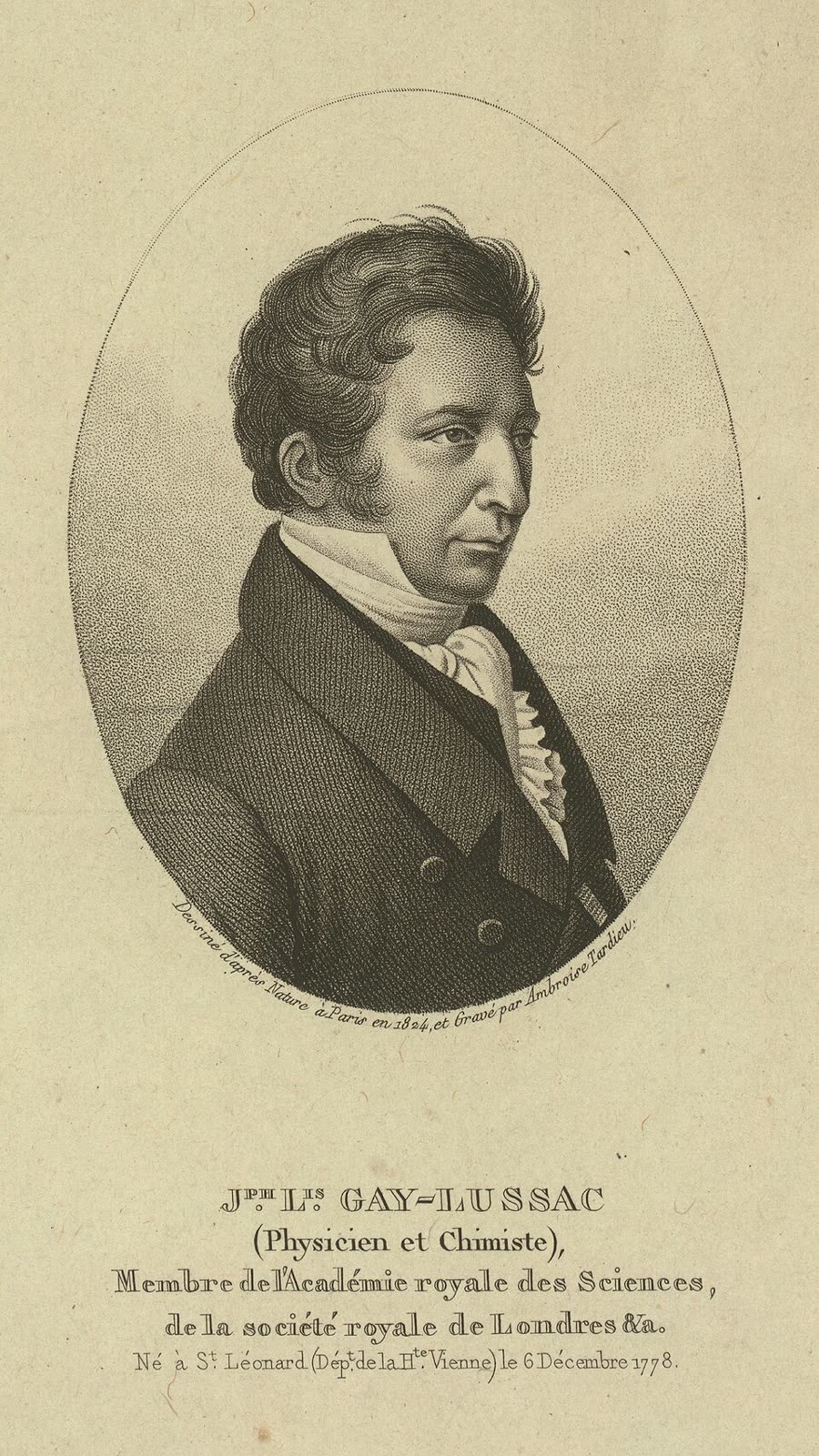
Joseph Louis Gay-Lussac was Berthollet’s protégé, worked at Berthollet’s private laboratory at Arcueil, and was in every institutional sense a member of the losing side of Act 2’s first argument. He then produced the strongest evidence anyone had yet found for the whole-number view of chemical combination. The history of science is full of this and it never stops being funny. He had already noticed something odd about gases. In 1802 he published the result that every gas expands by the same fraction of its volume for the same rise in temperature — he put it at about one part in 266.66 per degree, which is close to the modern 1/273.15. The important word is every. Hydrogen, oxygen, carbon dioxide, whatever you like: same fraction. That is already a hint that gases share some property having nothing to do with their chemistry. And he was the sort of person who goes and looks. On 16 September 1804 he took a hydrogen balloon to 7,016 metres — an altitude record that stood for fifty-eight years — in order to collect air samples and settle whether the composition of the atmosphere changes with height. It does not, to the precision he could manage. He very nearly froze, and he came down with the answer.
The composition of water, by volume
- The question
- Hydrogen and oxygen combine to make water. In what proportion by volume — and is that proportion a round number or merely a number?
- The apparatus
- A eudiometer: a graduated glass tube of gas standing inverted over water, with two wires sealed through the glass so a spark can be struck inside it. Fill with a measured mixture of hydrogen and oxygen, spark, let the water condense, and read off what is left in the tube. The residue is the measurement.
Nothing in the chemistry of 1805 demanded a round number. Composition by mass had turned out to be fixed but not simple — 7.94 grams of oxygen per gram of hydrogen is not a number anyone would call tidy.
100 volumes of oxygen combined with 199.89 volumes of hydrogen. That is 2 : 1, wrong in the fourth figure. Not approximately two. Two, to about one part in two thousand.
How sure could they be? This is the number that eventually made Dalton’s position untenable, and it is why it is worth quoting to five figures rather than saying "two to one". Dalton’s counter-argument was that the ratios only looked exact because the experiments were poor. A residue read off a graduated tube at one part in two thousand is not a poor experiment, and it does not average out to 1.9.
The masses in water are in the ratio 7.94 to 1, which is nothing in particular. The volumes are in the ratio 2 to 1. Whatever a volume of gas is counting, it is counting something the masses obscure.
Here is why this is a second handle and not more of the same. Masses tell you how much stuff there is. That is what a balance does, and it is why a mass analysis can never separate "many light atoms" from "few heavy ones". Volumes, if you grant one assumption, tell you how many particles there are. The assumption is that equal volumes of any two gases, at the same temperature and pressure, contain equal numbers of particles. Grant that, and the missing equation appears from nowhere. You now have two independent measurements — mass and number — on the same sample, and the underdetermination that wrecked Dalton’s atomic weights simply dissolves. And the assumption is not arbitrary. Gay-Lussac’s own 1802 expansion law had already shown that all gases respond identically to heat, whatever they are made of. Boyle’s law had shown the same for pressure. Gases were behaving as though their chemical identity was irrelevant to their bulk properties, which is precisely what you would expect if a volume of gas is mostly empty space with a certain number of particles rattling about in it. So the pieces are all on the table by 1808. Putting them together takes three more years, and the person who does it will be ignored for fifty.
Gay-Lussac’s volumes, with Dalton’s picture of a gas particle: one atom each, and equal volumes holding equal numbers. Spark it, then look at the bottom of the picture. Leave the other button alone — it belongs to the next lesson.
Dalton rejected the result, and the reason is not obstinacy. He had a valid argument, and it is worth laying out as an argument rather than as a personality flaw. Premise 1. Atoms are indivisible. This is not a detail — it is the postulate that explains multiple proportions, and without it Dalton has nothing. Premise 2. Equal volumes of gases contain equal numbers of particles. Premise 3. Water is HO, one atom of each, by the rule of greatest simplicity. Observation. 2 volumes of hydrogen and 1 of oxygen give 2 volumes of steam. Those four cannot all be true. Two volumes of product need two particles-worth of oxygen; only one volume of oxygen went in; so each particle of steam holds half an atom. Something has to be given up. Dalton gave up Premise 2 — and he had an independent reason to. He believed the particles of different gases were different sizes, each surrounded by its own atmosphere of caloric, so a fixed volume of a light gas would simply hold more particles than the same volume of a heavy one. On that view, equal volumes holding equal numbers is not a modest assumption; it is a strong and unmotivated claim about all gases being alike. Having rejected Premise 2, he was left with the awkward fact that the ratios still came out very round. So he attacked the data as well — and there, unlike everywhere else, he was simply wrong.
The decomposition of ammonia by a spark
- The question
- The water result gives the ratio of the reactants only. Is there a case where the product volume can be read off the same tube, so that all three numbers are measurements?
- The apparatus
- A eudiometer of ammonia gas, and a spark. Rather than build ammonia from its elements — which nobody could do until Haber, a century later — take it apart, and measure what comes out.
On any view, the products should be nitrogen and hydrogen. Nothing predicts what volume they should occupy relative to the ammonia that produced them.
100 volumes of ammonia give 200 volumes of gas, in the proportion 1 nitrogen to 3 hydrogen. Run backwards, that is 1 volume of nitrogen plus 3 of hydrogen giving 2 of ammonia — three volumes in, two volumes out. And with nitrogen and oxygen: 1 volume of each gives 2 volumes of nitrous gas, two in and two out.
How sure could they be? Volume measurements over water are good to a fraction of a per cent with care, and the ratios here are 1 : 3 : 2 and 1 : 1 : 2 — far too coarse a target to be reached by accident. The decisive feature is that the total volume changes, and changes by a simple factor. Gases are being repackaged, not merely mixed.
This is where the law becomes unavoidable. In the water case the product volume was inferred; here it is read straight off the tube, and it is still a whole number. Any theory of what a gas particle is has to produce two volumes of product from two volumes of reactants — and Dalton’s cannot.
Dalton refused to accept the combining volumes because they threatened his theory.
He refused because, given his premises, they implied a divisible atom — and the indivisibility of atoms is not a decoration on Dalton’s theory, it is the thing that explains multiple proportions. Accepting Gay-Lussac at face value in 1809 meant giving up the explanation of the law that made the atomic theory worth having. He had two escape routes and he took both: he denied that equal volumes hold equal numbers, for which he had an independent reason in his caloric picture of gases, and he denied that the volume ratios were exact, for which he had no reason at all. The first move was sound reasoning from a false premise. The second was wrong, and it is the one to hold against him. It is also worth noticing how ordinary the move is: doubting a measurement that contradicts a well-supported theory is frequently correct — it was the right response to the apparently faster-than-light neutrinos reported in 2011, which turned out to be a loose cable. What made it fail here is precision. A ratio measured to one part in two thousand does not average away.
Read the residue
You put 60 mL of hydrogen and 40 mL of oxygen into a eudiometer over water, at room temperature and pressure, and strike a spark. The water formed condenses. What volume of gas is left in the tube, and of what?
- Hydrogen taken
- 60 mL
- Oxygen taken
- 40 mL
- Combining ratio, by volume
- 2 volumes hydrogen to 1 of oxygen
- Product
- water — condenses, and leaves the gas phase
The truth is, I believe, that gases do not unite in equal or exact measures in any one instance; when they appear to do so, it is owing to the inaccuracy of our experiments.
- 1802Gay-Lussac: every gas expands by the same fraction per degree. Chemistry is irrelevant to how a gas behaves in bulk.
- 1804He takes a balloon to 7,016 m to sample the air. The composition is the same up there.
- 1805With Humboldt: water is 199.89 volumes of hydrogen to 100 of oxygen.
- 1808A New System of Chemical Philosophy appears in Manchester in the spring.
- 180831 December: Gay-Lussac reads the memoir on combining volumes to the Société Philomathique.
- 1809It is published from Berthollet’s laboratory at Arcueil — evidence for whole-number combination, out of the house that had opposed it.
- 1810Dalton, in print: the gases do not really combine in exact measures, and it is the experiments that are inaccurate.
- 1811Avogadro publishes the repair, in a journal nobody important reads.