Dalton draws the conclusion
Whole-number ratios are exactly what you get if matter comes in indivisible pieces that combine one-to-one, one-to-two, and no other way. Dalton says so in 1808 — and in the same book makes one reasonable-looking assumption that will poison every atomic weight in chemistry for the next fifty years.
- State Dalton’s postulates, and identify which of them was genuinely new
- Explain why composition by mass alone cannot fix both a formula and an atomic weight
- Say what the rule of greatest simplicity was, why it was reasonable, and what it cost
- Distinguish explaining a set of laws from demonstrating that atoms exist
Two facts are on the table, and both were got with a balance. Compounds keep their recipes. Copper carbonate from a mine and copper carbonate from a bench are the same to the limit of analysis; offer a compound more of one ingredient than it can use and the excess stays in the dish. The recipes are related by small whole numbers. Per gram of carbon, one oxide takes 1.332 g of oxygen and the other takes exactly twice that. Per gram of nitrogen, the five oxides run 1 : 2 : 3 : 4 : 5. Neither statement mentions the structure of matter. Both are about weighing things. Somebody now has to say what could make them true.
The person who does it is an unlikely candidate, and the route he takes is stranger still. John Dalton was a Quaker from Eaglesfield in Cumberland, teaching in a school from the age of twelve, largely self-taught, and by trade and inclination a meteorologist. He began a daily weather diary in 1787 and kept it for fifty-seven years — something in the region of two hundred thousand entries, the last of them made on the day he died. He was colour-blind, and in 1794 wrote the first scientific description of the condition, which is why it is still daltonisme in French. He left instructions for his eyes to be preserved and examined; in 1995 they were, and DNA from them confirmed that he lacked the medium-wavelength pigment. He did not come to atoms through chemistry. He came to them through the air, and through two questions that are not chemical questions at all: Why does the atmosphere not settle into layers, with the heavy gases at the bottom and the light ones on top, the way a jar of oil and water does? And why does water dissolve a great deal of one gas and almost none of another? Both are physics. The answer he reached for was that a gas is made of particles, and that the particles of different gases have different weights and different sizes.
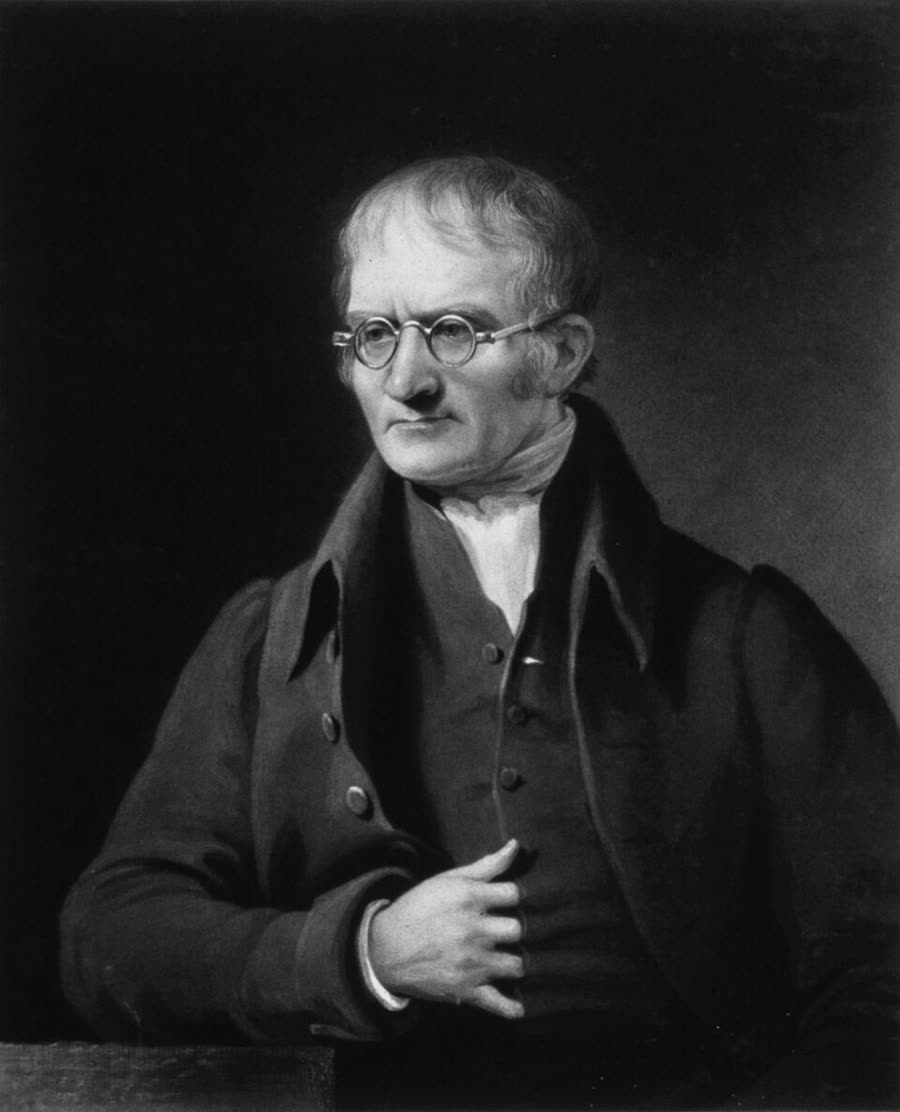
haade, 20 November 2006 (upload date). Public domain
On the absorption of gases by water and other liquids
- The question
- Water takes up a great deal of carbon dioxide, a moderate amount of oxygen and hardly any nitrogen. Why should a liquid discriminate between gases at all, if a gas is merely an elastic fluid?
- The apparatus
- Water, a set of gases, and a means of measuring how much of each dissolves at a given temperature and pressure — the ordinary apparatus of a careful gas chemist, and nothing that Priestley could not have built thirty years earlier.
On any picture in which a gas is a continuous elastic fluid, no answer is available: there is nothing about one fluid to make it more welcome in water than another.
The gases differ enormously, and they differ in a way that tracks their densities. Dalton’s conclusion, in his own words: he was "nearly persuaded that the circumstance depends upon the weight and number of the ultimate particles of the several gases".
How sure could they be? The measurements are unremarkable and were not the point. What matters is what he printed at the end of the paper: a table of the relative weights of the ultimate particles of a dozen substances. It is the first table of atomic weights in the history of chemistry, and it is an appendix to a paper about gases dissolving in water.
The atomic theory enters chemistry sideways, as a solution to a problem in the physics of gases. The chemical laws it explains so well — definite and multiple proportions — were not what led Dalton to it, and this is the single most commonly misreported thing about him.
It is important not to give Dalton credit for the wrong thing, because the wrong thing is a much older idea than he was. Atoms are ancient. Leucippus and Democritus have them in the fifth century BC: matter is particles and void, and nothing else. Lucretius writes six books of Latin verse about it. Pierre Gassendi revives the position in the 1630s and makes it respectable to Christians. And Newton, in Query 31 of the Opticks in 1704, is entirely explicit — matter was formed into "solid, massy, hard, impenetrable, moveable particles", and chemistry happens by the forces between them. None of those atoms could be weighed. Or counted, or told apart, or used to predict a single measurement. They were a philosophical position about whether matter can be divided for ever, and no experiment available in two thousand years could distinguish a world with them from a world without. So when people say Dalton proposed the atomic theory, that is not quite it. Atomism was on the shelf and had been for millennia. What was missing was any way to make it do work.
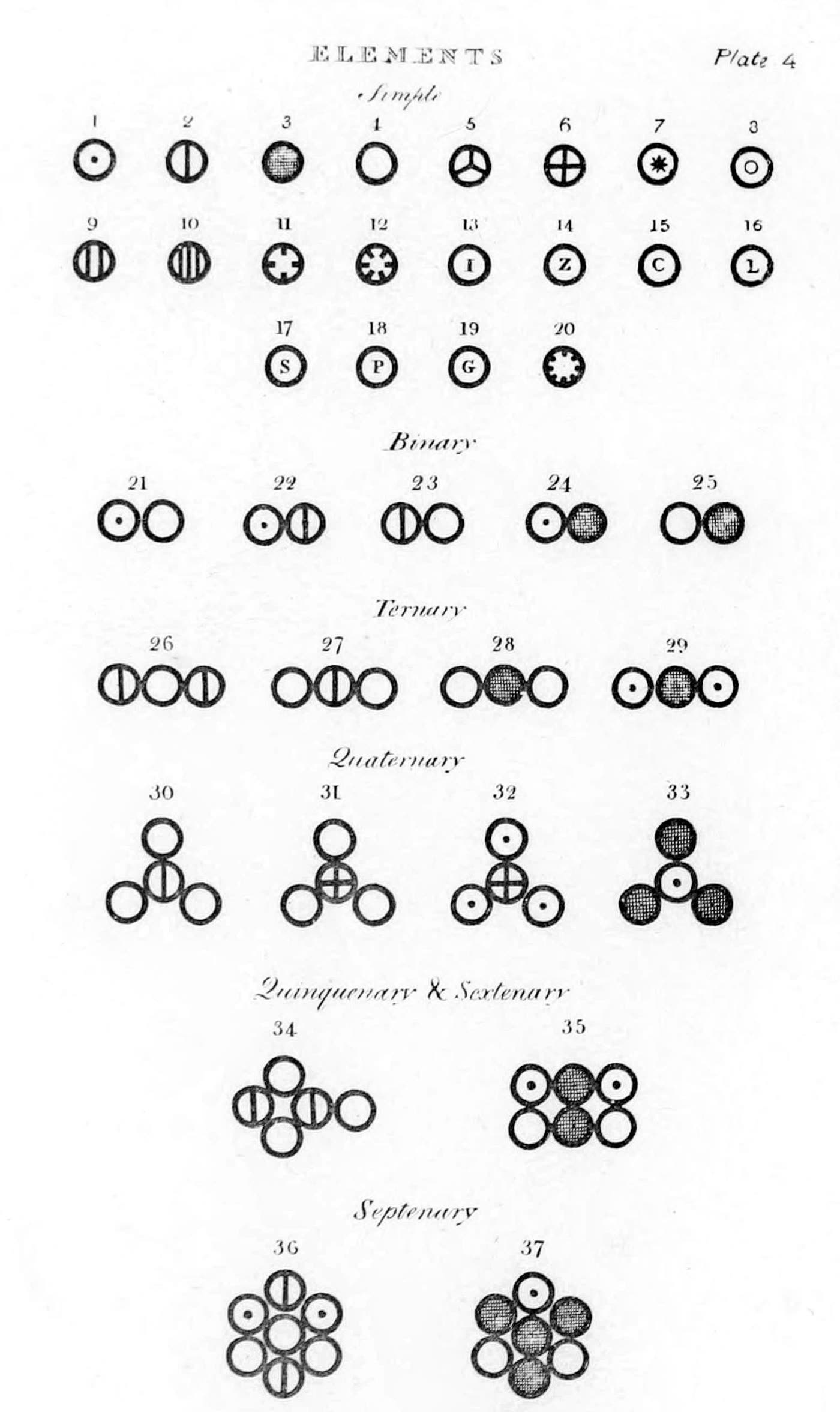
Dalton needed something and had nothing, so he made a rule. The rule of greatest simplicity. If only one compound of two elements is known, presume it is one atom of each — binary — unless something appears to the contrary. If two compounds are known, presume one is binary and the other is one-to-two. If three, one binary and two of the one-to-two kind. And so on. Apply it. Only one compound of hydrogen and oxygen was known in 1808, so water is HO. Only one of nitrogen and hydrogen, so ammonia is NH. Carbon monoxide and carbon dioxide are two compounds, so they are CO and CO₂ — which happens to be right, and shows the rule was not stupid. It is worth pausing on how defensible this is. He is not guessing carelessly; he is adopting the only rule available, in a situation where some rule is logically required and the data can supply none. Simplicity is what you fall back on when you have run out of evidence, and falling back on it is normal scientific practice to this day. It is also, in this instance, wrong — and wrong in a way that will take fifty years and an international congress to undo.
The theory was taken up quickly, which is not what usually happens. Thomas Thomson heard it from Dalton over two days in Manchester in August 1804, and published an account of it in the third edition of his System of Chemistry in 1807 — a year before Dalton’s own book appeared. Wollaston supplied the oxalate confirmation in 1808 while refusing to believe the underlying picture. Berzelius adopted it immediately and set about doing the analytical work properly. Humphry Davy thought it speculative to begin with and came round; it was Davy who presented Dalton with the Royal Society’s first Royal Medal in 1826. The one thing nobody adopted was the notation. Dalton drew his atoms as circles with distinguishing marks, and compounds as those circles touching — a genuinely pictorial system, and unprintable at any scale. In 1813 Berzelius proposed letters instead, with numbers for how many, which is what we still use. Dalton refused to the end of his life. "Berzelius’s symbols are horrifying," he wrote. "A young student in chemistry might as soon learn Hebrew as make himself acquainted with them." He was outvoted, and it is one of the rare cases where the losing side left behind a picture worth keeping. His plate is drawn above, and it shows you what he thought a compound was in a way that a formula does not.
Dalton proved that atoms exist.
He proposed a hypothesis that explained two laws superbly, which is excellent grounds for using it and is not the same as showing the things are there. The distinction was live for a century, and the people on the other side of it were not cranks. Wilhelm Ostwald — Nobel laureate, author of the standard textbook, founder of physical chemistry as a discipline — regarded atoms as a useful fiction and would not assert their reality until 1909. Ernst Mach is supposed to have asked atomists whether they had ever seen one, and never accepted them at all. Their objection was principled: the atomic hypothesis and a purely relational account of chemical combination made identical predictions about every measurement anyone could then perform, and a difference that makes no difference is not a fact about the world. What eventually settled it was not chemistry. It was Einstein’s 1905 treatment of Brownian motion and Perrin’s measurements of 1908–1909, which counted the things — three unrelated methods agreeing on the number in a gram — and Ostwald conceded on the spot. That is Act 3 of this path, and it is a hundred years after this lesson.
Dalton’s oxygen
Water is 88.809% oxygen by mass and 11.191% hydrogen. Apply Dalton’s rule of greatest simplicity — only one compound of hydrogen and oxygen was known, so water is HO, one atom of each. Taking hydrogen as 1, what atomic weight does oxygen get?
- Water, by mass
- 88.809% oxygen, 11.191% hydrogen
- Assumed formula
- HO — one atom of each
- Scale
- hydrogen = 1
Chemical analysis and synthesis go no farther than to the separation of particles one from another, and to their reunion. No new creation or destruction of matter is within the reach of chemical agency. We might as well attempt to introduce a new planet into the solar system, or to annihilate one already in existence, as to create or destroy a particle of hydrogen.
- 450 BCLeucippus and Democritus: matter is particles and void. No experiment can touch the claim for the next two thousand years.
- 1704Newton, Opticks, Query 31: matter formed into "solid, massy, hard, impenetrable, moveable particles".
- 1787Dalton begins a daily meteorological diary. He will make about two hundred thousand entries.
- 1794His paper on colour blindness — the first description of the condition, and of his own case.
- 1801The law of partial pressures. He is working on the atmosphere.
- 18036 September: the first table of atomic weights, in a notebook. In October, the paper on gases dissolving in water.
- 1807Thomson publishes Dalton’s theory before Dalton does.
- 1808A New System of Chemical Philosophy, part 1: the postulates, the rule of greatest simplicity, and a table of weights that is wrong.
- 1813Berzelius proposes letters and numbers instead of Dalton’s circles. Dalton refuses to use them for the rest of his life.
- 1826Davy presents Dalton with the Royal Society’s first Royal Medal.
- 1844Dalton dies in Manchester. Tens of thousands file past the coffin.