Mendeleev leaves holes and fills them
He published the atomic weight, the density, the melting behaviour and the oxide formula of an element nobody had ever seen. Four years later a French spectroscopist found it in a Pyrenean zinc ore, and Mendeleev corrected his density measurement by post.
- Explain why leaving a gap is a different kind of claim from filling one
- Say how Mendeleev got numbers for elements nobody had seen, and why the method works
- Compare his published predictions for gallium and germanium with the measurements
- State what he got wrong, and why the misses do not weaken the case
Mendeleev was not looking for a law of nature. He was trying to finish a textbook. He had been appointed to a chair at St Petersburg and there was no adequate Russian textbook of inorganic chemistry, so he wrote one: Principles of Chemistry. The first volume dealt with the halogens and the alkali metals, and it went well. The second had to cover everything else, and that meant deciding what order to take the elements in — which is an entirely practical question, and the sort of practical question that forces you to work out what you actually believe. There is a pattern here worth noticing, because it recurs. The people who systematise a subject are very often the people who have had to teach it. A researcher can leave an awkward corner alone. A textbook has to have a next chapter.
On 17 February 1869 by the Russian calendar — 1 March in ours — he laid out the 63 known elements by atomic weight, in rows arranged so that chemically similar elements fell underneath one another. So far this is what de Chancourtois, Odling, Newlands and Lothar Meyer had all done. The next decision is the entire lesson. Where the chemistry refused to line up — where the next element by weight plainly did not belong in the family the column called for — everyone before him had shuffled something into the space to keep the table full. Mendeleev left the space empty, and said an element would be found to fill it. And then, in a longer paper in 1871, he did something considerably more exposed than that. He published what the missing elements would weigh, how dense they would be, how they would melt, what their oxides and chlorides would look like, and in one case how they would be discovered.
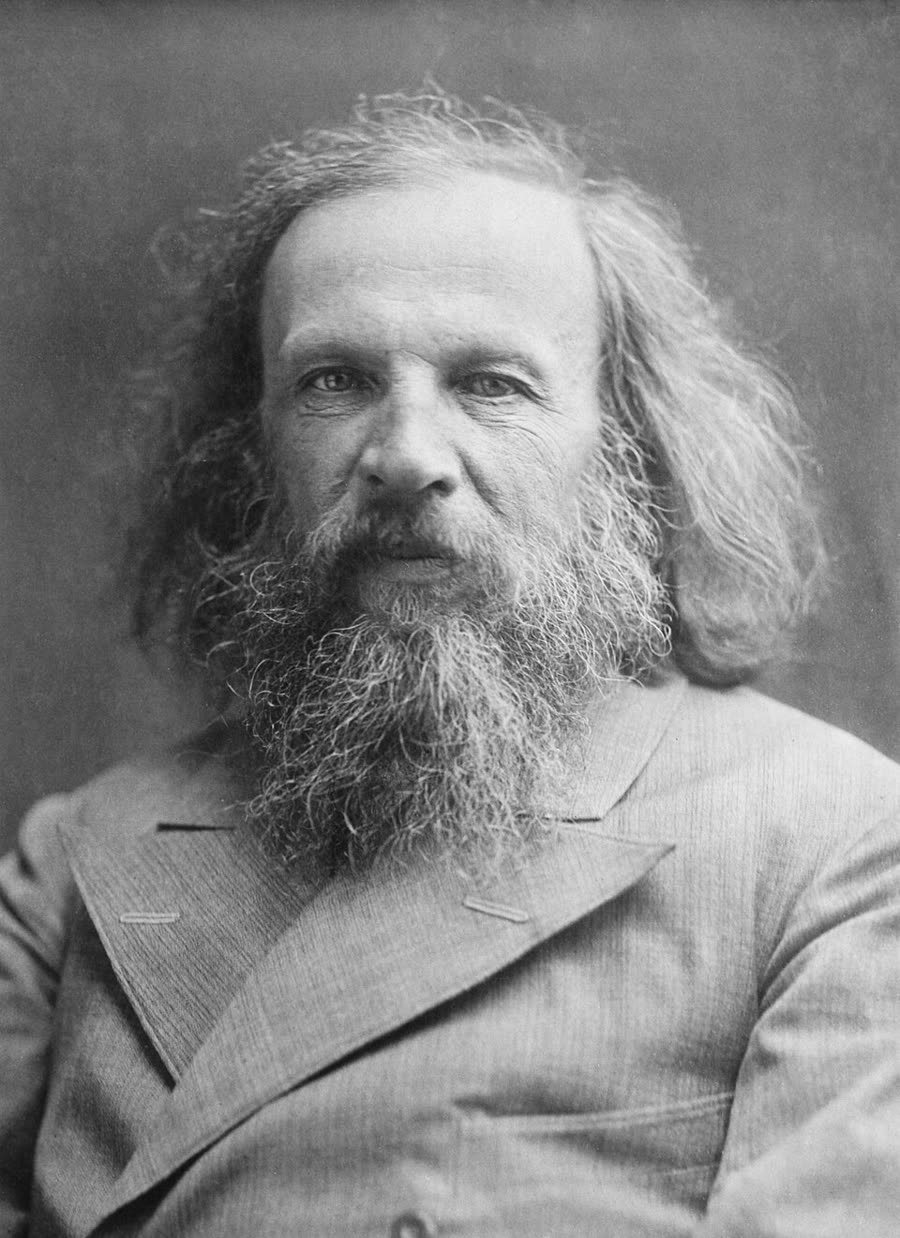
Original: Unknown author Unknown author Upload: Germansociety2014, 10 May 2014, 12:44:43 (upload . Public domain
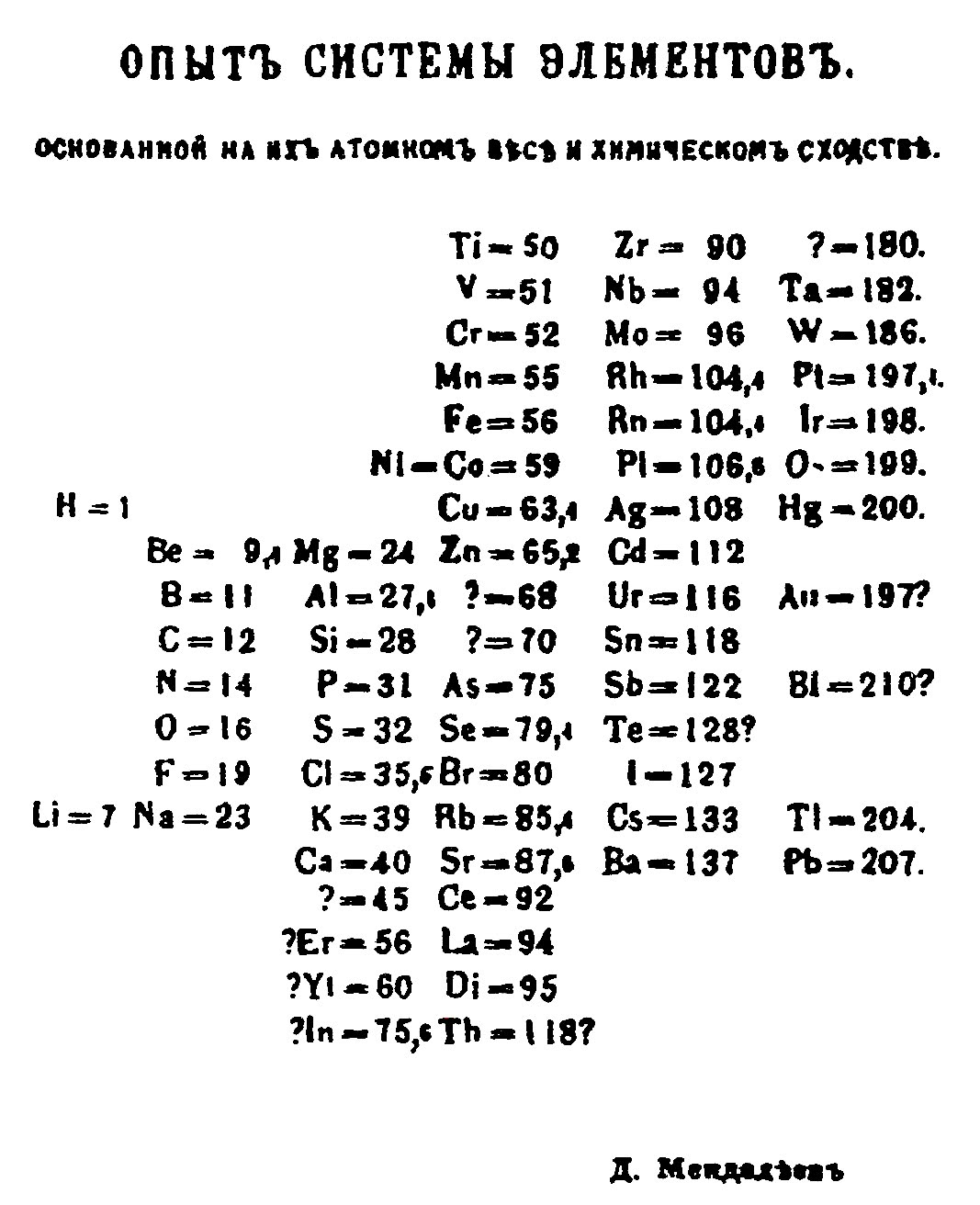
The table as it stood in 1869: blank where nobody had found anything, and dashed where Mendeleev put a prediction. Tap each dashed box, and read the published numbers against the measured ones.
Where do numbers for an element nobody has ever seen come from? From the neighbours. Atomic weight climbs smoothly as you move along a row and down a column, so the value in an empty box is close to the average of the four boxes around it. For the eka-silicon slot that is silicon above, tin below, gallium to the left and arsenic to the right. Density comes the same way. So do melting points, roughly. The formula of the oxide does not need interpolation at all — it comes from the group, because that is what a group is: eka-silicon sits in the column of carbon, silicon and tin, all of which form RO₂, so eka-silicon forms EsO₂. None of this is difficult. What is difficult is being willing to print it. He used the same reasoning in the other direction too, and this is less often mentioned: where an element’s accepted weight put it in the wrong place, he changed the weight. Indium had been assigned 75.6; he reassigned it to about 113 on the grounds that its chemistry demanded a different valency. Uranium he roughly doubled, from 120 to 240. Beryllium, cerium, yttrium and titanium all moved. Every one of those corrections turned out to be right.
Two violet lines in a Pyrenean zinc ore
- The question
- Lecoq had spent fifteen years cataloguing the spark spectra of the known elements. The question he was asking was his own — is there anything in this ore whose spectrum I do not recognise? — and it was not Mendeleev’s question.
- The apparatus
- A spectroscope and a spark discharge. Dissolve the mineral, spark it, and look at the lines. Then, for the metal itself, precipitation and electrolysis of a hydroxide solution — the whole first sample weighed well under a gram.
Mendeleev had published, four years earlier, that an element would be found below aluminium with atomic weight about 68, density about 5.9, a low melting point, an oxide Ea₂O₃, and — this part in print — that it would probably be discovered by means of the spectroscope.
Two violet lines belonging to nothing known. The metal came out at atomic weight 69.7, oxide Ga₂O₃, and it melts at 29.8 °C — low enough that a lump of it liquefies in a closed hand. Lecoq’s first density measurement was 4.7.
How sure could they be? On atomic weight, 2.5% out. On density, once the sample was clean, 0.2% — a prediction of 5.9 against a measurement of 5.91, for a substance no one had ever held.
A named, quantified, published prediction, made about a substance that did not exist as far as anybody knew, confirmed by a man who had not read the prediction and was not looking for it. Lecoq initially disputed that Mendeleev had any claim on his element at all. That independence is what makes the confirmation worth something.
And then the moment the whole history of chemistry keeps coming back to. Mendeleev, in St Petersburg, read Lecoq’s announcement and wrote to say that the density of 4.7 was wrong. It should be about 5.9, and the sample was probably still contaminated with sodium from the preparation. Lecoq — who owned the world’s only gallium — repurified it and measured it again. 5.904. It is worth being precise about why this is impressive, because it is not the accuracy. It is that the correction came from the table. Mendeleev had no gallium, no spectroscope pointed at any, and no information about Lecoq’s procedure. He had a position in a grid, four neighbours, and enough confidence in the arrangement to tell a specialist that his own measurement of his own element was out by a quarter.
The missing seven per cent of argyrodite
- The question
- A new silver mineral from the Himmelsfürst mine analysed as silver and sulphur — and the analysis came out about seven per cent short every time. Winkler’s question was not "where is eka-silicon". It was "what is the missing seven per cent of my sample".
- The apparatus
- Classical wet analysis. Precipitate, weigh, dissolve, repeat, for months, on a mineral available in small quantities. Eventually he obtained the element as a grey-white metal and its tetrachloride as a volatile liquid.
Mendeleev had published in 1871: atomic weight 72, density 5.5, oxide EsO₂, a chloride EsCl₄ boiling below 100 °C with a density about 1.9. Winkler himself first thought he had found eka-antimony; Mendeleev’s early guess was the same. It was Lothar Meyer who suggested eka-silicon.
Atomic weight 72.6. Density 5.32. Oxide GeO₂. And GeCl₄, a colourless liquid boiling at 86 °C with a density of 1.88. Winkler named it germanium.
How sure could they be? Weight 0.9% out, density 3.3%, chloride density 1.1%, boiling point predicted "below 100 °C" and found at 86 °C.
This is the one that ended the argument. Gallium could be called a lucky hit on a single number; germanium matched on the weight, the density, the oxide, the chloride, the chloride’s density and its boiling point, none of which had been measured when the predictions were printed. Winkler wrote that it was hard to find a more striking proof of the doctrine of the periodicity of the elements, and he had no reason to flatter anyone.
Now drag the year slider forward from 1869 and watch the holes close: gallium in 1875, scandium in 1879, germanium in 1886. Then select eka-manganese and keep dragging.
There is one more thing he did, and at the time it looked far worse than leaving gaps. Tellurium weighs 127.6. Iodine weighs 126.9. By weight, iodine comes first. But tellurium behaves like sulphur and selenium, and iodine behaves like chlorine and bromine, so putting iodine first destroys two columns at once. Mendeleev put tellurium first, against the weights. He did the same with cobalt and nickel, where cobalt is the heavier and belongs first. His stated reason was that the accepted weight of tellurium must be wrong, and that a better determination would put it below 126.9. It was measured again, and again, and again over the following thirty years. It is 127.6. He was wrong about that. To his critics this was exactly the move that makes a theory unfalsifiable: when the data agrees with you it is evidence, and when it disagrees you declare it faulty. That criticism was fair. He had no principled way to say which weights to trust and which to overrule beyond his own judgement about what the chemistry demanded — and judgement is what everyone claims to have. He was right anyway. Proving it took another twenty-seven years and an entirely different kind of measurement, and it is the last lesson of this act.
Mendeleev discovered the periodic table.
He discovered how to use one. At least five people arranged the elements periodically within a decade — de Chancourtois in 1862, Odling in 1864, Newlands in 1865, Lothar Meyer from 1864, Mendeleev in 1869 — and Meyer’s is not a footnote. His 1870 plot of atomic volume against atomic weight is one of the most persuasive pieces of evidence for periodicity ever drawn: the curve has sharp peaks, the peaks are the alkali metals every time, and you can see the law instead of being told it. The Royal Society gave Mendeleev and Meyer the Davy Medal jointly in 1882, which was the correct decision. What Meyer did not do was leave holes and print numbers in them; he said afterwards that he had not had the courage to do so. The difference between the two men is not insight into the pattern. It is willingness to be caught out by it.
Interpolate an element that does not exist yet
Do what Mendeleev did, for the empty box below aluminium. In the finished table its four neighbours are aluminium above, indium below, zinc to the left and germanium to the right. What atomic weight does the four-neighbour average give for eka-aluminium?
- Aluminium
- 26.982
- Indium
- 114.82
- Zinc
- 65.38
- Germanium
- 72.63
Before the promulgation of this law the chemical elements were mere fragmentary incidental facts in Nature; there was no special reason to expect the discovery of new elements.
- 1869The first table: 63 elements, arranged by weight, with question marks where nothing fits.
- 1870Lothar Meyer publishes the atomic-volume curve, and periodicity becomes something you can look at.
- 1871The long paper: eka-boron, eka-aluminium, eka-silicon and eka-manganese, with weights, densities and formulae.
- 1875Lecoq de Boisbaudran finds gallium by two violet lines, and is corrected on its density by post.
- 1879Nilson isolates scandium in Uppsala; Cleve recognises it as eka-boron.
- 1882The Royal Society awards the Davy Medal to Mendeleev and Lothar Meyer jointly.
- 1886Winkler tracks down the missing seven per cent of argyrodite and it is eka-silicon.
- 1894Argon, which fits nowhere at all, and briefly looks like a refutation.
- 1937Perrier and Segrè make eka-manganese in Palermo from a foil irradiated in Berkeley. Technetium: sixty-six years late.