An entire column nobody had noticed
Nitrogen prepared from air weighed one part in two hundred more than nitrogen prepared from chemicals. Rayleigh published the discrepancy and asked for help instead of explaining it away, and inside six years the periodic table had gained a column that had never been suspected.
- Say what Rayleigh measured, and why a half-per-cent discrepancy was worth chasing
- Work out the composition of the air from two weighings of the same globe
- Explain how the ratio of specific heats fixed argon’s atomic weight
- Say why a whole new column was a harder thing to accept than a missing element
John William Strutt, third Baron Rayleigh, spent much of the 1880s and 1890s on a programme of work so unglamorous that it is worth dwelling on before the interesting part. He was measuring the densities of the common gases, to as many decimal places as he could manage, in his own laboratory at Terling Place in Essex. Fill a glass globe of known volume with a gas at a known temperature and pressure; weigh it; evacuate it; weigh it again. The point was atomic weights: if you know a gas is diatomic and you know its density, you know what its atoms weigh, and every atomic weight in chemistry was resting on measurements less careful than the ones he could do. This is metrology, not discovery, and it is the sort of work that gets a scientist remembered as reliable rather than brilliant. And nitrogen would not behave. Nitrogen taken out of the air — by removing the oxygen, the water vapour and the carbon dioxide, and keeping what was left — filled his globe to 2.3102 g. Nitrogen released from a chemical compound — ammonia, or nitric oxide, or urea, it made no difference which — filled the same globe at the same temperature and pressure to 2.2990 g. The difference is eleven milligrams, about one part in two hundred. And it was completely reproducible.
Now think about what almost anyone would do with a discrepancy of half a per cent. Half a per cent is exactly the size of the errors that plague gas work. A tap that seeps. A trace of water the drying tubes missed. A thermometer half a degree out. A globe that flexes slightly when evacuated — Rayleigh corrected for that one. Every one of those explanations is more likely, on any ordinary reckoning, than "there is an undiscovered constituent of the atmosphere". He spent two years looking for the mistake. He varied the source of the chemical nitrogen; all the sources agreed with each other and disagreed with the air. He varied the method of purifying the atmospheric nitrogen; it stayed heavy. He looked for a lighter contaminant in the chemical sample and a heavier one in the atmospheric sample and found neither. So in September 1892 he did something that reads oddly now. He published the anomaly without a theory attached, in a four-sentence letter to Nature, and asked the readership for suggestions.
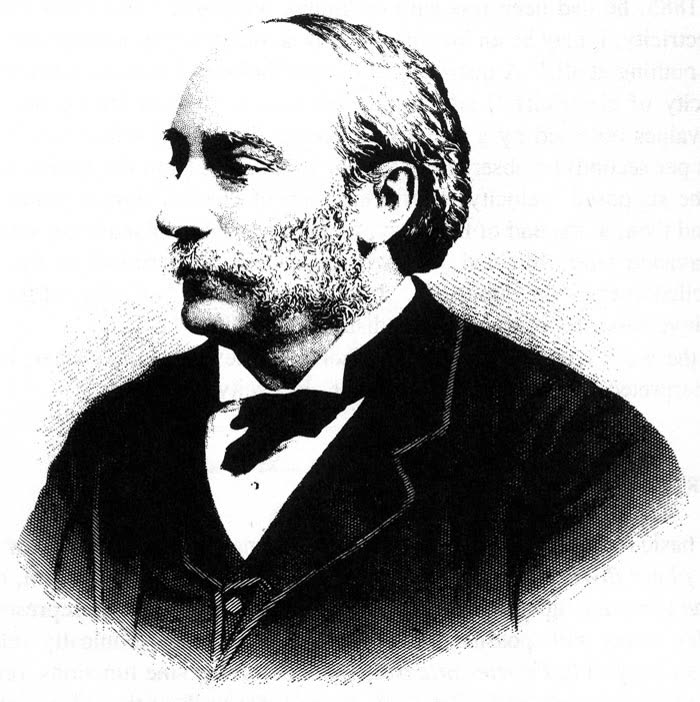
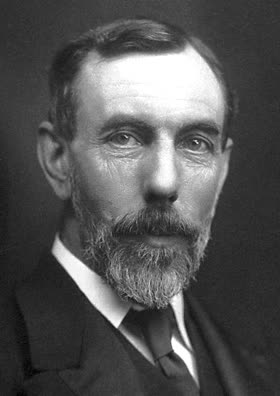
Elliott & Fry, published in 1907 in Les Prix . Public domain
Two ways of making nitrogen, weighed against each other
- The question
- Does nitrogen prepared from the atmosphere have the same density as nitrogen prepared from a compound? If not, which sample is wrong?
- The apparatus
- A glass globe of about 1.8 litres, filled at a standard temperature and pressure and weighed on a precision balance. Atmospheric nitrogen made by passing air over red-hot copper to take the oxygen, then through potash and phosphorus pentoxide. Chemical nitrogen made from ammonia, nitric oxide, nitrous oxide, ammonium nitrite and urea — five independent routes, precisely so that a contaminant peculiar to one of them could be ruled out.
Identical densities. Nitrogen is nitrogen; the whole edifice of atomic weights assumes that a pure substance is the same substance however it was prepared, and that assumption had never before been tested at this precision.
Atmospheric nitrogen came out at 2.3102 g in the globe and chemical nitrogen at 2.299 g, a ratio of 1.00487. All five chemical routes agreed with each other to within a few parts in a hundred thousand and all five disagreed with the air by the same half per cent.
How sure could they be? The discrepancy is 0.49%, against a reproducibility between samples of about 0.005%. That is a hundred-to-one signal, which is the only reason it was possible to insist that it was real rather than sloppy.
Either atmospheric nitrogen contains something heavier than nitrogen, or chemical nitrogen contains something lighter, or a pure substance is not the same substance depending on where it came from. The third possibility would have been far more damaging than the first, and it is why the measurement had to be settled rather than shelved.
William Ramsay, professor of chemistry at University College London, wrote to Rayleigh in April 1894 asking whether he might try to remove the nitrogen chemically. They agreed to work in parallel, by different methods, and to publish together. Ramsay’s method: magnesium. Red-hot magnesium combines with nitrogen to form a solid nitride. He passed atmospheric nitrogen back and forth over heated magnesium turnings for days on end, and the volume of gas fell, and fell, and then stopped falling. What was left would not react with magnesium, or with oxygen, or with hydrogen, or with chlorine, or with red-hot lithium, or with anything else he tried. Rayleigh’s method: sparking. Mix the nitrogen with excess oxygen and pass an electric spark through it over a solution of alkali; the two combine and are absorbed as nitrate. Days of sparking, and again a residue that stopped shrinking. Both residues were about one part in eighty of the original gas. Both gave the same spectrum — a set of red and green lines belonging to nothing known. And both were completely inert. They announced it at the British Association meeting in Oxford in August 1894, and named it argon, from the Greek for idle.
Then a genuine difficulty, and it is the one that decides where argon goes. A density measurement tells you the mass of whatever unit is flying around in the gas. It does not tell you the mass of an atom, because most gases fly around in pairs: nitrogen is N₂, oxygen is O₂, hydrogen is H₂. Argon’s density says its flying unit weighs about 40 on the scale where hydrogen’s atom is 1. So: if argon is diatomic, its atoms weigh 20, and it belongs between fluorine at 19 and sodium at 23 — which is already occupied territory and a disaster. If argon is monatomic, its atoms weigh 40, and it belongs between chlorine at 35.5 and potassium at 39.1 — which is a different disaster, as we will see, but a smaller one. No gas known to chemistry in 1894 was monatomic. Every one of them travelled in pairs or larger. Proposing a single-atom gas was proposing a new kind of substance, and it needed evidence that had nothing to do with the density itself.
Set the year to 1894 and there is one element in this column. Drag forward to 1900 and there are six. Tap each to see how it was found.
And now the problem that made argon look, for a while, like a refutation of the periodic table rather than an addition to it. Argon weighs 39.95. Potassium weighs 39.10. Sorted by atomic weight, argon comes after potassium — which drops an utterly inert gas into the middle of the alkali metals, the most violently reactive family in chemistry. And there was no gap for it. Mendeleev’s table had holes in it, famously, but not one of them was here. Nothing had predicted an eighth family. A brand new element that fits nowhere is a much more awkward object than a missing element that fits somewhere. Mendeleev’s response was that argon was probably not an element at all, but N₃ — a triple molecule of nitrogen, by analogy with ozone being O₃. That would explain a weight near 42 and, he suggested, the inertness. It is easy to be rude about this and it should not be. He was defending an arrangement with a serious track record against a single anomalous substance, which is exactly what you should do with a single anomalous substance. And the N₃ proposal was testable: a triatomic molecule has γ = 1.33, not 1.67. The speed of sound had already ruled it out. What actually settled it was that argon was not alone. One inert gas is an anomaly. Six inert gases, all monatomic, all with a valency of zero, sitting one below another in a clean sequence of atomic weights, is a group — with the same internal structure as every other group in the table. That is not a patch. That is the table doing what the table does. Mendeleev accepted it in 1902 and gave it a number: group zero.
The periodic table predicted the noble gases, and Rayleigh and Ramsay went and found them.
Nothing predicted them, and that is what makes this episode interesting rather than merely satisfying. Mendeleev’s table had no gap in this position, no room for an eighth family, and no reason to expect one; the discovery came from a discrepancy in a density measurement made for a completely different purpose. The table then had to be extended to accommodate a group it had not anticipated. What justifies that extension — and stops it being the kind of ad hoc repair that kept phlogiston alive for a century — is that the new column was forced by chemistry rather than invented to save appearances. Six elements, all monatomic, all with valency zero, all in weight order, each one below the last: the column has the same structure as every other column, and it was assembled from six independent discoveries by people who were not trying to fill it.
The composition of the air, from two weighings
Treat atmospheric nitrogen as a mixture of ordinary nitrogen and one heavy inert gas. Equal volumes of gas at the same temperature and pressure hold equal numbers of molecules, so the ratio of the two weighings is the ratio of the mean molar masses. What percentage of Rayleigh’s atmospheric nitrogen is argon?
- Globe filled with atmospheric nitrogen
- 2.3102 g
- Globe filled with chemical nitrogen
- 2.299 g
- Molar mass, nitrogen
- M(N₂) = 28.013 g/mol
- Molar mass, argon
- M(Ar) = 39.948 g/mol
I am much puzzled by some recent results as to the density of nitrogen, and shall be obliged if any of your chemical readers can offer suggestions as to the cause.
- 1785Cavendish sparks air over alkali and reports a residue "not more than 1/120 part of the whole". Nobody returns to it for 109 years.
- 1868A yellow line in the Sun’s chromosphere during an eclipse, belonging to no known element. Lockyer and Frankland name it helium.
- 1892Rayleigh’s letter to Nature: atmospheric nitrogen is half a per cent heavier than chemical nitrogen, and he cannot say why.
- 1894Ramsay absorbs the nitrogen with hot magnesium; Rayleigh sparks it away. Argon, announced at the British Association in August.
- 1895Ramsay heats cleveite and gets helium — the solar line, on Earth at last.
- 1898Ramsay and Travers distil liquid air: krypton on 30 May, neon in June, xenon on 12 July.
- 1900Dorn finds the gas given off by radium. It will be called radon.
- 1902Mendeleev accepts the new family and numbers it group zero.
- 1904Rayleigh takes the Nobel Prize in Physics and Ramsay the Nobel Prize in Chemistry, for the same work.