The table is ordered by charge, not weight
Fire electrons at an element, photograph the X-rays that come off, and the square root of their frequency is a straight line in a whole number. That number is the charge on the nucleus — and it fixes the three places where the table had been wrong, counts the elements that are still missing, and disposes of several that were never there.
- State Moseley’s law and say which quantity it turns out to be measuring
- Explain why the same data is a straight line against atomic number and a scatter against atomic weight
- Say what the law settled: the inversions, the count of the elements, and several false claims
- Derive an element’s atomic number from a measured X-ray wavelength
By 1912 the periodic table is the most successful organising idea chemistry has ever had, and it has three sores on it that will not heal. Argon (39.95) must come before potassium (39.10). Cobalt (58.93) must come before nickel (58.69). Tellurium (127.60) must come before iodine (126.90). In every case the heavier element goes first, and the only reason offered is that the chemistry looks wrong otherwise. That is a judgement, not a measurement, and Mendeleev’s critics were entitled to say so. And there is a worse problem, which gets less attention because it is a problem of absence rather than of contradiction. Nobody can say how many elements there are. The rare earths are the scandal. Fourteen or fifteen metals of almost identical chemistry, separable only by hundreds of repeated fractional crystallisations, each separation taking years. Through the 1880s and 1890s a steady stream of announcements of new ones arrived — didymium, decipium, philippium, mosandrum, victorium, celtium, nipponium — some of which were real, most of which were mixtures, and none of which anybody could adjudicate. There was no test. Two chemists with different samples and different opinions had no procedure that would settle it. So the state of play is: an arrangement that works, with three exceptions it cannot justify, of a list whose length is unknown.
The idea that fixes all of it comes from outside chemistry, and it arrives in two pieces. Rutherford, 1911. Alpha particles fired at gold foil mostly pass through and occasionally come straight back, which means the positive charge of an atom is concentrated in a tiny nucleus. His scattering formula depends on the nuclear charge, and the early measurements put it at roughly half the atomic weight. Van den Broek, 1911 and 1913. Antonius van den Broek was a Dutch lawyer who did physics as an amateur, and he published a short note suggesting something sharper than "roughly half". His proposal was that the charge on the nucleus is exactly the element’s ordinal position in the periodic table: hydrogen one, helium two, lithium three, and so on without exception. It was a guess. It had no direct evidence behind it, it made the atomic weight a secondary and slightly untidy quantity, and it implied that the periodic table had been sorted by the right thing for the wrong reason for forty years. What it needed was a way to measure nuclear charge on an element that did not involve chemistry at all.
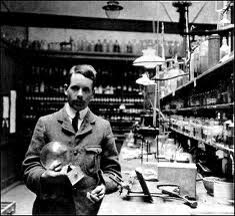
The high-frequency spectra of the elements
- The question
- Every element, bombarded with electrons, gives off X-rays with a few sharp characteristic wavelengths. Is there a regularity across the elements — and if so, is it a regularity in atomic weight or in position in the table?
- The apparatus
- A small railway. Moseley mounted up to a dozen different metal targets on a trolley running on rails inside an evacuated X-ray tube, so that each could be drawn into the electron beam in turn without breaking the vacuum. The emitted X-rays passed through a slit onto a crystal of potassium ferrocyanide, which diffracts them by wavelength, and were recorded on a photographic plate. The whole apparatus fits on a bench, and the exposures took minutes.
On van den Broek’s hypothesis, and Bohr’s brand-new model of the atom, the frequency of the strongest line should go as the square of the nuclear charge — so the square root of the frequency should be a straight line in the element’s ordinal number, with a slope fixed by the Rydberg constant and no free parameters worth the name.
A row of lines marching steadily along the plate, one element to the next, in equal steps. Plotted as √ν against ordinal number the points fall on a straight line from aluminium at 13 to gold at 79. Against atomic weight the same points scatter, and in three places double back on themselves.
How sure could they be? The root-mean-square scatter about the line, over the K series from aluminium to barium, is about 0.4% — smaller than the disagreement between contemporary determinations of most atomic weights. The residuals are not random: they run smoothly from about +2% at aluminium to about +0.6% at barium, which is the screening constant drifting rather than the measurements wandering. On copper the simple law gives 8.00 keV against a measured 8.048 keV, an error of 0.6%.
The ordinal position of an element in the periodic table is a physical quantity, measurable to an integer, and it is the charge on the nucleus. Atomic weight is demoted at a stroke from the organising principle of chemistry to a correlated quantity that mostly agrees with it. And the measurement is chemistry-free: it works on an impure sample, on an oxide, on an alloy, and it does not care what the substance does with acid.
The square root of each element’s Kα frequency, against its atomic number. Turn on the residuals to see how straight it actually is, then mark the empty slots.
The same measurements, plotted against atomic weight instead. Nothing has changed but the horizontal ruler. Look at the three places where the joined-up sequence runs backwards.
We have here a proof that there is in the atom a fundamental quantity, which increases by regular steps as we pass from one element to the next. This quantity can only be the charge on the central positive nucleus.
And now the part that turns a discovery into an instrument. Once every element has an integer, a missing integer is a missing element, and there is nothing left to argue about. No judgement call about whether a family has room for one more. No dispute about whether a sample is a new substance or a badly separated mixture. You measure the X-ray line, you get a number, and either that number is already taken or it is not. When Moseley finished, four integers between aluminium and gold had nothing on them: 43 — filled by technetium in 1937. 61 — filled by promethium in 1945. 72 — filled by hafnium in 1923. 75 — filled by rhenium in 1925. All four were eventually filled, and none of them by accident: in each case people knew precisely what they were looking for. And the same measurement answered the question chemistry had never been able to touch. From hydrogen to uranium there are exactly 92 places. Not "about ninety, depending on how you count the rare earths". Ninety-two, and the rare earths number fourteen, and that is the end of the matter.
It worked in the destructive direction too, which is how you can tell it was a real test. Georges Urbain, one of the most respected rare-earth chemists in Europe, had announced element 72 in 1911 and named it celtium. Some accepted it; some doubted it; there was no way to settle it, which was the whole problem with the rare earths. In 1914 Urbain came to Oxford with his samples, expecting Moseley’s new method to confirm him. It did not. The X-ray spectra showed nothing that was not already accounted for. What happened next is the part worth admiring. Urbain accepted it. He went home persuaded, and wrote afterwards that the X-ray method had brought to the study of the rare earths a clarity that classical chemistry could never have supplied. He had lost an element and gained a technique, and he said so in print. Element 72 turned out to be hafnium, and it is not a rare earth at all. Bohr’s theory said that 72 should be a d-block element behaving like zirconium, so Coster and Hevesy went looking in Norwegian zirconium ores in Copenhagen in 1923 and found it inside a few months — in samples that had been sitting in laboratories for a century.
Moseley discovered atomic number.
He measured it, which is a different and in this case a larger contribution. The hypothesis that an element’s ordinal position equals its nuclear charge was published by Antonius van den Broek — a Dutch lawyer doing physics in his spare time — before Moseley began, and Moseley cites him by name in the 1913 paper. Rutherford’s 1911 scattering supplied the nucleus, and Bohr’s 1913 model supplied the formula that turns a nuclear charge into an X-ray frequency. What Moseley added was the thing none of them had: a measurement, on element after element, precise enough that the integers could not be doubted. That is not a lesser achievement than the idea. An untested guess about nuclear charge was one of several available in 1913; a plate showing forty lines in equal steps ended the discussion in a single afternoon of looking at it.
Read an element off its X-ray line
Copper Kα has a wavelength of 154.06 pm — the most measured X-ray line in the world, because it is what almost every laboratory diffractometer runs on. Use Moseley’s law to find the atomic number of the element that emitted it.
- Wavelength
- 154.06 pm = 154.06 × 10⁻¹² m
- Speed of light
- c = 2.998 × 10⁸ m/s
- Rydberg frequency
- Rc = 3.2898 × 10¹⁵ Hz
- Moseley’s law, Kα
- ν = (3/4) Rc (Z − 1)²
- 1911Rutherford’s nucleus. Van den Broek suggests, in a short note, that its charge is the element’s ordinal number.
- 1912Laue diffracts X-rays through a crystal; the Braggs turn it into a measuring instrument within months.
- 1913Bohr’s model of the atom. Moseley publishes Part I: the K series from calcium to zinc, and a straight line.
- 1914Part II extends it from aluminium to gold, and names four empty slots: 43, 61, 72 and 75.
- 1914Urbain brings his celtium samples to Oxford. There is no new element in them, and he accepts it.
- 1915Moseley is killed at Suvla Bay on 10 August, aged 27.
- 1923Coster and Hevesy find hafnium in zirconium ore in Copenhagen — element 72, where Bohr’s theory said to look.
- 1925Rhenium, element 75: the last stable element to be discovered.
- 1945Promethium, element 61, separated from reactor fission products at Oak Ridge. The table is complete to uranium.