The aether problem
Every wave anyone knew of waved in something. The substance invented to carry light had two experiments behind it and a job description no material could survive.
- Explain why physicists were sure light needed a medium
- Describe the measurement that gives you the Earth’s speed from a star’s position
- List the contradictory properties the aether was required to have
Light is a wave. Maxwell showed it in 1865 and Hertz made some in a laboratory in 1887. Which leaves a question that sounds almost childish and was taken entirely seriously for two hundred years: if light is a wave, what is waving?
Every other wave anyone had ever met was a disturbance in some material. Sound is moving air — pump the air out of a jar and a bell ringing inside it falls silent, a demonstration Robert Boyle had performed in 1660 and every lecture hall repeated ever since. Ripples are moving water. Waves on a rope are moving rope. A wave was not understood as a thing in its own right; it was something a substance does.
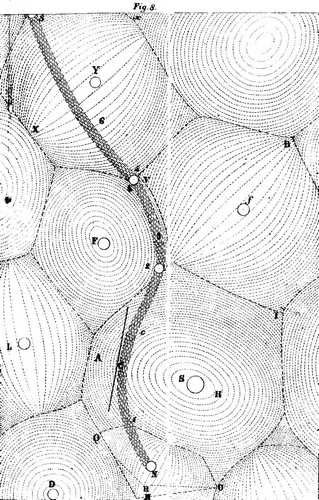
René Descartes (1596-1650), 1647. Public domain
The rain and the telescope
James Bradley was Astronomer Royal, and in 1725 he was trying to detect stellar parallax — the tiny annual wobble in a star’s position caused by the Earth moving from one side of its orbit to the other. Finding it would prove the Earth orbits the Sun. He picked γ Draconis, which passes almost directly overhead in London, and watched it for a year.
He found a wobble. But it was in the wrong direction — displaced three months out of phase from where parallax should have put it. Something was shifting the star’s apparent position, and it depended not on where the Earth was in its orbit, but on which way it was moving.
Start with the rain: change your walking speed and watch the umbrella. Then switch to starlight — the same geometry, with the numbers of the real sky.
Sit with what that measurement means. A star’s apparent position hands you the Earth’s speed through space, to three significant figures. Moving relative to what, though? Relative to whatever the light is travelling in. That is a real, repeatable, quantitative measurement of motion through the aether — and it is still taught and still used, because the effect is entirely real.
The aberration of starlight
- The question
- Does a nearby star shift its apparent position over a year, proving that the Earth orbits the Sun?
- The apparatus
- A zenith sector — a telescope over three metres long, fixed almost vertically and braced against a chimney stack, so that a star passing near the zenith could be measured with far more precision than a moveable instrument allowed. Bradley chose γ Draconis because it passes nearly overhead in southern England, which removes the errors that atmospheric refraction introduces at lower angles.
Parallax: an annual ellipse in the star’s position, peaking when the Earth is at the extremes of its orbit.
An annual ellipse of about 20 arcseconds — but three months out of phase with parallax, so it tracked the Earth’s velocity rather than its position. Bradley worked out that it was the ratio of the Earth’s speed to the speed of light.
How sure could they be? Bradley’s figure of roughly 20.2 arcseconds is within about two per cent of the modern 20.49. The stellar parallax he actually set out to find is around a hundred times smaller and was not measured by anyone until Bessel managed it in 1838.
It was the first direct evidence that the Earth moves, and it gave the speed. It also gave the aether its best experimental footing: aberration works precisely if the Earth travels freely through a medium that stays still, which is exactly the picture Michelson and Morley would set out to confirm.
Light in moving water
The second piece of evidence came from Hippolyte Fizeau, who two years earlier had made the first terrestrial measurement of the speed of light with a spinning toothed wheel and a mirror eight kilometres away. In 1851 he asked a sharper question: if light travels through moving water, does the water carry it along?
The answer was: partly. Roughly 43 per cent of the water’s speed was added to the light — not all of it, not none of it, but a specific fraction. And that fraction was exactly what Fresnel had predicted decades earlier, from the assumption that a transparent body drags only the aether inside it, in proportion to how much it slows light down.
Light through moving water
- The question
- Does a moving transparent medium drag light along with it, and if so by how much?
- The apparatus
- A beam of light split in two and sent down a pair of tubes of flowing water — one beam with the current, one against — then recombined into interference fringes. Reversing the flow reverses the effect, so the shift could be doubled and measured against itself rather than against a fixed reference.
Fresnel’s partial drag: the water should add a fraction 1 − 1/n² of its own speed to the light. For water, that fraction is about 0.43.
A fringe shift consistent with a drag coefficient close to Fresnel’s prediction. Michelson and Morley themselves repeated the experiment with a better instrument in 1886 and confirmed it more precisely.
How sure could they be? Fizeau’s own figures were rough and he was careful about saying so. The 1886 repetition was the convincing one — and it was performed by the same two men who, the following year, would fail to find the aether wind.
It looked like a direct confirmation of aether theory. In fact it is a relativistic velocity-addition result in disguise: Einstein’s formula reproduces Fresnel’s coefficient exactly, without any aether at all. For half a century the right answer was being read as evidence for the wrong theory.
The job description
So the aether was doing well on the evidence. The trouble was what it had to be made of. Light is a transverse wave — it oscillates sideways to its direction of travel — and transverse waves do not propagate through fluids. Only solids resist shearing. So the aether had to be a solid.
And not merely a solid. Wave speed in a solid goes as the square root of its rigidity over its density, so to carry a wave at 300,000 km/s the aether had to be more rigid than steel. All of the following also had to be true at once:
The aether was a vague hand-wave that nobody took seriously enough to specify.
The opposite. It was specified in painful detail, and the specification was the problem. It had to be more rigid than steel, yet offer zero resistance to planets that have ploughed through it for billions of years. It had to be massless, or it would gravitate. It had to fill every vacuum, including a sealed evacuated jar. And it had to be completely undetectable by any means other than light. Kelvin, Stokes, Maxwell and others spent decades building mechanical models of it, and none of them worked.
Worse, the two successful experiments pulled in opposite directions. Bradley’s aberration only comes out right if the Earth moves freely through an aether that stays put — no dragging at all. But an undragged aether should produce a detectable wind at the Earth’s surface, and nobody had found one. George Gabriel Stokes proposed the alternative, that the Earth drags its local aether along with it. That removes the wind — and destroys the explanation of aberration.
Pirou, Eugène (1841-1909). Fonction indéterminée, 1883. Public domain
Teresa Stokes, 2012-11-27 04:58. CC BY-SA 2.0
So go and measure it
By the 1880s the sensible next step was obvious to everybody. If the Earth ploughs through a stationary aether at 30 km/s, there is a wind. Winds can be measured. The effect would be tiny — it goes as the square of the Earth’s speed over the speed of light, one part in a hundred million — but instruments were getting very good.
- 1644Descartes fills space with vortices of subtle matter.
- 1690Huygens proposes that light is a wave, and needs a medium to be a wave in.
- 1729Bradley announces aberration: the Earth’s speed, read off a star.
- 1801Young’s interference experiment settles that light really is a wave, against Newton’s authority.
- 1818Fresnel works out partial aether drag, and predicts the coefficient.
- 1845Stokes proposes a fully dragged aether instead — no wind, but no aberration either.
- 1851Fizeau measures the drag in flowing water and finds Fresnel was right.
- 1886Michelson and Morley repeat Fizeau’s experiment and confirm it more precisely.
- 1887The same two men go looking for the wind.