Light is an electromagnetic wave
Maxwell worked out the speed of his waves from two bench measurements and got the speed of light. Twenty-three years later, Hertz made some.
- Explain how Maxwell concluded that light is electromagnetic without doing an optical experiment
- Describe how Hertz produced and detected waves nobody could see
- Say how measuring a distance in a room gives you the speed of light
By the middle of the nineteenth century, electricity and magnetism were known to be connected. Move a magnet near a coil and current flows. Send current through a wire and a compass needle swings. Faraday had spent decades mapping these effects and had become convinced that the space around a magnet was itself doing something — that it was filled with what he called lines of force.
James Clerk Maxwell put Faraday’s picture into mathematics, and the mathematics said something nobody had gone looking for. A changing electric field produces a magnetic field. A changing magnetic field produces an electric field. So a disturbance in one can hand itself to the other and back again indefinitely, moving away from wherever it began. Not carried by anything. Just moving.
Then Maxwell asked how fast such a disturbance would travel, and this is where it becomes remarkable. The answer depended on two constants that describe how strongly electric and magnetic effects act — both of which had already been measured on a laboratory bench, by Weber and Kohlrausch, using batteries, coils and a torsion balance. No light was involved anywhere in that measurement.
This velocity is so nearly that of light, that it seems we have strong reason to conclude that light itself (including radiant heat, and other radiations if any) is an electromagnetic disturbance in the form of waves propagated through the electromagnetic field according to electromagnetic laws.
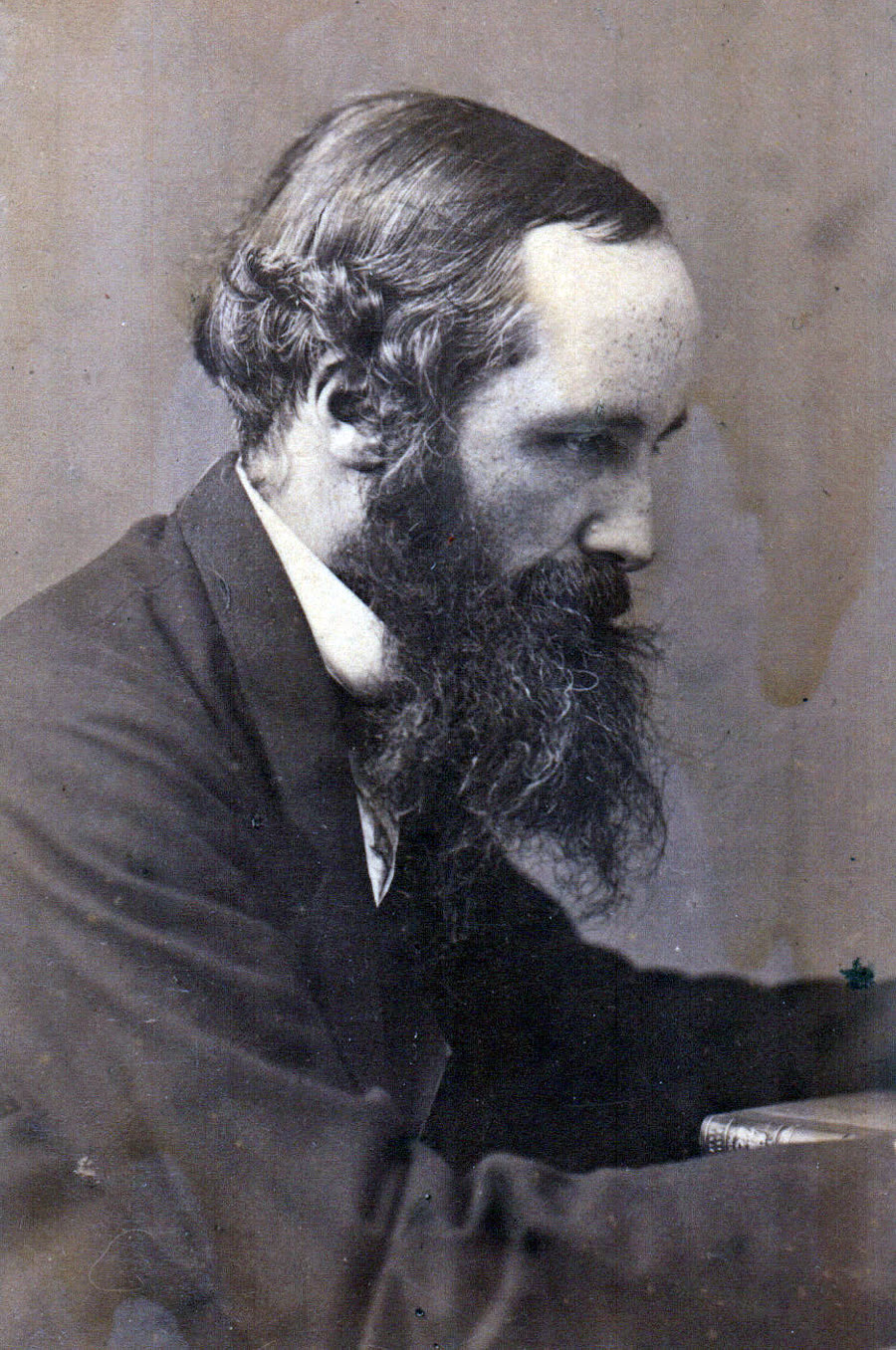
Unidentified photographer. Smithsonian Institution from United States, before 1879. Public domain
Making one
The person who settled it was Heinrich Hertz, a 29-year-old professor at Karlsruhe, in 1886. His apparatus was almost comically plain: an induction coil to build up a high voltage, two metal balls separated by a small air gap, and a spark.
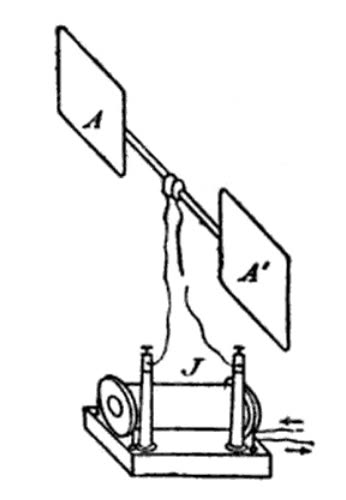
Original image: Heinrich Hertz Derived image: Chetvorno, 1888. Public domain
The detector was simpler still: a loop of wire with a tiny gap in it. No battery. Connected to nothing. Hertz put it on the far side of the room, turned out the lights, and watched the gap through a magnifying glass.
The transmitter is on the left, the detector loop on its track. Press Walk the detector and watch the little spark at the bottom of the loop.
That alone was the result: invisible waves, predicted from equations about coils and batteries, produced and caught on a bench. But a sceptic could still object that something else was going on — induction, perhaps, reaching across the room. What Hertz did next removed that escape.
Weighing light with a metre rule
He leaned a sheet of zinc against the far wall. The waves reflect from it and travel back through the ones still arriving. Where a crest meets a trough the two cancel exactly, and at those places the field stays zero no matter what the transmitter does. Those dead spots do not move, and they sit half a wavelength apart.
The zinc sheet is now in place. Walk the detector along the room again — and this time notice that the spark does not just fade, it dies completely at certain spots and comes back.
Hertz’s own speed measurements were messier than this makes them sound. His first attempts gave one answer for waves guided along wires and a different one for waves in open air, and the discrepancy took several years and other people’s work to resolve — it turned out to be an artefact of his apparatus resonating at more than one frequency. The conclusion survived the mess intact.
Hertz’s electric wave experiments
- The question
- Do Maxwell’s predicted electromagnetic waves actually exist, and if so do they behave like light?
- The apparatus
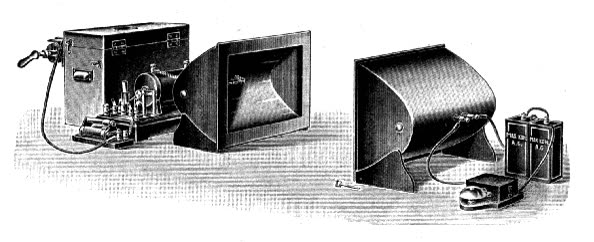
- A spark-gap oscillator: an induction coil charging two conductors separated by a small gap, so that each spark set charge oscillating at tens of megahertz. The detector was an unpowered loop of wire with a micrometre gap, observed in a darkened room. A zinc sheet provided a reflector; a prism cut from pitch, and a grid of parallel wires, tested refraction and polarisation.
From Maxwell: radiation travelling at the speed of light, reflecting, refracting and polarising exactly as light does.
A visible spark in the detector gap across the room with nothing connecting the two. Standing waves against the zinc sheet with nodes half a wavelength apart, giving a propagation speed matching light’s. Reflection from metal, refraction through pitch, and polarisation by a wire grid — all confirmed.
How sure could they be? The detector spark was a few hundredths of a millimetre long and had to be viewed in a darkened room, which is why the experiment took years rather than an afternoon. Hertz’s early speed figures were internally inconsistent — waves on wires appeared to travel faster than waves in air — and it took until the 1890s for that to be traced to unwanted resonances rather than to physics.
Maxwell’s fields stopped being a mathematical convenience and became something you could make, catch and measure. It also opened a question the next fifteen years could not answer: these waves cross empty space, and every other wave anyone knew of needed a medium. What were they waving in?
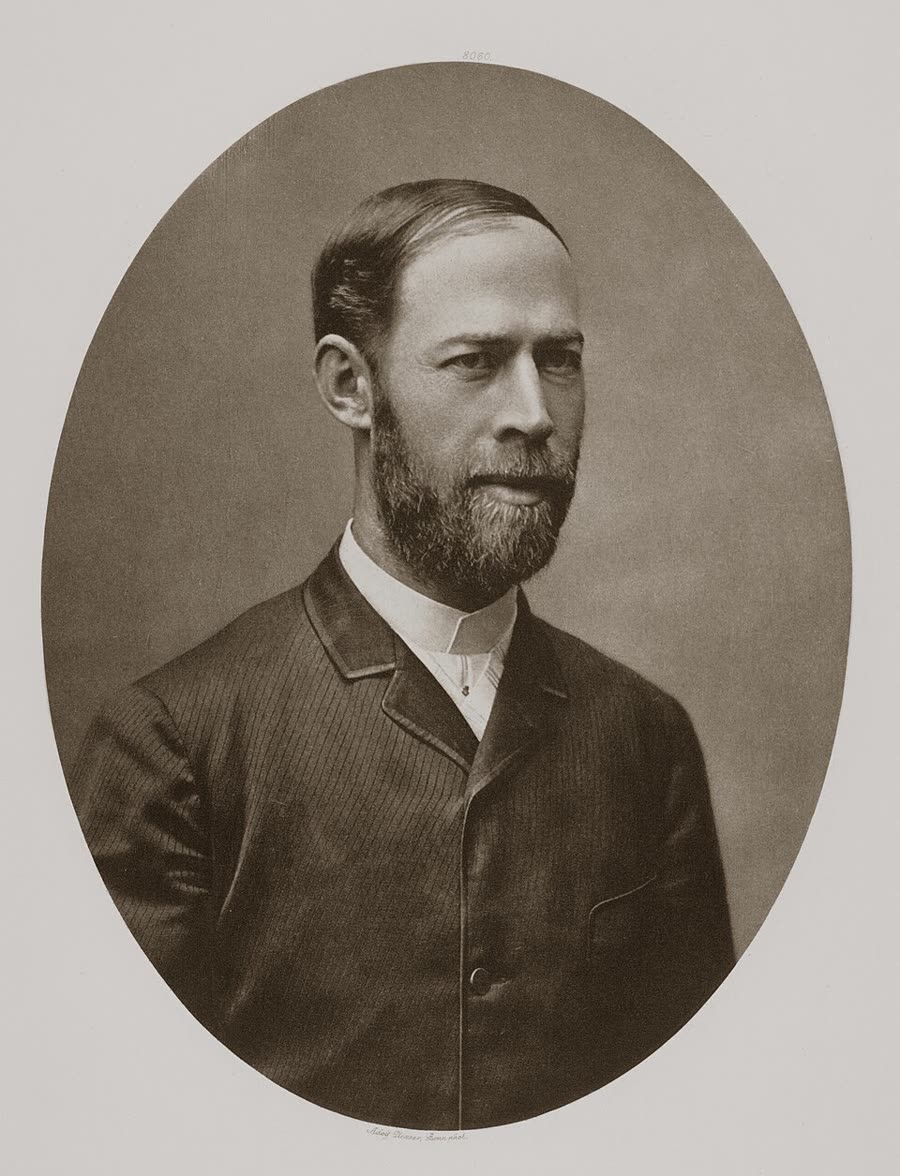
Robert Krewaldt, Kaiserplatz 16, Bonn, circa 1890. Public domain
It’s of no use whatsoever. This is just an experiment that proves Maestro Maxwell was right — we just have these mysterious electromagnetic waves that we cannot see with the naked eye. But they are there.
Pressed on what would come of it, he is said to have answered: "Nothing, I guess." Within nine years Marconi was signalling over a mile with the same physics. Within fifteen, across the Atlantic. Hertz saw none of it. The unit of frequency carries his name, which means that every time you read off a number in hertz you are using the notation of a man who thought he had proved a point and nothing more.
The spark travels across the room and sets off the detector.
Nothing material crosses the room at all. The spark shakes the electromagnetic field where the transmitter is; that disturbance propagates; and the field where the detector sits pushes charge around the loop hard enough to jump its gap. The field is the thing doing the travelling — and it was already there before anyone lit a spark.
- 1831Faraday discovers induction and starts talking about lines of force, to general scepticism about whether space can carry anything.
- 1856Weber and Kohlrausch measure the ratio of electrical units — the number that will turn out to be the speed of light.
- 1865Maxwell publishes the field equations and identifies light as an electromagnetic wave.
- 1879Maxwell dies at forty-eight, with the prediction untested.
- 1887Hertz detects the waves across his laboratory — the same year Michelson and Morley go looking for the medium they travel in.
- 1888Hertz measures their wavelength with standing waves and demonstrates reflection, refraction and polarisation.
- 1894Hertz dies at thirty-six.
- 1901Marconi sends a signal across the Atlantic.