Fields, not forces
A bookbinder’s apprentice with no mathematics had the idea the whole of modern physics is built on: the space in between is doing something.
- Say what a field is, and why it is different from a force acting at a distance
- Describe the experiment that showed a changing magnetic field makes electricity
- Explain why Faraday’s lines of force were dismissed, and why he was right
Start with a problem nobody in 1700 could solve. The Sun pulls on the Earth across 150 million kilometres of nothing at all. Newton gave the world an equation for exactly how strong that pull is — one of the most successful equations ever written — and was entirely honest that he had no idea what does the pulling. "I frame no hypotheses," he wrote, and left it there.
For a century and a half the accepted answer was to stop asking. Gravity acts at a distance. Electric charges act at a distance. The space in between is empty and has nothing to do with it. It worked, the mathematics was elegant, and remarkably few people were troubled by it.
Michael Faraday was troubled. He had left school at thirteen and been apprenticed to a London bookbinder — which turned out to be an excellent physics education, because he read the books before he bound them. He had almost no mathematics; he never learned calculus. What he had instead was an unusual stubbornness about pictures.
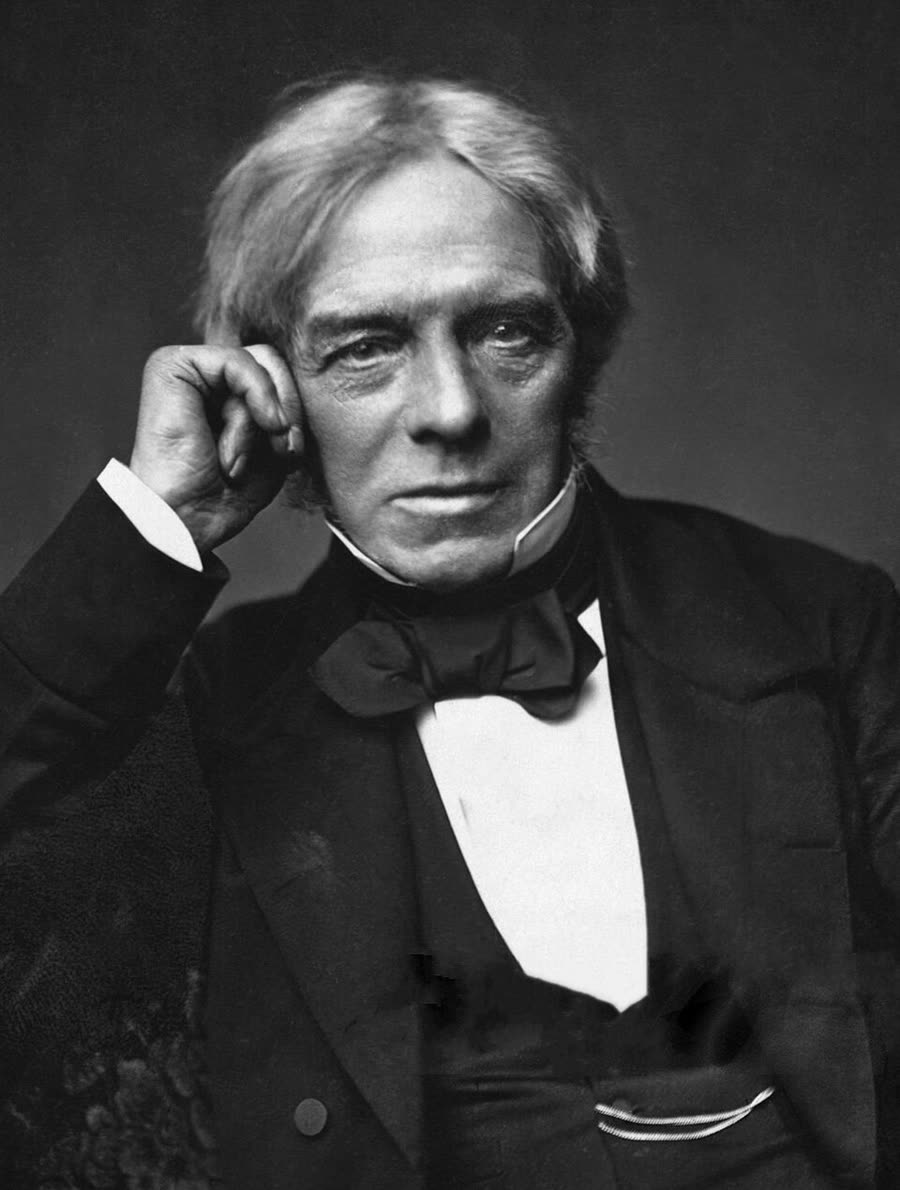
Michael Faraday, 1852-01-01. CC BY-SA 4.0
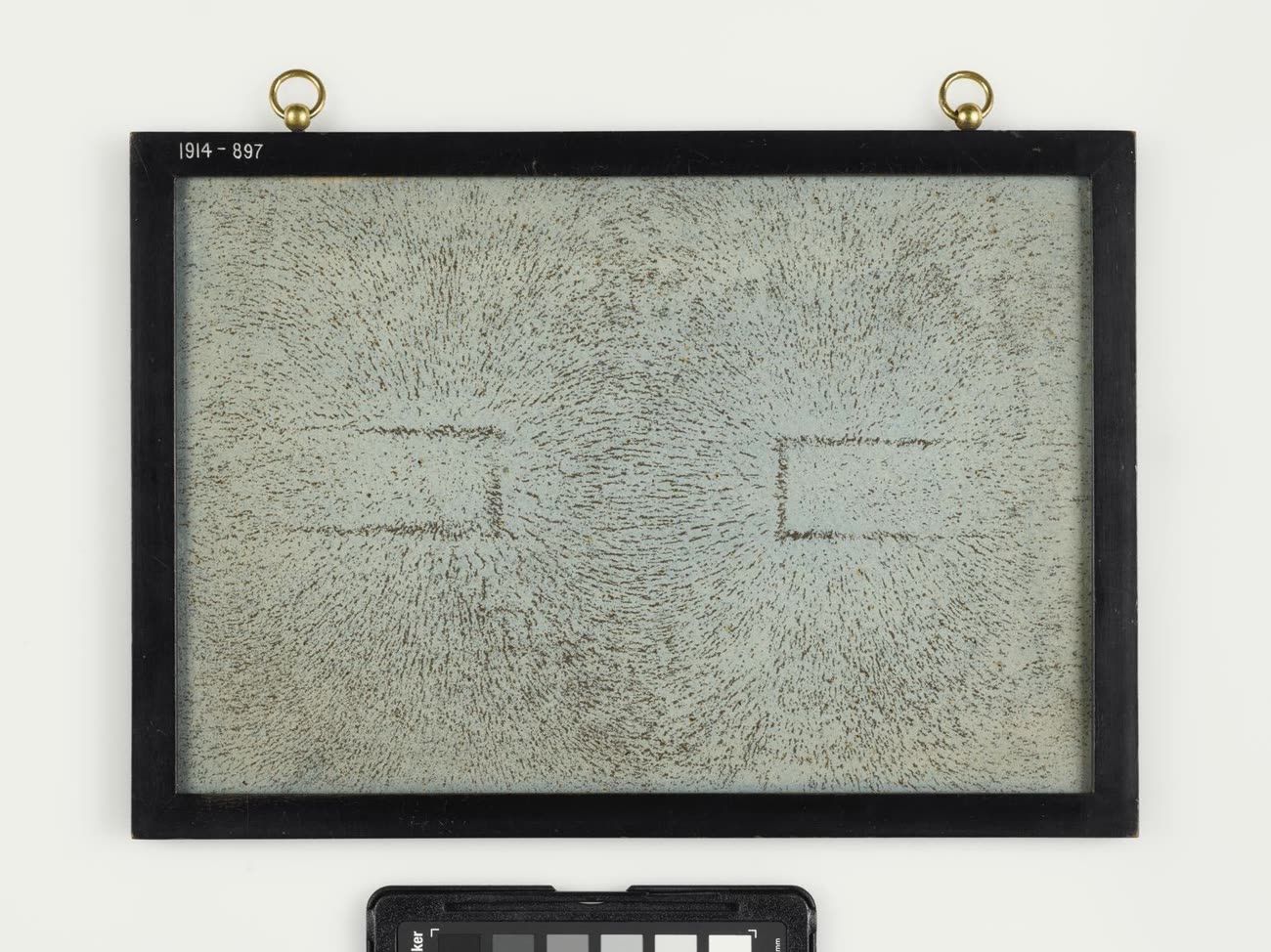
Drag the compass anywhere. Then scatter the filings — each one is a tiny compass doing the same thing — and try adding a second magnet.
Field lines are a drawing convention — a way of sketching which direction a force points.
That is how they were received, and it is why Faraday was patronised for thirty years. But a field is not a summary of forces between distant objects. It is a physical condition of space with its own energy, its own dynamics, and — as the next lesson shows — its own waves that travel at a finite speed. You can put energy into a field, walk away, and the energy stays there in transit.
The mathematicians found this embarrassing. Lines of force were a crutch for a man who could not handle equations. The serious Continental physicists — Ampère, Weber, Neumann — calculated forces directly between distant currents, got the right answers, and imagined nothing at all filling the space between them. On the arithmetic, they were doing fine.
The experiment
Faraday’s picture let him ask a question the equations did not suggest. Ørsted had shown in 1820 that a current produces a magnetic field. If the field is a real thing filling space, the reverse ought to be possible: a magnetic field should be able to produce a current. Faraday tried for ten years and failed. He is said to have carried a coil of wire in his pocket throughout, in case an idea arrived.
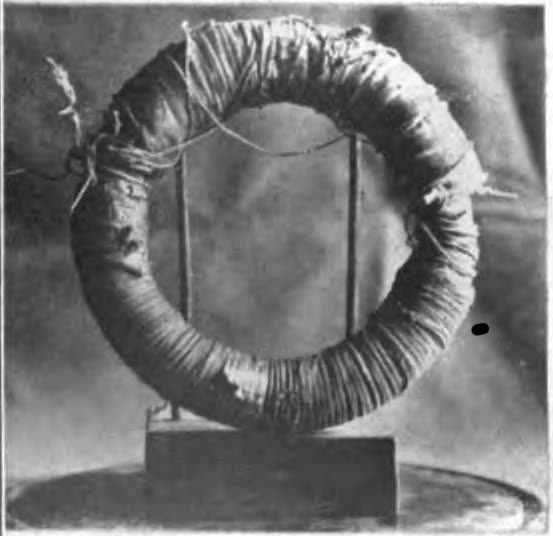
1922. Public domain
Press Make the circuit and watch the galvanometer on the right. Then keep watching it for a few seconds while the current keeps flowing — and read the strip chart at the bottom.
The induction ring
- The question
- If an electric current creates a magnetic field, can a magnetic field be made to create an electric current?
- The apparatus
- A soft iron ring about six inches across, with two separate coils of insulated copper wire wound on opposite sides — no electrical connection between them. One coil could be connected to a battery through a switch; the other led only to a galvanometer, a compass needle placed near a wire to reveal any current.
Faraday’s own expectation, after ten years of failed attempts, was that a steady current in the first coil should produce a steady current in the second. That is what he had been looking for since 1821.
Nothing at all while current flowed steadily. But at the instant of connecting the battery the galvanometer needle swung, then settled back to zero — and at the instant of disconnecting it swung the other way. The effect existed only during change.
How sure could they be? The galvanometer was a compass needle, read by eye. Faraday had no way to measure the size of the effect properly, which is part of why he described it in language and pictures rather than numbers. Within weeks he had also produced continuous current by rotating a copper disc between magnet poles — the first dynamo.
Electricity and magnetism stopped being two subjects. More importantly for everything that follows: the two coils never touched, so whatever carried the effect between them was the magnetic field in the iron and the space around it. The field had stopped being a bookkeeping device and become the thing that does the work.
That last point is the one worth sitting with. The two coils are not connected. Nothing material passes between them. What passes is a change in the magnetic field threading the iron — and the field takes time to build, stores energy while it does, and gives that energy back when it collapses. It is not a summary of what distant objects do to each other. It is a thing.
The sealed note
In March 1832 Faraday deposited a sealed note at the Royal Society, to be opened later, establishing priority for an idea he could not yet test. He guessed that magnetic influence does not act instantaneously but spreads outward like ripples on disturbed water, taking time to travel — and that light was probably the same kind of thing.
I am inclined to compare the diffusion of magnetic forces from a magnetic pole, to the vibrations upon the surface of disturbed water… I think it likely that I shall be able to make out a case of the vibratory theory as applied to these phenomena, as it is applied to sound, and most probably to light.
He had no mathematics for any of it. He was right about all of it. Thirty years later a young Scot read Faraday’s papers and set out to translate the lines of force into equations — and found, to his own surprise, that they were already rigorous.
Faraday, in his mind’s eye, saw lines of force traversing all space where the mathematicians saw centres of force attracting at a distance: Faraday saw a medium where they saw nothing but distance.
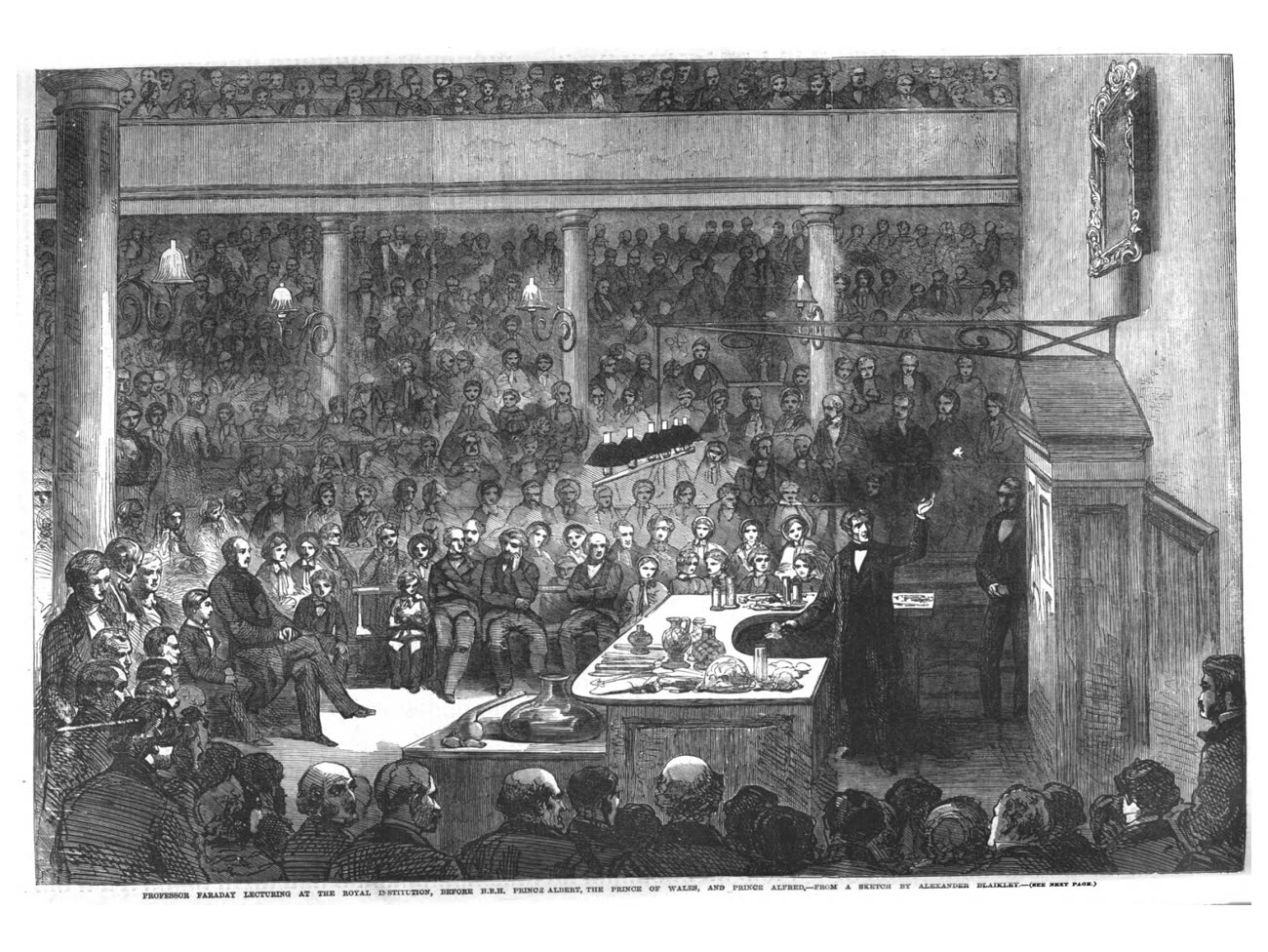
- 1791Born in Newington Butts, south London, the son of a blacksmith.
- 1805Apprenticed to a bookbinder at fourteen, and starts reading the stock.
- 1813Takes a job washing bottles for Humphry Davy at the Royal Institution.
- 1820Ørsted finds that a current deflects a compass needle. Electricity and magnetism are connected.
- 1821Faraday builds the first device to turn electricity into continuous motion — the ancestor of the electric motor.
- 1831Induction, on 29 August. The dynamo follows within two months.
- 1832The sealed note: magnetic influence propagates, and light may be the same thing.
- 1845Shows that a magnetic field rotates the polarisation of light — the first direct link between magnetism and light.
- 1873Maxwell publishes the Treatise, six years after Faraday’s death, and credits him throughout.