Spacetime and light cones
Four lessons of things that depend on who is looking, and then one quantity that does not. Minkowski turned the whole theory into geometry, and the geometry has a minus sign in it.
- State the invariant interval and say what makes it different from a distance
- Sort a pair of events into timelike, lightlike or spacelike, and say what each means for cause and effect
- Explain why the twin paradox is a statement about path length, and why straight lines are the longest
Four lessons in a row have taken something away. Simultaneity went first, then duration, then length, then mass — each one turning out to depend on who was doing the measuring. That is a great deal of demolition, and it earns a fair question: if everything is relative, is anything real? Is there one number that every observer agrees on, no matter how they are moving? There is exactly one. Getting hold of it turns special relativity from a list of strange effects into a single piece of geometry.
Start somewhere familiar. Two towns on a map. You measure that one is 30 km north of the other and 40 km east. I turn my map a few degrees before measuring and get 48 km north and 14 km east. Neither of us has made a mistake. North and east are not properties of the towns — they are properties of the grid we chose to lay over them. But we agree on something. You compute √(30² + 40²) = 50 km. I compute √(48² + 14²) = 50 km. The distance survives the rotation. It is the thing about the towns that does not depend on how we set up our axes.
Drag the event, then boost the frame and watch s² refuse to move.
The analogy with the map is close, but it breaks in one place, and the break is the whole physics. On a map you add the squares. In spacetime you subtract them. That single minus sign is what stops spacetime from being four-dimensional space with a clock bolted on the side. It is why the curves of constant interval are hyperbolas rather than circles — and hyperbolas run off to infinity, which is why boosting can carry an event arbitrarily far away while its interval never budges. It is also why time is not simply a fourth direction. You can turn around in space. You cannot turn around in time, and the minus sign is where that asymmetry lives.
Because everyone agrees on s², everyone agrees on its sign. And the sign sorts every pair of events into three kinds that no observer can argue about. Timelike (s² > 0). There is more time between the events than there is distance to cover, so something travelling below light speed can get from one to the other. These events can be cause and effect. The square root of s², divided by c, is the proper time — what a clock carried along the journey reads. Lightlike (s² = 0). Exactly a light ray joins them. The interval is zero, which means light travels no spacetime interval at all. Spacelike (s² < 0). Too far apart for anything, even light, to cross in the time available. Neither event can influence the other, and — only for these — different observers genuinely disagree about which happened first. The square root of −s² is the proper distance: the separation measured by the one observer who finds them simultaneous.
Which leaves the region off to the sides of the cone. Those events are not in your future and not in your past. The standard name for it is elsewhere, and it is not a small place. Everything happening on the Sun right now — in the loose sense you would normally mean — is elsewhere to you. Eight minutes of solar history is sitting in a region you can neither observe nor affect. There is no fact of the matter about what is happening there now; there is only a fact about what you will be able to see, and when. As you read this, roughly 99.99…% of the universe is in your elsewhere.
Do photons from a fast source travel faster?
- The question
- The whole geometry rests on the light cone being the same for every observer — those 45° lines must not tilt when the source moves. So: does light emitted by a source moving at almost c travel faster than light from a source at rest?
- The apparatus
- A proton beam produced neutral pions travelling at 0.99975c. Those pions decay almost immediately into pairs of gamma rays. The gamma rays were timed over a flight path of about 31 metres using scintillation counters and the accelerator’s own radio-frequency structure as the clock — effectively a stopwatch on light emitted by the fastest-moving source anyone could arrange.
Under an emission theory, where light picks up the speed of its source, these gammas should arrive at nearly 2c. Under relativity they should arrive at c, exactly as if the pion had been sitting still.
The gamma rays travelled at (2.9977 ± 0.0004) × 10⁸ m/s — indistinguishable from c, and nowhere near 2c. Expressed as the emission-theory parameter k, the result was k = (−3 ± 13) × 10⁻⁵, consistent with zero.
How sure could they be? About one part in 10,000 on the speed. It is the cleanest form of the test because the source speed is so extreme: any dependence on source motion would have shown up multiplied by 0.99975 rather than by the Earth’s orbital crawl.
This is the light cone measured directly. A source moving at 99.975% of light speed emits light that travels at exactly c, so the 45° lines really are the same for everybody. Every other statement in this lesson — the invariant interval, the three kinds of separation, the protection of causality — is built on that cone being frame-independent, and here it is, checked against a moving source at close to the theoretical maximum.
Spacetime is a fabric — a physical sheet that things sit on and stretch.
Spacetime is not a substance and nothing is embedded in it. In special relativity it is a bookkeeping system for labelling events, which happens to carry a geometry — a rule for computing the interval between any two of them. The geometry is entirely real and testable. The sheet is a drawing aid, and it belongs to general relativity, where even then it illustrates curvature rather than describing a material. Nobody has ever measured the tension in spacetime, because there is not any.
Now go back to the twins. We resolved that paradox by pointing at who turned around, which is correct but feels like a technicality. The geometry says it properly. The interval along a worldline is the time a clock carried along that line reads. So the total time a traveller experiences is nothing more than the length of their path through spacetime — the twin paradox is a question about path length, exactly like asking which of two roads between two cities is longer. And here the minus sign turns your instincts inside out. In ordinary geometry the straight line between two points is the shortest path. In spacetime, between two timelike-separated events, the straight line is the longest. The stay-at-home twin travels the straight worldline and therefore ages the most. Every detour is a shortcut through time — and you pay for it in years.
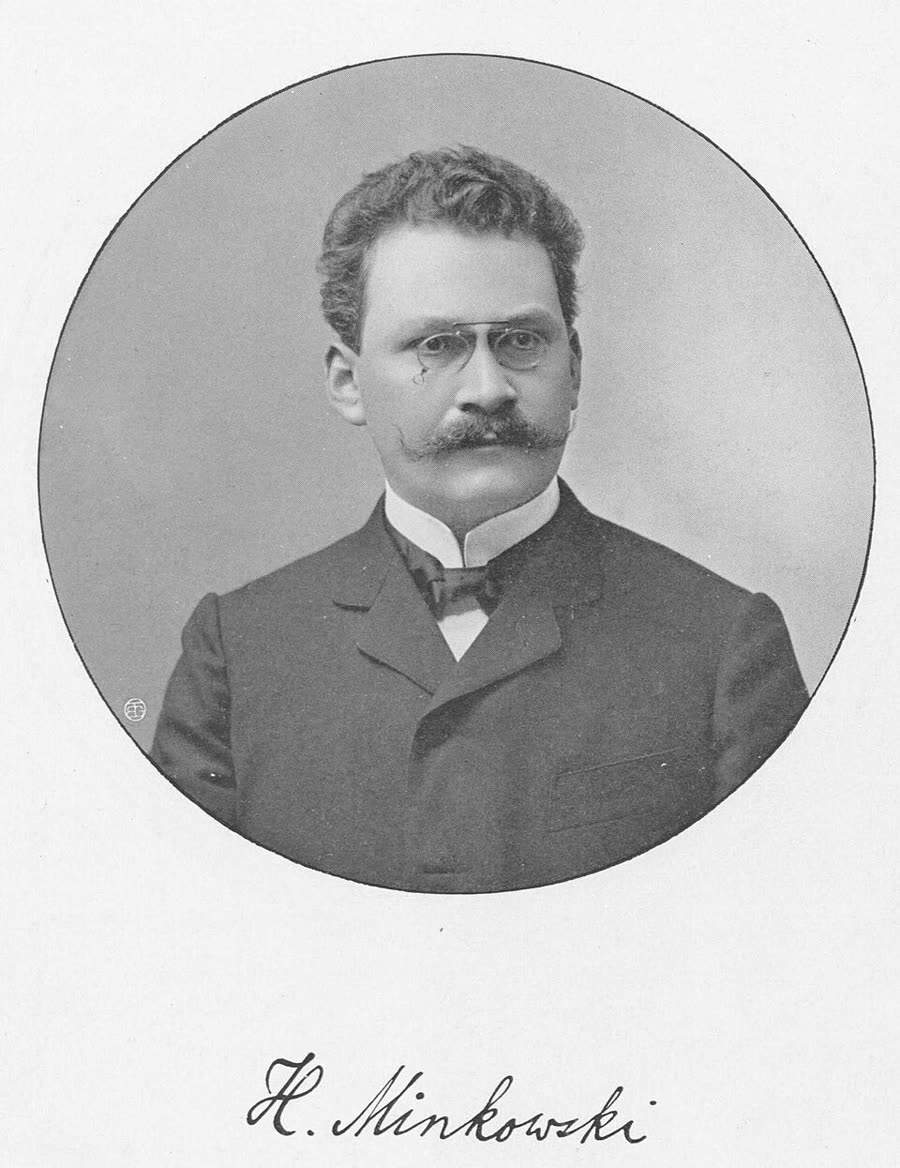
The views of space and time which I wish to lay before you have sprung from the soil of experimental physics, and therein lies their strength. They are radical.
- 1905Einstein publishes special relativity as a set of rules for transforming coordinates.
- 1907Minkowski begins recasting it geometrically in lectures at Göttingen.
- 1908The Cologne address: space and time separately are "doomed to fade away". The interval and the light cone arrive.
- 1909Minkowski dies at forty-four, months after the address.
- 1915Einstein builds general relativity on Minkowski’s geometry, having spent years calling it unnecessary.
- 1964Alväger and colleagues time gamma rays from pions moving at 0.99975c. The light cone does not tilt.