E = mc²
A three-page afterthought to the relativity paper, which turned out to say where the Sun gets its light and what most of your mass actually is.
- Explain what is genuinely new in E = mc² — that a body at rest already has energy
- Say why nothing with mass can reach the speed of light, in terms of energy rather than rules
- Describe the experiment that first checked the equation, and what it measured
Three months after the relativity paper, Einstein sent the same journal a follow-up of about three pages. It contains no experiment, no apparatus and barely any mathematics, and its title is a question: "Does the inertia of a body depend upon its energy content?" The answer is yes, and the paper is the shortest famous document in physics.
The argument fits in a paragraph. Take a body at rest and let it emit two flashes of light in exactly opposite directions, so that momentum balances and the body stays put. Now describe the same event from a frame gliding past. The Doppler shift changes the energies of the two flashes unequally, and insisting that energy is conserved in both accounts forces a conclusion: the body’s mass has decreased, by the energy it radiated divided by c².
The mass of a body is a measure of its energy content; if the energy changes by L, the mass changes in the same sense by L/9 × 10²⁰… It is not impossible that with bodies whose energy content is variable to a high degree (e.g. with radium salts) the theory may be successfully put to the test.
The amount is absurd. c² is 9 × 10¹⁶ in metres and seconds, so one gram of anything at all carries about 90 terajoules — in the region of a couple of kilotons of TNT. There is nothing exotic about the material; the energy is in your coffee cup and your desk. It is simply extraordinarily hard to get at, because almost nothing releases more than a whisper of it.
In a nuclear reaction, matter is converted into energy — one substance becomes another.
Nothing is transmuted. Mass is a form of energy: the energy a system has when it is not going anywhere. In a nuclear reaction the products have less rest mass than the reactants, and the difference appears as kinetic energy of the fragments. Weigh the whole sealed system afterwards, including all the heat and light, and the total is unchanged. The books simply balance in a currency nobody had noticed.
Why nothing reaches c
Pour energy into a particle and watch two markers: what relativity says, and what Newton’s ½mv² says. Slide from the bottom of the range to the top, and try the LHC proton button.
Twenty-seven years later
Einstein had no way to test any of it, and said so in the paper — suggesting that radium salts might one day allow a check. The check came in 1932, from two men in Cambridge building the first machine deliberately designed to smash a nucleus apart.
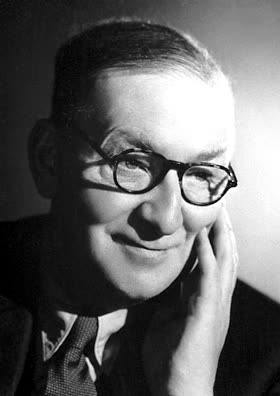
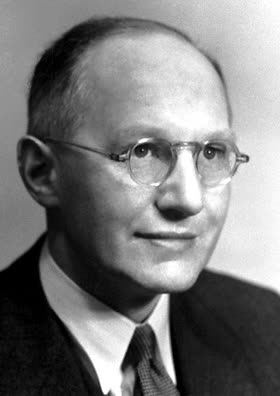
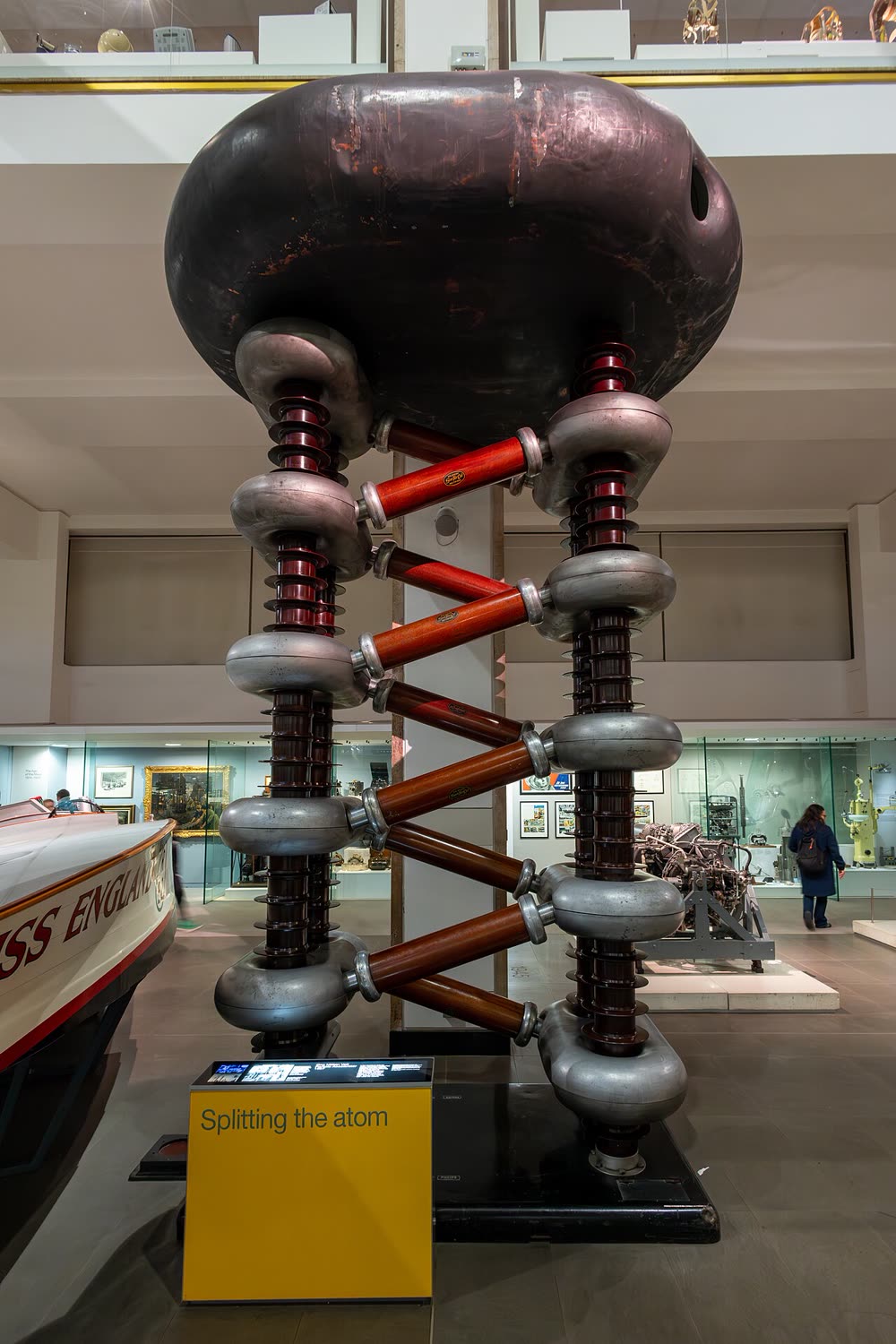
Splitting lithium
- The question
- If a nucleus is broken apart, does the energy released match the mass that goes missing, at exactly c² per kilogram?
- The apparatus
- A voltage multiplier of their own design producing several hundred kilovolts, accelerating protons down an evacuated tube onto a lithium target. The products were detected as scintillations on a zinc sulphide screen, watched by eye in a darkened hut, with the observer’s eyes dark-adapted for half an hour first.
From the known atomic masses, ⁷Li + ¹H → 2 ⁴He should lose about 0.0186 atomic mass units. Multiplied by c², that is about 17.3 MeV, and the two alpha particles should share it — roughly 8.6 MeV each, flying apart back to back.
Scintillations in coincidence on opposite sides of the target, from alpha particles of about 8.6 MeV each. The energy released matched the missing mass to within the precision of the mass measurements available.
How sure could they be? Limited mainly by how well the atomic masses were then known, a few parts in a thousand. Later repetitions have confirmed the relation to better than one part in a million; a 2005 measurement using nuclear binding energies and Penning traps tested it to about four parts in ten million.
The first direct experimental confirmation of E = mc², and an unusually clean one: a weighing on one side, a measurement of motion on the other, and c² in between. It was also the first nuclear disintegration produced by artificially accelerated particles — the beginning of accelerator physics.
Where it shows up
The consequence everybody knows is the Sun. Around 600 million tonnes of hydrogen fuse into helium every second, and the helium is about four million tonnes lighter. Those four million tonnes, times c², are the sunlight — including the fraction that reaches your skin. The Sun has been running this way for four and a half billion years and has consumed roughly a hundredth of one per cent of itself.
- 1905Einstein, September: three pages, and the suggestion that radium might test it.
- 1907He generalises the argument and starts calling rest energy a property of all matter.
- 1932Cockcroft and Walton split lithium and check the sum.
- 1938Bethe works out the fusion cycles that power the Sun.
- 1945The equation acquires a reputation it has never lost, for a weapon Einstein did not build and later regretted encouraging.
- 2005A direct test using Penning-trap mass measurements confirms it to four parts in 10⁷.