Length contraction
Measuring how long something is means noting where both ends are at the same moment — and that is the one thing you have just lost.
- Explain why length contraction follows from the relativity of simultaneity
- Resolve the pole-and-barn paradox by looking at the order of four events
- Say why nobody has ever directly photographed a contracted object, and where it matters anyway
How long is a moving object? It sounds like a question with an obvious method: note where the front is, note where the back is, subtract. But there is a hidden word in that recipe, and after the last two lessons it should be setting off alarms.
So two observers measuring the same rod are not performing the same operation. They are marking two different pairs of events. There is no reason for them to agree, and they do not: a moving object is shorter along its direction of travel, by the same factor γ.
The same γ again — time stretched by it, length divided by it. And only the direction of motion is affected: a rod carried sideways is unchanged. That asymmetry is a clue, because it is only along the direction of travel that the simultaneity disagreement has any purchase.
The pole and the barn
Now the puzzle that makes this feel impossible. Take a pole 20 metres long and a barn 12 metres long with a door at each end. Run the pole through the barn at 0.9c, and arrange for both doors to slam shut for an instant as it passes.
Watch it first in the barn’s frame, where the pole is contracted and fits. Then press Switch to the pole’s frame — and this time watch the numbered list of events underneath, not just the picture.
So does it fit or not? This is not a matter of appearances. Slam both doors and you either have a pole inside a closed barn or you have a wrecked barn, and which of those happened cannot possibly depend on who was watching.
There is the resolution. "Shut both doors at once" is not a frame-independent instruction. In the pole’s frame the far door shuts and reopens before the near door shuts at all — so the pole is never enclosed, and nothing is ever crushed. The two frames agree completely about everything that actually happens: a pole goes in one end and comes out the other, undamaged. They disagree only about the labels "at the same time" and "inside".
The moving rod is physically compressed — squeezed by the forces of its motion.
Nothing is squeezed and no stress is involved; the rod in its own frame is entirely unbothered and measures its full proper length. This is the crucial difference from the FitzGerald–Lorentz version, which really did propose a mechanical squashing against the aether. The formula survived that theory’s death. The mechanism did not.
Has anyone seen it?
Here is the honest part. Nobody has ever directly photographed a contracted object. The effect is hopelessly small for anything you can machine and accelerate, and there is a second complication: at speeds where it would show, a camera would not record a simple flattening anyway. Light from the far side of an object left earlier than light from the near side, so a fast-moving object photographs as rotated rather than squashed — a result Terrell and Penrose worked out only in 1959, half a century after the prediction.
Heavy-ion collisions
- The question
- When two nuclei collide at nearly the speed of light, what shape are they, and does it matter?
- The apparatus
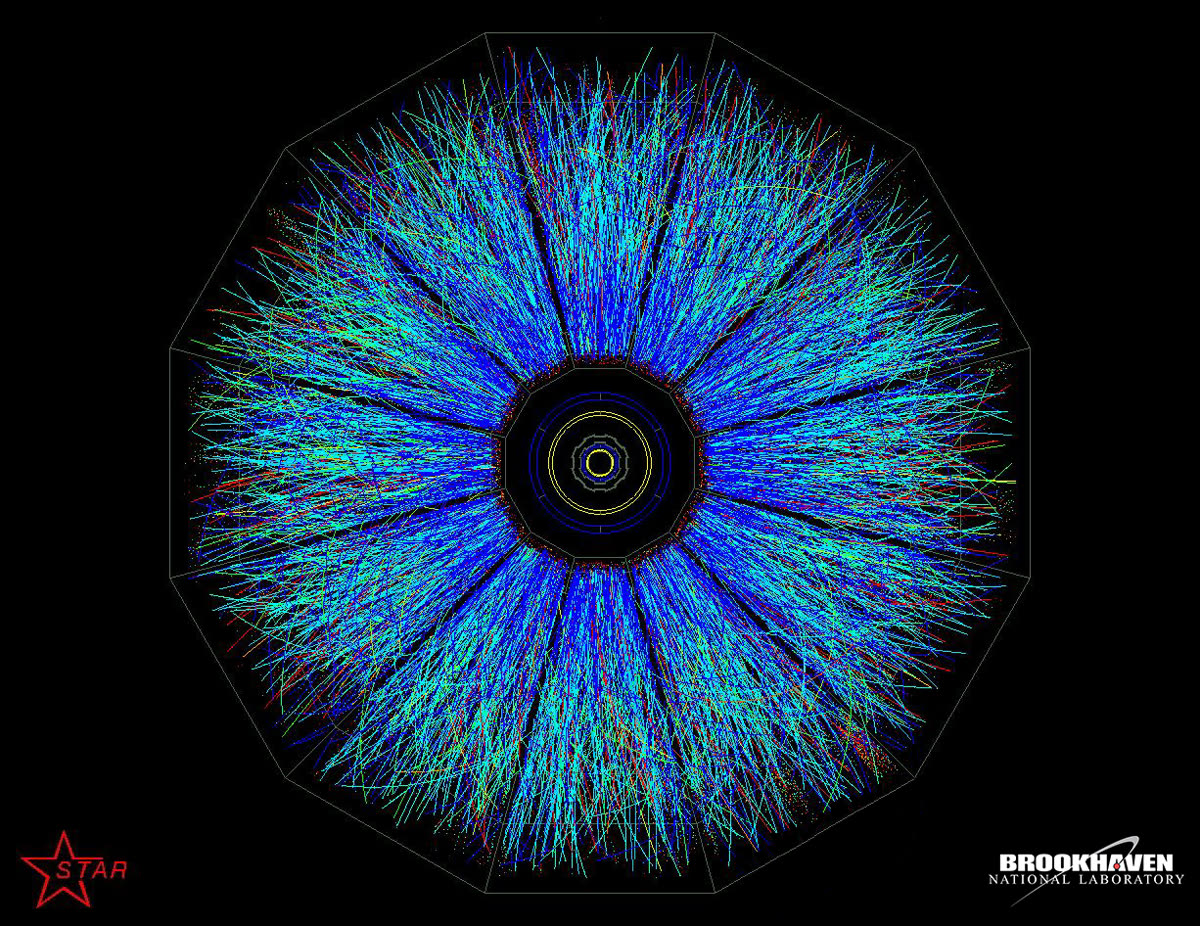
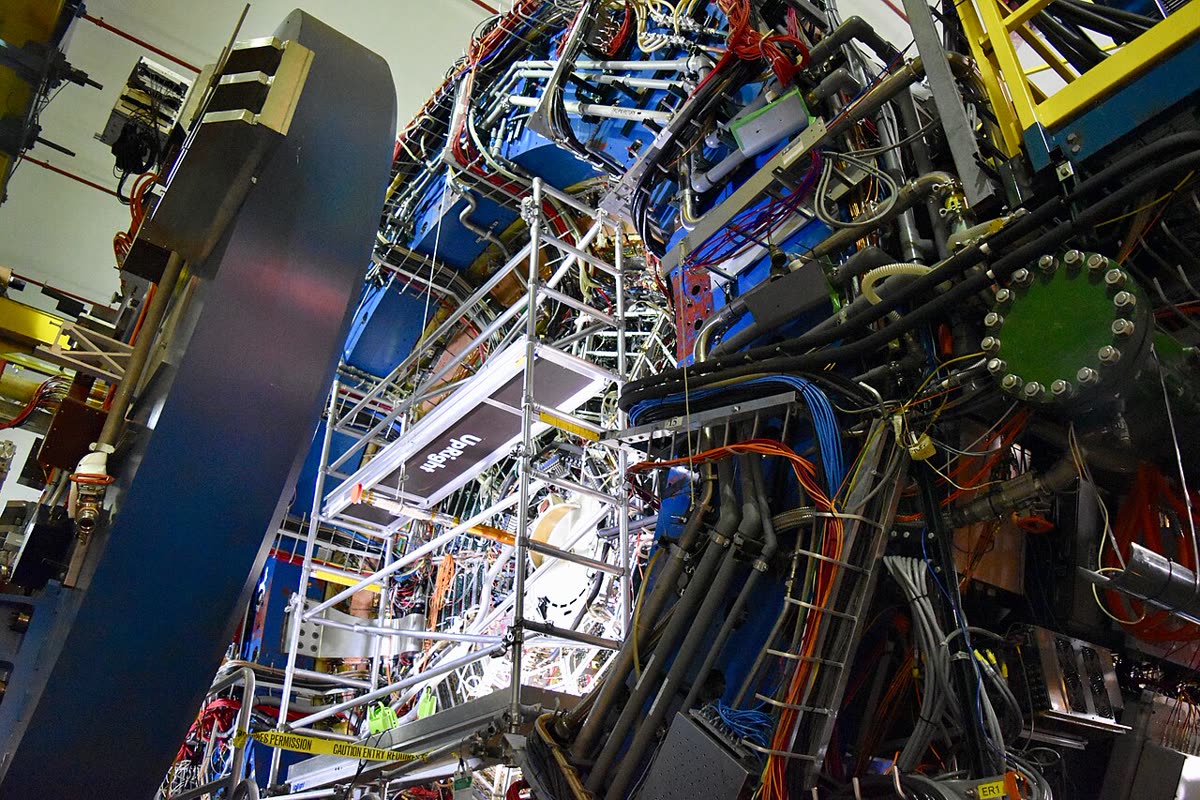
- Gold or lead nuclei accelerated to γ of order 100 (RHIC) or 2,700 (LHC) and brought into head-on collision inside detectors that reconstruct the thousands of particles produced. The initial geometry of the overlap region is inferred from how the debris is distributed in angle.
If the nuclei were spheres, the overlap region in a glancing collision would be symmetric and the debris would emerge evenly in all directions around the beam.
The debris comes out with a pronounced elliptic flow that matches a contracted, almond-shaped overlap region — the signature of two flattened discs meeting off-centre rather than two spheres. The measurements agree with hydrodynamic models built on that contracted geometry to within a few per cent.
How sure could they be? This is an inference from a fitted model, not a photograph, and it deserves to be labelled as such. What it establishes is that the contracted geometry is required to reproduce the data, and that a spherical one cannot. No experiment has ever imaged a contracted object directly, and given the Terrell–Penrose rotation, none straightforwardly could.
Length contraction is the one major relativistic effect with no clean direct measurement, and it is nevertheless load-bearing engineering. Accelerator physicists do not treat it as an interpretation — the beams are designed around it.
- 1889FitzGerald proposes contraction as a mechanical squashing against the aether.
- 1892Lorentz derives the same factor from electron theory.
- 1905Einstein derives it from the postulates, with no aether and no stress.
- 1911The pole-and-barn puzzle begins circulating in various forms.
- 1959Terrell and Penrose show that a fast object would photograph as rotated, not flattened.
- 2000RHIC begins colliding gold nuclei that are pancakes in the laboratory frame.