Is any of it true?
Six lessons of reasoning from two postulates, and not one of them settles anything. This one is nothing but measurement — muons on a mountain, caesium clocks on airliners, and the satellites that would fail without it.
- Describe an experiment that tests time dilation directly, and say what it would have shown if relativity were wrong
- Explain why the muon result works out identically in both frames, using dilation in one and contraction in the other
- Say where special relativity has been tested most precisely, and where it stops being enough
Everything in this act has been an argument. Start from two postulates, reason carefully, and out fall a series of increasingly uncomfortable conclusions about time, length, simultaneity and mass. But careful reasoning from false premises produces confident nonsense, and the history of physics is substantially a history of exactly that. The aether was a careful argument too, built by serious people on excellent grounds. So the question this act has been deferring finally has to be faced. Is any of it true? Not elegant, not internally consistent — true, in the sense that you can go outside and check. This lesson has no reasoning in it. It is only measurement.
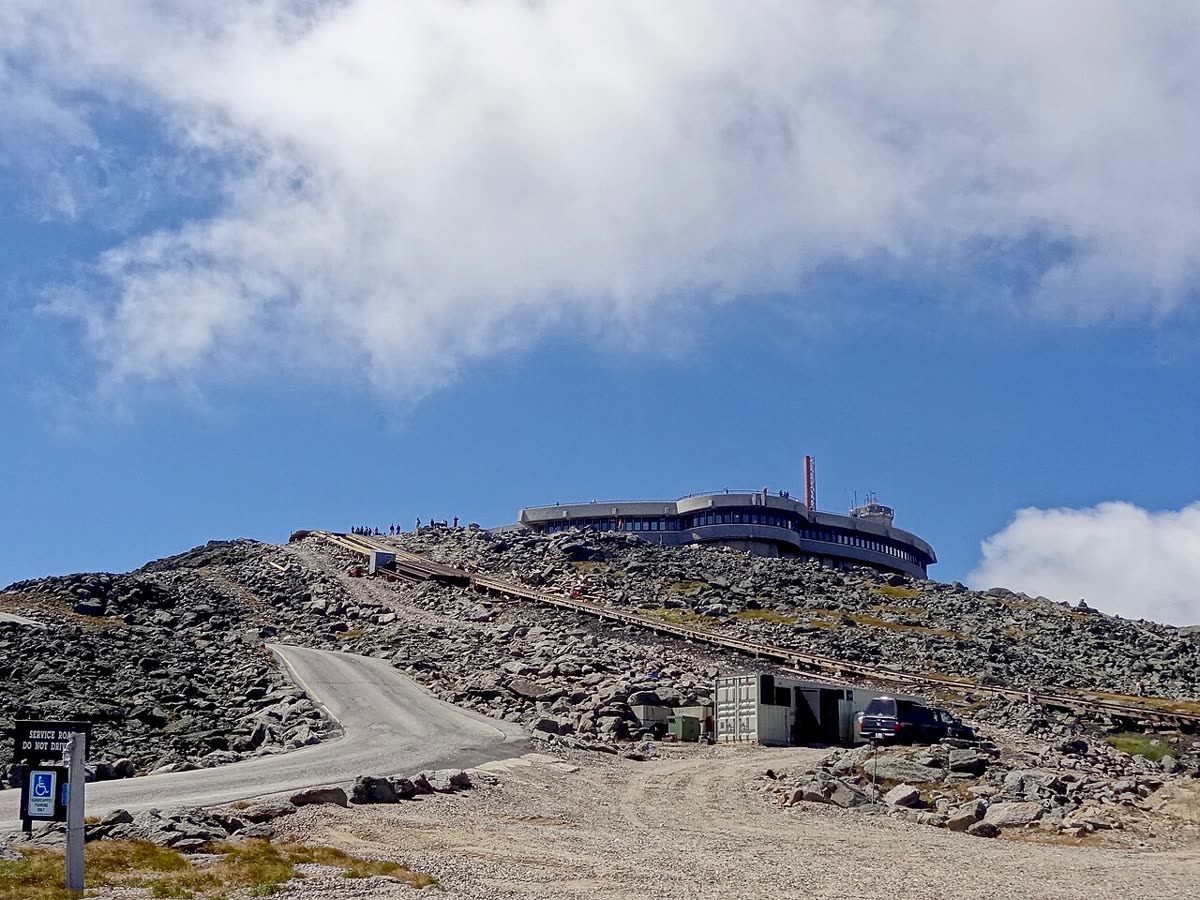
Rizka, 2016-08-27 11:08:15. CC BY-SA 4.0
The cheapest check available is falling on your head as you read this. Cosmic rays strike the upper atmosphere and produce muons — heavy, unstable relatives of the electron — roughly 15 km up. A muon at rest survives 2.2 microseconds on average before decaying. Even at the speed of light, which it cannot quite reach, 2.2 μs buys about 660 metres. So muons should not reach the ground. They should be gone within the first kilometre, and essentially none should survive fifteen. Instead they arrive in enormous numbers — several hundred pass through your body every minute. Something is badly wrong with that calculation.
Watch the two streams, then switch to the muon’s frame and watch the mountain shrink instead.
Counting muons up a mountain
- The question
- A muon lives 2.2 μs and cannot outrun light, so it should manage about 660 m. Do muons cross 1907 m of mountain anyway — and if so, by exactly the factor relativity predicts?
- The apparatus
- A scintillator and photomultiplier stack that detected a muon arriving and then, microseconds later, the electron from its decay — measuring the lifetime directly rather than assuming it. Iron absorbers selected a narrow speed band around 0.995c, so the muons counted at the summit were the same population counted at the bottom. The whole apparatus was then driven down to sea level and run again.
Without time dilation: 6.4 μs of flight against a 2.2 μs lifetime leaves about 5% surviving, or 27 per hour. With time dilation at γ ≈ 10, the muon ages 0.64 μs and about 73% survive, or 412 ± 20 per hour.
563 ± 10 muons per hour at the summit; 408 ± 9 per hour at sea level. The relativistic prediction is inside the uncertainty. The non-relativistic prediction is low by a factor of fifteen — these are Frisch and Smith’s own published figures, which fold in the spread of muon speeds their apparatus actually admitted.
How sure could they be? A few per cent, limited by counting statistics and by how tightly the speed band could be selected. That is crude by modern standards and completely sufficient, because the two hypotheses differ by 1500%. Later storage-ring measurements at CERN pushed the same test to 0.1% at γ = 29.
The most direct test of time dilation there is, using unstable particles as clocks that cannot be miscalibrated or mishandled — a muon has no dial to misread. It is also unusually teachable: the experiment was filmed for undergraduates, and the whole result is two numbers and a mountain.
Now the part worth slowing down for, because it is where the last three lessons turn out to be one lesson. Ride along with the muon and there is no time dilation at all. Its clock is perfectly ordinary. It lives 2.2 μs, exactly like any muon at rest, and from its point of view nothing whatever has happened to time. What has changed is the mountain. In the muon's frame Mount Washington is contracted to 190 metres and rushes up to meet it in 0.64 μs. Same proper time, same survival fraction, same number of muons at the bottom of the mountain. One observer explains the result with time dilation, the other with length contraction, and they are not two competing theories — they are one geometry described from two angles. They must agree, because the number of muons arriving is a fact and not a perspective. Had they disagreed by a single muon, relativity would be finished.
Muons are persuasive but exotic. In October 1971 Joseph Hafele and Richard Keating did the domestic version: they loaded four caesium beam atomic clocks onto scheduled commercial flights, sent them around the world eastward, then around the world westward, and compared them against the clocks that had stayed at the US Naval Observatory. The clocks travelled in the passenger cabin, with their own tickets bought for them. The total budget was about $8,000, most of it airfare, and it remains one of the best-value experiments in the history of physics.
Time dilation is about how things appear — a trick of the delay in light reaching you, not a real difference.
Signal delay is a real and separate effect, and relativity already accounts for it before making any of these predictions. What is left over is physical. The muons genuinely arrive; you can count them in a bucket. The Hafele–Keating clocks genuinely disagreed, and they still disagreed when they were brought home, switched off and laid on the same bench — an illusion of observation would have evaporated the moment the observers were reunited. The satellites genuinely need their frequencies adjusted before launch, and engineers who ignored it would produce a system that does not work. These are nanoseconds nobody gets back.
The testing has never stopped, and the precision is now extraordinary. The constancy of c. Modern versions of Michelson–Morley use cryogenic optical resonators instead of mirrors and half-silvered glass. The isotropy of light speed has been confirmed to about one part in 10¹⁸ — roughly a hundred million times better than the 1887 experiment that started all this. Time dilation. In 2014, lithium ions circulating at 33% of light speed in a storage ring at GSI in Darmstadt tested the dilation factor to two parts in 10⁸, a direct descendant of the Ives–Stilwell experiment of 1938. Unstable particles as clocks. Muons held in a storage ring at CERN at γ = 29.3 lived 29.3 times longer than muons at rest, confirmed to 0.1% — the same test as Mount Washington, with the mountain replaced by a magnetic ring and the error bars shrunk by a factor of thirty. Special relativity is among the most heavily tested propositions in science. In a century and a bit of increasingly aggressive attempts, it has not failed once.
- 1938Ives and Stilwell measure the transverse Doppler shift — time dilation in a laboratory, at about 1% precision.
- 1941Rossi and Hall count muons on Mount Evans, Colorado. The first mountain version.
- 1963Frisch and Smith repeat it on Mount Washington and film it for teaching.
- 1971Hafele and Keating fly caesium clocks around the world in both directions.
- 1977CERN muon storage ring confirms dilation at γ = 29.3 to 0.1%.
- 1978The first GPS satellite launches with its clock pre-offset for relativity.
- 2014Stored lithium ions test time dilation to two parts in 10⁸.