The happiest thought
A man falling off a roof does not feel his own weight. Einstein spent two years staring at that sentence, and it turned gravity from a force into a shape.
- State the equivalence principle and say what an observer in a sealed box can and cannot determine
- Derive, from the box alone, that light must bend in a gravitational field
- Explain why the equivalence only holds locally, and what tidal effects reveal
Special relativity has a hole in it, and Einstein knew it from the start. It is a theory of observers moving steadily in straight lines. Accelerate, and it falls silent. And there was a worse problem than incompleteness. Newton's law of gravity is an instantaneous action at a distance: move the Sun, and the Earth's orbit responds at once, across 150 million kilometres, with no delay whatsoever. Relativity had just spent a decade establishing that nothing outruns light. The two theories did not merely fail to connect. They contradicted each other outright, and one of them had to give.
If a person falls freely, he will not feel his own weight. I was startled. This simple thought made a deep impression upon me. It impelled me toward a theory of gravitation.
It is worth sitting with how strange that is. You are being pulled on by the entire mass of the Earth — some 6 × 10²¹ tonnes of it — and in free fall you feel absolutely nothing. Not a reduced force. Nothing at all. Compare that with any other force. Push a magnet at a fridge and both parties feel it. Fire a rocket and everyone aboard is pressed into their seat. Gravity is the only influence in physics that can be made to vanish entirely, everywhere in your vicinity, simply by letting go. Astronauts are the standing demonstration. They are not beyond Earth's gravity: at the space station's altitude it is still about 90% as strong as at sea level. They float because they are falling continuously and missing the planet. Weightlessness is not the absence of gravity. It is the experience of gravity when nothing is in the way.
Step through all four boxes. Two feel weightless, two feel heavy — and the members of each pair cannot be told apart from inside.
Now watch what that costs you. Fire a light beam horizontally across the accelerating rocket. Light takes time to cross — 33 nanoseconds for a 10 m box, small but not zero. In that time the rocket has moved upward, so the beam lands lower on the far wall than the height it entered at. From outside, nothing has happened to the light at all: it travelled a perfectly straight line, and the box rose to meet it. From inside, the light curved. So far this is bookkeeping about a moving rocket. But the equivalence principle now forces the conclusion: > If the rocket and the gravitational field are genuinely indistinguishable, light must bend in a gravitational field too — by exactly the same amount. Otherwise the sealed observer could shine a torch across the box, measure the deflection, and deduce which situation they were in. That is precisely what the principle forbids. And this is not a small claim. Light has no mass. In Newton's theory gravity acts on mass, so it has nothing whatsoever to say to a light beam. Einstein has just derived that gravity bends light — and he did it from a man falling off a roof.
The whole structure rests on a coincidence that Newton noticed and then shrugged at for two hundred years. There are two quite separate quantities called mass: Inertial mass — how hard a thing is to push. It appears in F = ma and has nothing to do with gravity. Gravitational mass — how strongly gravity pulls on a thing. It appears in Newton's law of gravitation, and is a sort of "gravitational charge". There is no obvious reason these should be equal. Electric charge is not proportional to inertial mass; nothing else is either. Yet if they differed even slightly, objects made of different materials would fall at measurably different rates — and the whole equivalence principle would collapse on the spot, because the floor of the rocket could not come up to meet everything equally.
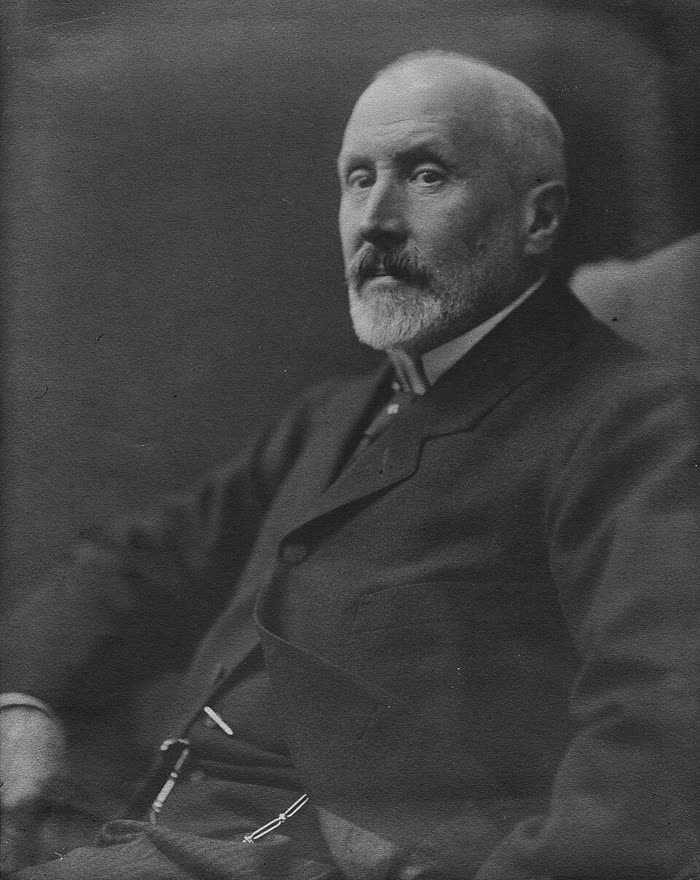
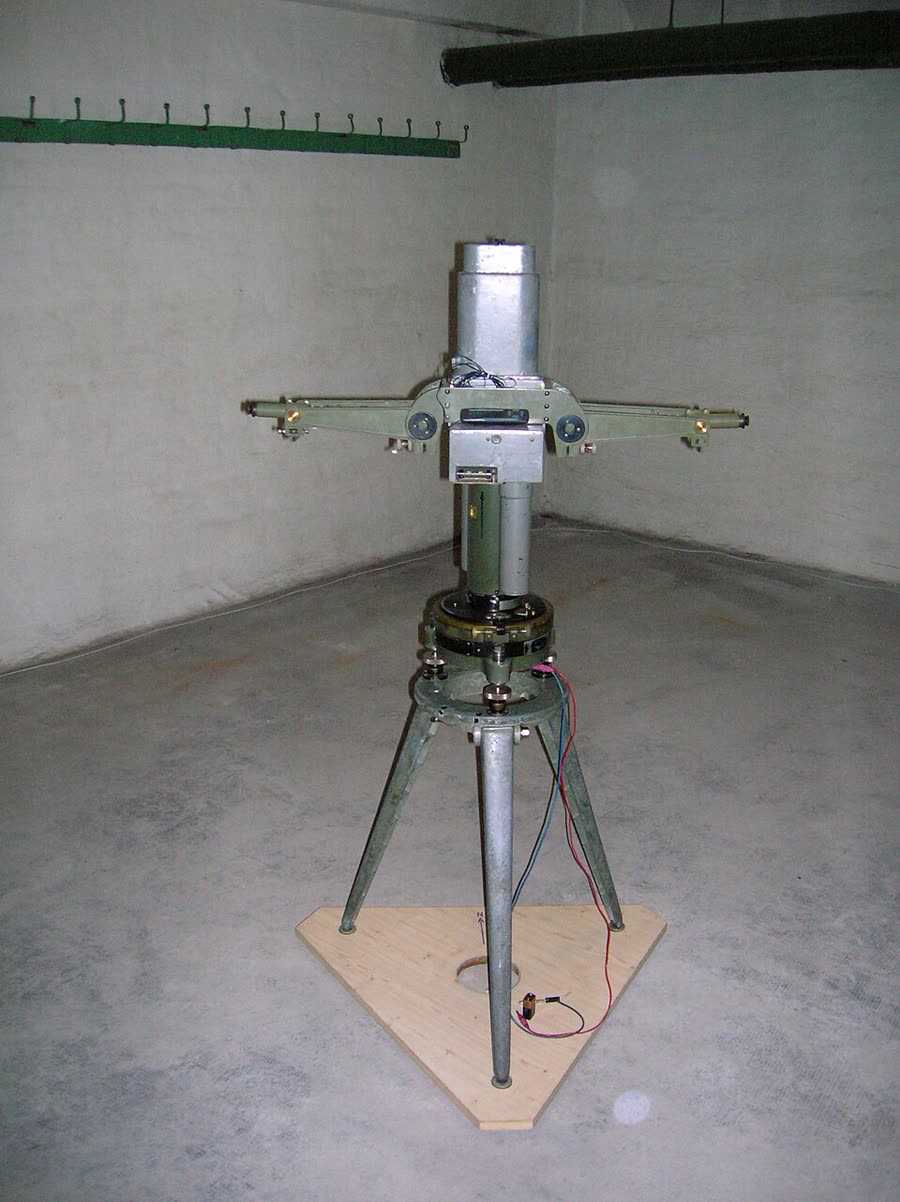
Weighing two kinds of mass against each other
- The question
- Is a body’s resistance to being pushed exactly proportional to the pull gravity exerts on it — for every material, without exception? If not, different substances fall at different rates and the equivalence principle is dead.
- The apparatus
- A torsion balance: two samples of different materials hung at the ends of a beam suspended on a fine platinum-iridium wire. Earth’s rotation supplies a centrifugal force that depends on inertial mass, while gravity depends on gravitational mass. If the two masses were not proportional, the beam would experience a tiny twist — and would twist the other way when the apparatus was rotated 180°. The instrument was buried in a cellar and read remotely to keep the experimenters’ own body heat from swamping the signal.
If inertial and gravitational mass are identical, the beam shows no differential twist for any pair of materials. Any departure would show up as a deflection reversing with the apparatus.
No difference, for wood against platinum, copper against glass, and more exotic pairings including snakewood and tallow. The Eötvös parameter η was bounded to about 5 × 10⁻⁹.
How sure could they be? Five parts in a billion, achieved with a torsion fibre and a telescope in the 1900s. The modern successor is the MICROSCOPE satellite, which compared platinum and titanium test masses in orbit and reported η = (−1.5 ± 2.7) × 10⁻¹⁵ in 2022 — a million times tighter, and still exactly zero.
This is the experimental footing the entire theory stands on. Einstein did not merely assume the two masses are equal; he elevated their equality into a principle and rebuilt gravity around it. Had Eötvös found a difference, general relativity would have been stillborn. Instead the equality has survived every attempt to break it across fourteen orders of magnitude — which is why searches for a violation continue to be funded: finding one would overturn the theory in a single stroke.
Gravity is just acceleration — so gravity is not real, and you can always transform it away.
The equivalence holds locally: at a point, and over a small enough region and short enough time. It is not a global statement, and the difference is where general relativity actually lives. In a large falling box, two balls released side by side both fall towards the Earth’s centre, so they converge. Two balls released one above the other drift apart, because gravity is stronger lower down. No uniform acceleration can imitate that pattern. What you can transform away is the uniform part; what remains is a genuine, frame-independent fact about the field.
Those relative drifts are called tidal effects — the same phenomenon that raises the oceans twice a day, since the Moon pulls harder on the near side of the Earth than the far side. They are the part of gravity that cannot be abolished by falling. In a small enough box over a short enough time they are undetectable, which is exactly what local means. But they are the residue that survives after every uniform effect has been transformed away, and a residue that no change of coordinates can remove is not an artefact of your point of view. It is real, and it is telling you something about the field itself. That residue has a name in geometry. It is curvature — and the next lesson is about taking that identification literally.
- 1889Eötvös begins torsion balance measurements comparing inertial and gravitational mass.
- 1907The happiest thought, at the patent office in Bern. Einstein publishes the equivalence principle in a review article.
- 1911He predicts light deflection by the Sun — and gets 0.87″, half the right answer.
- 1914An eclipse expedition sets out to test that prediction, and is interrupted by the First World War.
- 1915The field equations, in November, after abandoning three years of work.
- 1919Eddington measures 1.75″. The 1911 value would have been refuted.
- 2022MICROSCOPE bounds any violation of the equivalence principle to 10⁻¹⁵.