Curved spacetime
Gravity is not a force pulling you down. It is the shape of spacetime, and almost all of what you feel is the curvature of time rather than of space.
- Explain what curvature means intrinsically, without reference to anything the surface is embedded in
- Say why free fall involves no force at all, and what a geodesic is
- Explain why everyday gravity is mostly curvature of time, not space
The last lesson ended with a residue. Gravity can be abolished at any point by falling — but not everywhere at once, because tidal effects survive. Two balls released side by side in a falling lift drift slowly together, because both are heading for the centre of the Earth. Two released one above the other drift apart, because gravity is stronger lower down. No change of coordinates removes that pattern. And something that survives every change of description is not a feature of your description. It is a feature of the world.
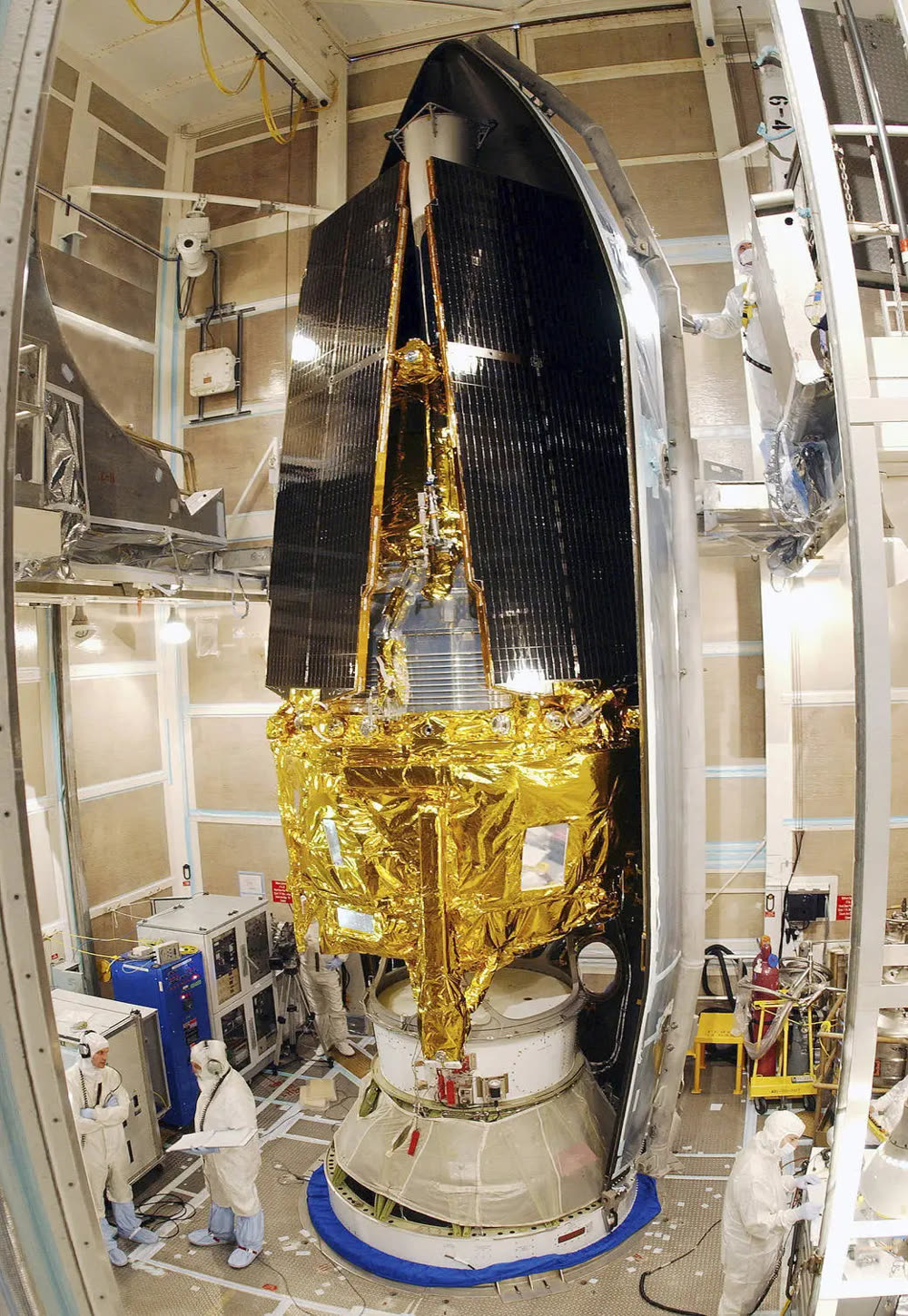
NASA, 2004. Public domain
The mathematics for handling it already existed, and it was eighty years old. Carl Friedrich Gauss had asked a question that sounds like a riddle: could a creature living inside a surface, with no access to any outside view, work out whether its surface was curved? It can. Draw a triangle and add up the angles. On a flat sheet you get 180°. On a sphere you get more — a triangle from the north pole down to the equator, a quarter way round, and back up has three right angles, totalling 270°. On a saddle you get less. Or draw a circle and measure its circumference: on a sphere it comes out smaller than 2πr, on a saddle larger. Gauss called this result so striking he named it the Theorema Egregium — the remarkable theorem. Curvature is detectable from the inside. You never have to step out.
Spacetime is like a rubber sheet: a heavy ball makes a dent, and other balls roll into it.
This picture fails in three separate ways, and it is worth knowing all three. First, it explains gravity using gravity — the small balls roll inwards only because there is real, downward gravity underneath the sheet. Remove that and nothing rolls anywhere. Second, it shows space bending into a third dimension, which does not exist; spacetime curvature is intrinsic, in Gauss's sense, not an embedding in anything. Third, and most seriously, it shows only space — and for everything you have ever watched fall, the curvature of time is doing essentially all of the work. The sheet omits the part that matters.
That third failure is the one worth dwelling on, because it is genuinely surprising and rarely said. Throw a ball across a room. It rises maybe a metre and comes down over about a second, tracing a modest arc — that is its path through space. Now put in the time axis properly. In one second, light travels 300,000 kilometres. So the ball's path through spacetime is a metre of vertical deflection set against 300 million metres of time. That path is very nearly a perfectly straight line. Work out the radius of curvature of that shallow arc and you get about one light-year. The ball's trajectory through spacetime is a tiny scrap of a circle a light-year across — which is exactly what you would expect of something that is genuinely trying to move in a straight line through a geometry that is very slightly bent.
Compare against Newton, then drag the orbit tighter and watch the ellipse stop closing.
Watching a gyroscope tip over in curved spacetime
- The question
- A gyroscope in flat space points the same direction forever. If spacetime near the Earth is genuinely curved, carrying a gyroscope around an orbit should slowly rotate its axis — by an amount general relativity predicts exactly. Does it?
- The apparatus
- Four gyroscopes made of fused quartz coated in niobium, ground to within 40 atomic layers of a perfect sphere — among the roundest objects ever manufactured. Cooled to 1.8 K in a 2,441-litre dewar of superfluid helium, spun to 4,000 rpm, and read out by SQUID magnetometers sensing the London moment of the superconducting coating. The whole satellite flew in drag-free mode, continuously manoeuvring to stay centred on a floating test mass.
Two distinct effects. The geodetic effect, from the curvature of spacetime around a static mass: 6,606.1 milliarcseconds per year. And frame dragging, from the Earth’s rotation twisting spacetime with it: 39.2 mas/yr, perpendicular to the first and about 170 times smaller.
Geodetic: 6,601.8 ± 18.3 mas/yr. Frame dragging: 37.2 ± 7.2 mas/yr. Both consistent with general relativity.
How sure could they be? 0.28% on the geodetic effect and about 19% on frame dragging. Reaching even that required four years of unplanned analysis, after electrostatic patches on the rotor coatings produced unexpected torques that had to be modelled and removed.
This is curvature measured directly rather than inferred from an orbit. An angle of 6,606 mas/yr is roughly the width of a human hair seen from ten miles, accumulated over a year. And frame dragging says something further: spacetime is not merely a curved stage but a medium that a rotating body can drag around with it.
- 1827Gauss proves the Theorema Egregium: curvature is intrinsic, detectable from inside a surface.
- 1854Riemann generalises it to any number of dimensions, with no physics in mind.
- 1912Einstein asks Grossmann for help and meets the Ricci calculus.
- 1915The field equations, in November.
- 1916Schwarzschild solves them exactly while serving on the Russian front. He dies months later.
- 1959Gravity Probe B is proposed.
- 2011It reports, 52 years later: geodetic effect confirmed to 0.28%.