Mercury's perihelion
Forty-three arcseconds per century, unexplained since 1859. Einstein calculated it in November 1915, got the right answer with nothing left to adjust, and said it gave him heart palpitations.
- Say what the 43-arcsecond anomaly actually was, and what it was measured against
- Explain why a prediction with no free parameters carries more weight than a fitted one
- Describe the alternatives that were tried first, and why they failed
Urbain Le Verrier was arguably the most successful predictive astronomer who has ever lived. In 1846 he noticed that Uranus was not quite where Newton's laws said it should be. He worked backwards from the discrepancy to the position of an unseen eighth planet, and posted the coordinates to Johann Galle at the Berlin Observatory. Galle found Neptune that same night, within one degree of the predicted place. It remains the most spectacular vindication Newtonian mechanics ever received: a planet discovered with a pen. So when Le Verrier announced in 1859 that there was something else wrong, this time with Mercury, nobody dismissed him.
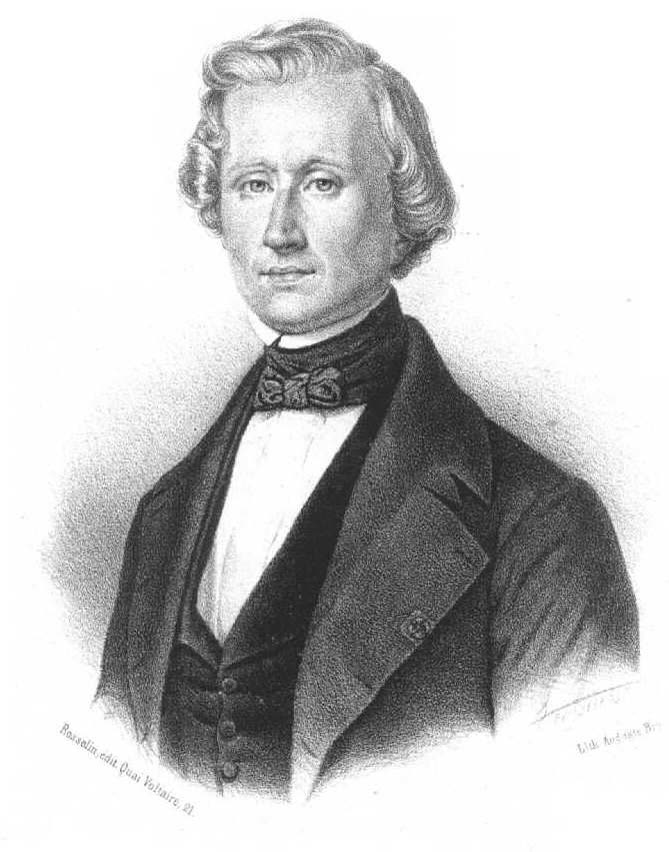
User Magnus Manske on en.wikipedia, Commons upload by File Upload . Public domain
Mercury's perihelion — its closest approach to the Sun — does not stay in one place. It creeps forward, so the orbit traces a slowly rotating ellipse rather than a fixed one. The total observed drift is about 5,600 arcseconds per century. Almost all of it is thoroughly understood, and the interesting part is what is left after the bookkeeping.
Le Verrier did the obvious thing — the thing that had already made him famous. If an unseen planet explained Uranus, an unseen planet could explain Mercury. He proposed one orbiting inside Mercury's orbit, lost in the Sun's glare except during a transit or an eclipse. He called it Vulcan. And then people started finding it. A French country doctor named Edmond Lescarbault reported watching a small dark object cross the Sun. Le Verrier travelled to interview him, came away convinced, and had him decorated with the Légion d'honneur. Further sightings were reported during eclipses over the following decades. Le Verrier died in 1877 still believing in Vulcan. There is no Vulcan. Every sighting was a sunspot, a known star misidentified, or an error. It is a useful and slightly uncomfortable lesson: the same method that found Neptune, applied by the same man with the same competence, produced a planet that was not there — and a community that kept confirming it.
Other repairs were attempted, and their failure modes are instructive. An oblate Sun. If the Sun were slightly squashed rather than spherical, its gravitational field would not be quite inverse-square and the orbit would shift. Plausible — but measurements of the solar figure showed the flattening was far too small, and a Sun oblate enough to explain Mercury would have disturbed Venus in ways nobody observed. A ring of dust inside Mercury's orbit. Same problem: enough dust to matter would have shown up elsewhere. A modified force law. Simon Newcomb noted that if gravity fell off as 1/r^2.00000016 instead of 1/r², the numbers worked. This is the most interesting failure, because it does fit. It fits because it has a free parameter, tuned to the answer you already knew. It also wrecks the Moon's orbit, and — more damningly — it explains nothing. It relocates the mystery into a decimal place and calls that a theory.
Drag the orbit tighter to make the effect visible, then remember Mercury is 200,000 times wider than anything shown here.
The residue that would not go away
- The question
- After subtracting every known effect — the precession of the equinoxes and the gravitational pull of every other planet — does Mercury’s orbit behave exactly as Newton requires?
- The apparatus
- No apparatus in the usual sense: a century of accumulated transit observations, in which Mercury is timed as it crosses the face of the Sun. Transits are rare, about 13 per century, but they fix Mercury’s position with unusual precision because the Sun’s limb provides a sharp reference. The work was arithmetic — perturbation theory carried out by hand to many terms.
Under Newtonian gravity the residue should be zero within the observational uncertainty, once the equinox precession and planetary perturbations are removed.
A residue of 38″ per century (Le Verrier, 1859), refined by Newcomb to 43″ per century using better data and more careful perturbation terms. It was far larger than the observational uncertainty and did not diminish as the data improved.
How sure could they be? Newcomb’s value carried an uncertainty of a few arcseconds per century. Modern radar ranging to Mercury and the MESSENGER mission give 42.98 ± 0.04″ per century, agreeing with general relativity to about one part in a thousand.
The only sustained, unambiguous failure of Newtonian gravity known in the nineteenth century — and the one place a successor theory could be caught out. It sat unexplained for 56 years while every conservative repair was tried and failed. Einstein’s theory produced 43″ with no adjustable quantity anywhere in the calculation.
For a few days I was beside myself with joyous excitement.
Explaining a number that was already known is weak evidence — anyone can fit existing data.
It depends entirely on whether the theory had room to be tuned. Fitting is cheap when you have a parameter to adjust, which is exactly why Newcomb’s 1/r^2.00000016 persuaded nobody: it could have accommodated any residue at all. Einstein’s calculation had no such freedom. The field equations were already pinned down, and the 43″ was a forced consequence — had it come out 30″ or 60″, the theory would have been dead on the spot. A prediction is risky in proportion to how easily it could have been wrong, and this one could have been wrong very easily indeed.
- 1846Le Verrier predicts Neptune from anomalies in Uranus. It is found the same night.
- 1859He reports that Mercury’s perihelion advances 38″ per century too fast, and proposes the planet Vulcan.
- 1860Lescarbault reports observing Vulcan in transit. He is decorated. It was not there.
- 1882Newcomb refines the anomaly to 43″ per century.
- 1895Newcomb proposes modifying the inverse-square exponent. It fits, and explains nothing.
- 1915Einstein computes 43″ from the field equations, with nothing to adjust.
- 2018MESSENGER radar ranging gives 42.98 ± 0.04″ per century.