Light bends
A prediction of 1.75 arcseconds, two expeditions, a total eclipse six months after the Armistice, and the morning Einstein woke up famous. Also the most-argued-over data reduction in the history of astronomy.
- Say why the eclipse test was a genuine prediction rather than an explanation
- Explain why light deflection is twice the equivalence-principle estimate
- Assess the charge that Eddington discarded data to get the answer he wanted
Mercury was a retrodiction — an explanation of a number that had been sitting in the tables since 1859. What general relativity needed was a prediction: something nobody had measured, stated in advance, where the theory could be publicly caught out. Einstein had one, and it was beautifully exposed. Starlight passing close to the Sun should be deflected by 1.75 arcseconds. Not approximately, not within a range — one specific number, with nothing available to adjust.
Compare with Newton — the dashed line is dead straight, because massless light feels no Newtonian gravity at all.
To measure the deflection you must photograph stars whose light grazes the Sun. Which means photographing stars that appear right beside the Sun. Which is impossible, because the Sun is there — unless something covers it. So the method is: 1. During totality, photograph the star field around the blacked-out Sun. 2. Months later, photograph the same stars at night, with the Sun elsewhere in the sky. 3. Compare. If the Sun bends light, the stars near its edge will appear shifted very slightly outward. Everything else is the problem of doing this to a fraction of an arcsecond, on glass plates, in the field, in a few minutes of darkness, having shipped your telescope to the tropics.
The eclipse of 29 May 1919 was unusually well suited to the job. Totality lasted nearly seven minutes — among the longest of the century, and far more than the couple of minutes that is typical. More importantly, the Sun on that date sat directly in front of the Hyades, a bright open cluster in Taurus. Instead of a handful of faint stars scattered near the limb, there were more than a dozen good ones well placed around the disc. Astronomers had been looking forward to this specific eclipse for years, entirely independently of Einstein.
Arthur Eddington was a Quaker and a conscientious objector. In 1918 he came close to being sent to a work camp, and was exempted partly on the argument — pressed by the Astronomer Royal — that he was needed for this expedition. It is worth pausing on the shape of that. Six months after the Armistice, a British astronomer sailed to West Africa to test the theory of a German physicist, in a war's aftermath that had killed a generation and left the scientific communities of the two countries refusing to correspond. Eddington saw the expedition explicitly as an act of reconciliation, and said so. He was also, by some distance, the person in Britain who best understood the theory he was testing.
Photographing starlight bending round the Sun
- The question
- Does the Sun deflect starlight, and if so by 0″ (Newton with massless light), 0.87″ (Newtonian corpuscles, and Einstein’s own 1911 value), or 1.75″ (general relativity)?
- The apparatus
- Portable telescopes fed by coelostat mirrors, exposing glass photographic plates during totality. Two sites were used to hedge against cloud, and Sobral carried two instruments: a 4-inch lens and a larger astrographic telescope. Comparison plates of the same star field were taken months later — at Oxford for the Príncipe plates, and in Brazil in July for Sobral — and the two sets measured against each other under a micrometer.
Stars nearest the solar limb should appear displaced radially outward by 1.75″ under general relativity, falling off inversely with distance from the Sun’s centre.
Sobral 4-inch: 1.98″ ± 0.12. Príncipe: 1.61″ ± 0.30. Sobral astrographic: 0.93″ — set aside on grounds of visibly defocused, distorted images, the mirror having been heated by the Sun during the eclipse.
How sure could they be? Roughly 10–20% on the accepted plates, which is enough to separate 1.75″ from 0.87″ but not enough to test the theory finely. At Príncipe it rained on the morning of the eclipse; the cloud broke near the end and Eddington obtained 16 plates, of which only 2 showed usable star images.
The first test of general relativity against a number stated in advance, and the one that made Einstein a household name within a week. Modern very-long-baseline interferometry, which watches quasars pass behind the Sun and needs no eclipse at all, has since confirmed the deflection to about 0.02% — and the closely related Shapiro time delay was measured by the Cassini spacecraft to one part in 50,000.
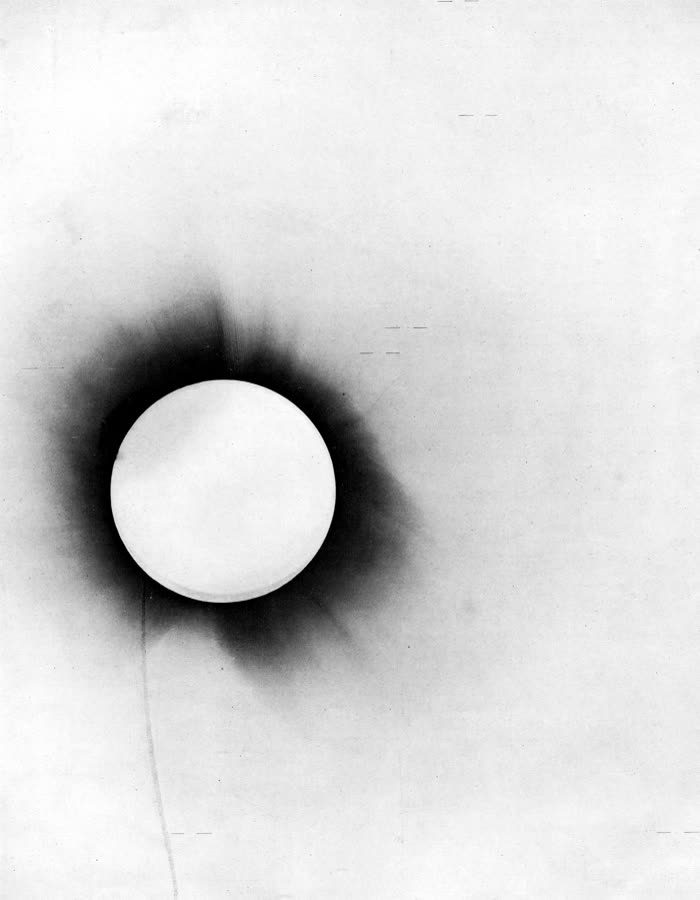
F. W. Dyson, A. S. Eddington, and C. Davidson, 1919-05-29. Public domain
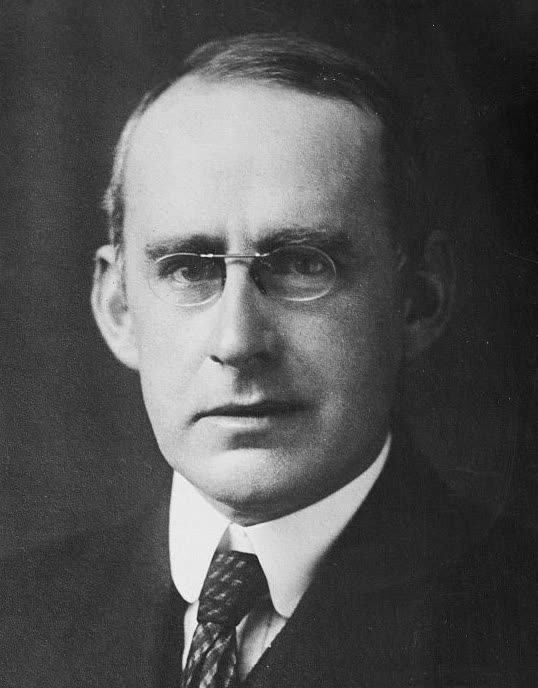
George Grantham Bain Collection, Library of Congress Prints and Photographs Division Washington, D.C., Unrecorded. Public domain
In 1980 the philosophers of science John Earman and Clark Glymour made a serious charge: that Eddington had discarded the data disagreeing with Einstein and kept the data agreeing with him, and that the most celebrated confirmation in modern physics was a case of a scientist finding what he had already decided to find. The accusation stuck, and you will still find it repeated as established fact. Given that this entire site is built on the premise that evidence is what separates physics from storytelling, it deserves a real answer rather than a defensive one.
The results were presented on 6 November 1919, at a joint meeting of the Royal Society and the Royal Astronomical Society in Burlington House, beneath a portrait of Newton. J. J. Thomson, presiding, called it "the most important result obtained in connection with the theory of gravitation since Newton's day". The philosopher Alfred North Whitehead, who was present, wrote that the atmosphere was that of a Greek drama. The next morning The Times of London ran: REVOLUTION IN SCIENCE. NEW THEORY OF THE UNIVERSE. NEWTONIAN IDEAS OVERTHROWN. Three days later the New York Times followed, with a headline that included the line "Stars Not Where They Seemed or Were Calculated to Be, but Nobody Need Worry". Einstein had been a professor known to a few hundred specialists. Within a week he was the most famous scientist alive, and remained so for the rest of his life.
Dear Mother, joyous news today. H. A. Lorentz telegraphed that the English expeditions have actually measured the deflection of starlight from the Sun.
By modern standards 1919 was crude — perhaps 20–30% precision, from a few usable plates. The measurement has since been done properly, and without waiting for the Moon. Radio interferometry. Quasars emit radio waves, and radio telescopes do not care that the Sun is bright. Very-long-baseline interferometry watches compact radio sources pass behind the Sun every year, and confirms the deflection to about 0.02%. The Shapiro delay. A closely related prediction: signals passing near the Sun are not only bent but delayed. The Cassini spacecraft measurement in 2002 confirmed it to one part in 50,000 — currently the tightest test of this part of the theory. Gravitational lensing. The same effect, applied to galaxies, is now a routine tool: it maps dark matter, magnifies objects too distant to see otherwise, and produces multiple images of single quasars. What Eddington strained to detect at 1.75″ is now an instrument.
- 1911Einstein predicts 0.87″ from the equivalence principle alone — half the right answer.
- 1914A German expedition to the Crimea sets out to test it, and is interrupted by the outbreak of war. The astronomers are interned.
- 1915The field equations give 1.75″. Einstein calls the 1914 interruption the luckiest thing that ever happened to him.
- 1919Eclipse of 29 May. Announcement on 6 November. Einstein becomes world-famous overnight.
- 1980Earman and Glymour accuse Eddington of discarding inconvenient data.
- 1979The disputed Sobral plates are re-measured with modern equipment: 1.55″ ± 0.34.
- 2002Cassini confirms the related Shapiro delay to one part in 50,000.