The photoelectric effect
Brighter light does not give electrons more energy. Bluer light does. Four small facts about a metal plate that no wave theory can survive — and the work Einstein actually got his Nobel Prize for.
- List the four experimental facts that classical wave theory cannot accommodate
- Use E = hν − φ to predict whether a given colour will eject electrons from a given metal
- Explain why Einstein’s light quantum was far more radical than Planck’s
The story starts with an annoyance. In 1887 Heinrich Hertz was performing the experiment from Act 1 — generating electromagnetic waves in one spark gap and detecting them in another, confirming Maxwell. The detecting spark was faint and hard to see, so he built a dark enclosure around it. And the spark got weaker. Hertz chased it down carefully and established that ultraviolet light falling on the electrodes made sparking easier. He published a thorough description, stated plainly that he had no explanation, and returned to the waves. He had just discovered, as a nuisance, the effect that would undermine the wave theory he was in the middle of proving.
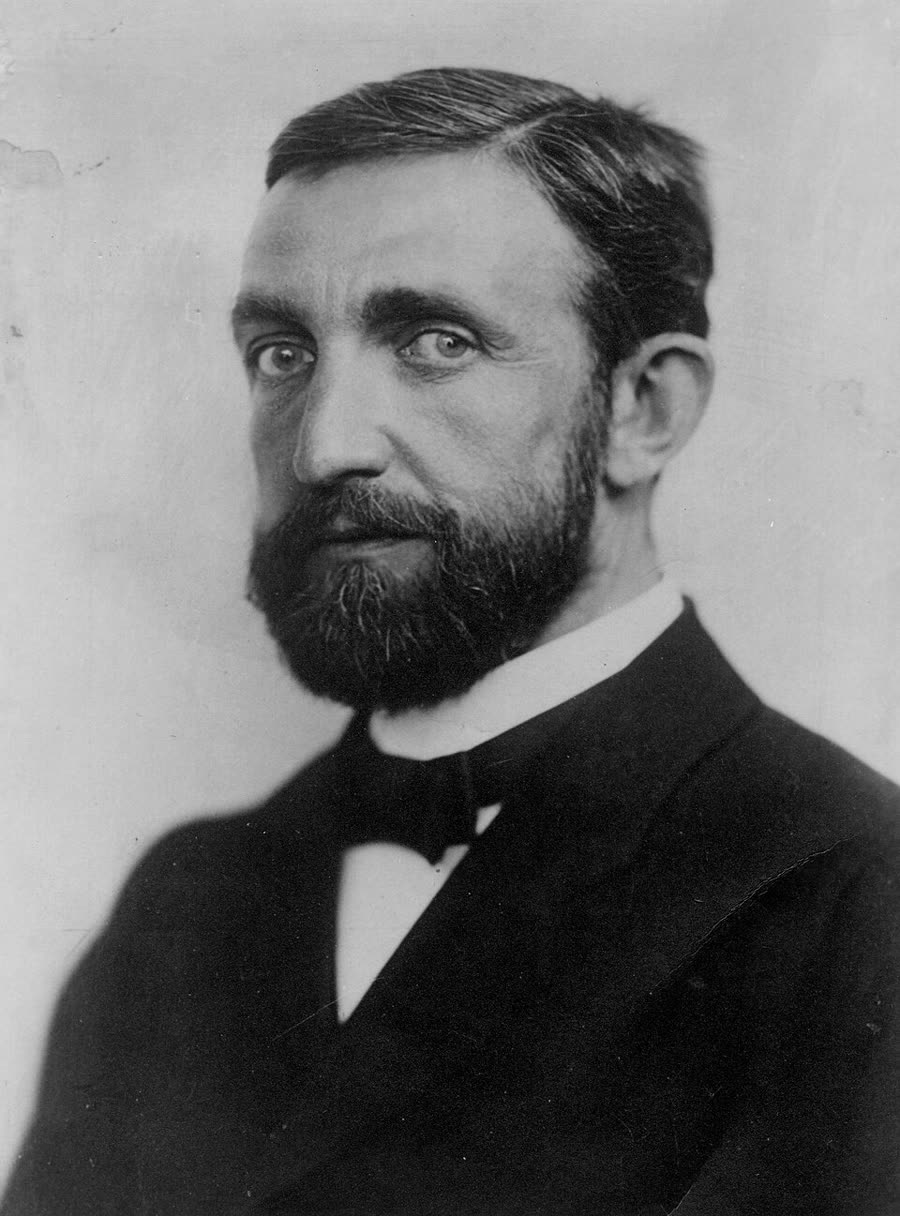
Not mentioned in any source, According this source , pictur. Public domain
The effect is easy to state: shine light on a clean metal surface and electrons come off. And it is unusually well suited to measurement, because you can get at both quantities that matter. How many — collect the electrons on a second plate and measure the current. How energetic — apply a reverse voltage that pushes them back. Increase it until the current just stops. At that point the electric potential energy exactly cancels the electrons' kinetic energy, so the stopping voltage gives you the maximum energy directly, in electronvolts. Philipp Lenard, who had been Hertz's assistant, did this systematically in 1902. What he found made no sense at all.
Go redder until emission stops, then turn the brightness to maximum. Then go bluer and turn it right down.
In 1905 — the same year as special relativity, E = mc², and the paper on Brownian motion that finally convinced people atoms exist — Einstein published something under a deliberately hedged title: On a Heuristic Viewpoint Concerning the Production and Transformation of Light. Heuristic means: a useful way of looking at it, not necessarily true. He was being careful, and he was right to be. The proposal is that light itself is grainy. Not that oscillators emit in lumps — that was Planck, and Planck thought it was a bookkeeping trick. Einstein's claim is that a beam of light is a hail of localised packets, each carrying energy hν, and that each packet is absorbed whole, by a single electron, in a single event.
Lenard’s systematic study of the effect
- The question
- When light ejects electrons from a metal, what determines how many come off and how fast they are moving — and does it behave as a wave theory requires?
- The apparatus
- An evacuated tube with a clean metal cathode illuminated through a quartz window (quartz rather than glass, because glass absorbs ultraviolet). Ejected electrons were collected on an anode and measured as a current. A retarding potential applied between the electrodes was raised until the current fell to zero, giving the maximum electron energy directly. Carbon-arc sources of varying intensity, and filters to select the spectral region.
On classical wave theory, brighter light carries more energy per second, so it should eject electrons with greater kinetic energy, and light of any colour should work if you wait long enough.
The stopping potential — and therefore the maximum electron energy — was completely independent of intensity, over a range of about 1000 in brightness. Intensity controlled only the number of electrons. Energy instead depended on the colour of the light, and below a certain frequency no electrons appeared at all.
How sure could they be? Lenard established the intensity independence and the existence of a threshold convincingly. His frequency measurements were much cruder — his sources had broad, poorly characterised spectra — so he could not establish the linear relation K = hν − φ. That took Millikan, and fourteen more years.
The result that made the photoelectric effect a crisis rather than a curiosity. Lenard received the 1905 Nobel Prize (for cathode rays), and never accepted Einstein’s explanation of his own experiment — he later became an enthusiastic Nazi and a leading figure in the "Deutsche Physik" movement that denounced relativity as Jewish science. Being an excellent experimentalist offers no protection whatever against being a bad judge of theory, or of anything else.
That he may sometimes have missed the target in his speculations, as for example in his hypothesis of light quanta, cannot really be held too much against him.
Einstein won the Nobel Prize for relativity.
He did not. The 1921 prize citation reads: "for his services to Theoretical Physics, and especially for his discovery of the law of the photoelectric effect." Relativity is not mentioned, and the omission was deliberate — it was still regarded as too speculative and too contested, and there was organised opposition to honouring it, some of it from Lenard and some of it antisemitic. The committee chose the safest of Einstein’s results. There is an irony in this: they picked the light quantum as the uncontroversial option, when it was arguably the more revolutionary idea of the two, and had itself been rejected by nearly everyone for fifteen years. It only became safe to reward once Millikan had spent a decade failing to disprove it.
- 1887Hertz notices ultraviolet light assisting a spark, while proving Maxwell right. Reports it without explanation.
- 1888Hallwachs shows a negatively charged zinc plate loses its charge under ultraviolet.
- 1899J.J. Thomson identifies the emitted particles as electrons.
- 1902Lenard establishes that electron energy is independent of intensity, and that a threshold exists.
- 1905Einstein proposes light quanta and K = hν − φ. Almost nobody accepts it.
- 1916Millikan confirms the equation to within 0.5%, having set out to refute it.
- 1921Einstein receives the Nobel Prize — for this, not for relativity.
- 1926Gilbert Lewis coins the word "photon".