Planck's desperate act
He guessed the formula in an evening, spent eight weeks finding out what it meant, and did not like the answer. Then he spent a decade trying to get rid of it.
- Distinguish Planck’s guessed formula from the derivation that forced the quantum
- Explain how energy quantisation stops the high-frequency modes from diverging
- Say what Planck himself thought he had done, and why he was uncomfortable
On Sunday 7 October 1900, Heinrich Rubens and his wife came to the Plancks' house in Grunewald for tea. Rubens mentioned his newest far-infrared measurements: at long wavelengths the intensity came out simply proportional to temperature, and Wien's law — which everybody had believed exact for four years — plainly failed there. Planck already knew that Wien's law worked beautifully at short wavelengths. So he now had two limits and nothing joining them: - short λ: Wien's exponential form, well tested - long λ: intensity ∝ T, brand new That evening, after his guests left, he wrote down a formula that reduces to the first at one end and the second at the other. He posted it to Rubens on a postcard the same night.
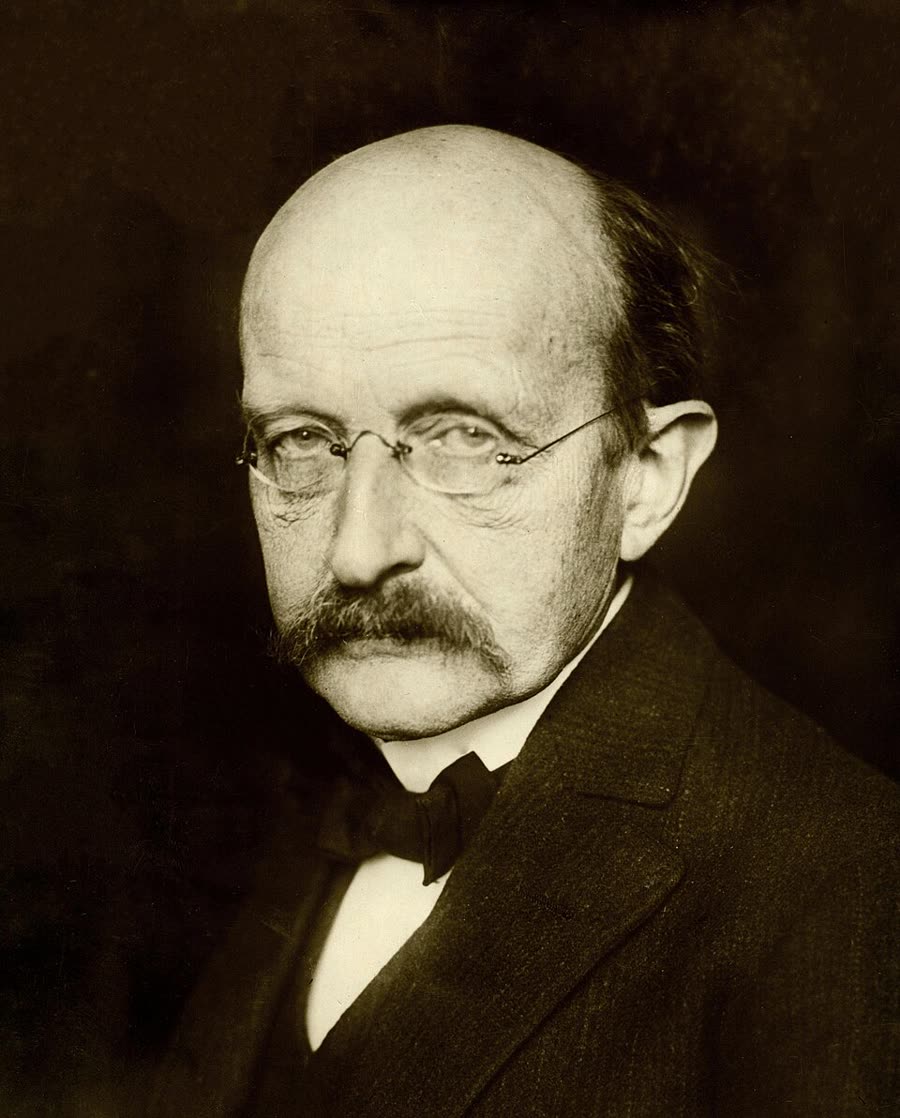
Berlin, 11 January 1933. Public domain
He afterwards described the following weeks as the most strenuous work of my life. And to get anywhere he had to do something he had spent two decades publicly resisting. Planck disliked Ludwig Boltzmann's statistical approach to thermodynamics. He had argued against it in print, because it makes the second law of thermodynamics probabilistic — overwhelmingly likely rather than absolute — and Planck had built his career on the second law being absolute. Now, to derive his own formula, he had to pick up Boltzmann's method and use it.
Boltzmann's technique works by counting: you find the entropy of a system by counting the number of ways its energy can be distributed among its parts, and the most probable distribution is the one realisable in the most ways. But counting requires discrete things to count. You cannot enumerate the ways of dividing something perfectly continuous — there are infinitely many, and the counting is meaningless. So Planck chopped the total energy into finite elements of size ε, purely so the combinatorics would work. This is a standard manoeuvre. You make the thing discrete, do the counting, and let ε shrink to zero at the end, recovering the continuous answer.
Switch the classical curve on and off, and watch how the two agree where the quantum is small compared with kT.
Weighing the electron by looking at a hot box
- The question
- If the radiation formula is correct, its two constants can be read off from the measured curve. What values does the blackbody spectrum imply for the constants of nature?
- The apparatus
- No new apparatus — a fit of the newly derived formula to the Berlin cavity measurements. The curve contains exactly two adjustable constants, h and k, and the shape of the spectrum fixes both: the position of the peak and the steepness of the fall-off constrain them independently.
Two numbers, h and k. But k unlocks more: the gas constant R was well measured and R = N_A·k, so Avogadro’s number follows. And the Faraday constant F = N_A·e was well measured, so the electron’s charge follows from that.
h = 6.55 × 10⁻²⁷ erg·s (modern 6.626, off by 1.2%); k = 1.346 × 10⁻¹⁶ erg/K (2.5%); N_A = 6.175 × 10²³ (2.5%); e = 4.69 × 10⁻¹⁰ esu (2.4%).
How sure could they be? One to three per cent on all four, limited by the radiation measurements rather than by the fitting. The value for e is the remarkable one: no direct measurement came close to it in 1900, and none beat it until Millikan’s oil-drop experiment of 1909 reached 0.6%.
A striking demonstration that the formula was more than a curve fit. It delivered four fundamental constants at once — including the charge on the electron, obtained years before anyone could measure it directly, from nothing but the colour of light leaving a hot cavity. Planck regarded this as the strongest evidence that his derivation had touched something real, even while he disbelieved the quantisation it rested on.
Briefly summarized, what I did can be described as simply an act of desperation. By nature I am peacefully inclined and reject all doubtful adventures. But by then I had been wrestling unsuccessfully for six years with the problem of equilibrium between radiation and matter, and I knew that this problem was of fundamental importance. A theoretical interpretation therefore had to be found at any price, however high that might be.
Planck discovered that energy is quantised and thereby founded quantum theory.
He did the first, but he did not believe it and he did not intend the second. Planck regarded ε = hν as a formal mathematical device — a piece of scaffolding demanded by the combinatorics, which he expected somebody would eventually explain away. He spent roughly the next decade trying to remove it: deriving the formula without quantisation, or confining the discreteness to emission so that the electromagnetic field itself could remain classical. As late as 1911 he was still proposing a scheme with continuous absorption and quantised emission. He was among the last physicists of his generation to accept the implications of his own result, and he said so himself.
- 1894Planck takes up the blackbody problem, funded partly by the electric lighting industry.
- 7 Oct 1900Rubens visits for tea. Planck writes down the formula that evening.
- 19 Oct 1900He presents it as an interpolation, with no derivation.
- 14 Dec 1900He presents the derivation, and with it ε = hν. Usually taken as the birthday of quantum theory.
- 1905Einstein proposes that light itself is quantised — a far stronger claim, which Planck rejects.
- 1911Planck is still trying to make absorption continuous and only emission quantised.
- 1918He receives the Nobel Prize for the discovery of energy quanta.