The man who tried to disprove it
Robert Millikan thought Einstein’s light quantum was reckless nonsense. He spent ten years and built a machine shop inside a vacuum tube to refute it, confirmed it to half a per cent, and announced that the theory was still untenable.
- Explain why a hostile test carries more evidential weight than a friendly one
- Say what Millikan actually measured and why the slope of his line matters
- Separate the question "is the equation right?" from "is the physics right?"
Robert Millikan did not believe in light quanta. He was in excellent company — almost nobody did — but he was unusually well placed to do something about it. He had just spent years perfecting the oil-drop experiment, measuring the charge on the electron to better than one per cent, and was arguably the finest precision experimentalist in America. His opinion of Einstein's 1905 paper was not ambiguous. He called the light-quantum hypothesis "bold, not to say reckless", and pointed out that it appeared to fly in the face of the thoroughly established facts of interference. He later wrote that he had spent ten years of his life testing that 1905 equation, and that contrary to all his expectations he had been compelled to assert its unambiguous verification, in spite of its unreasonableness.
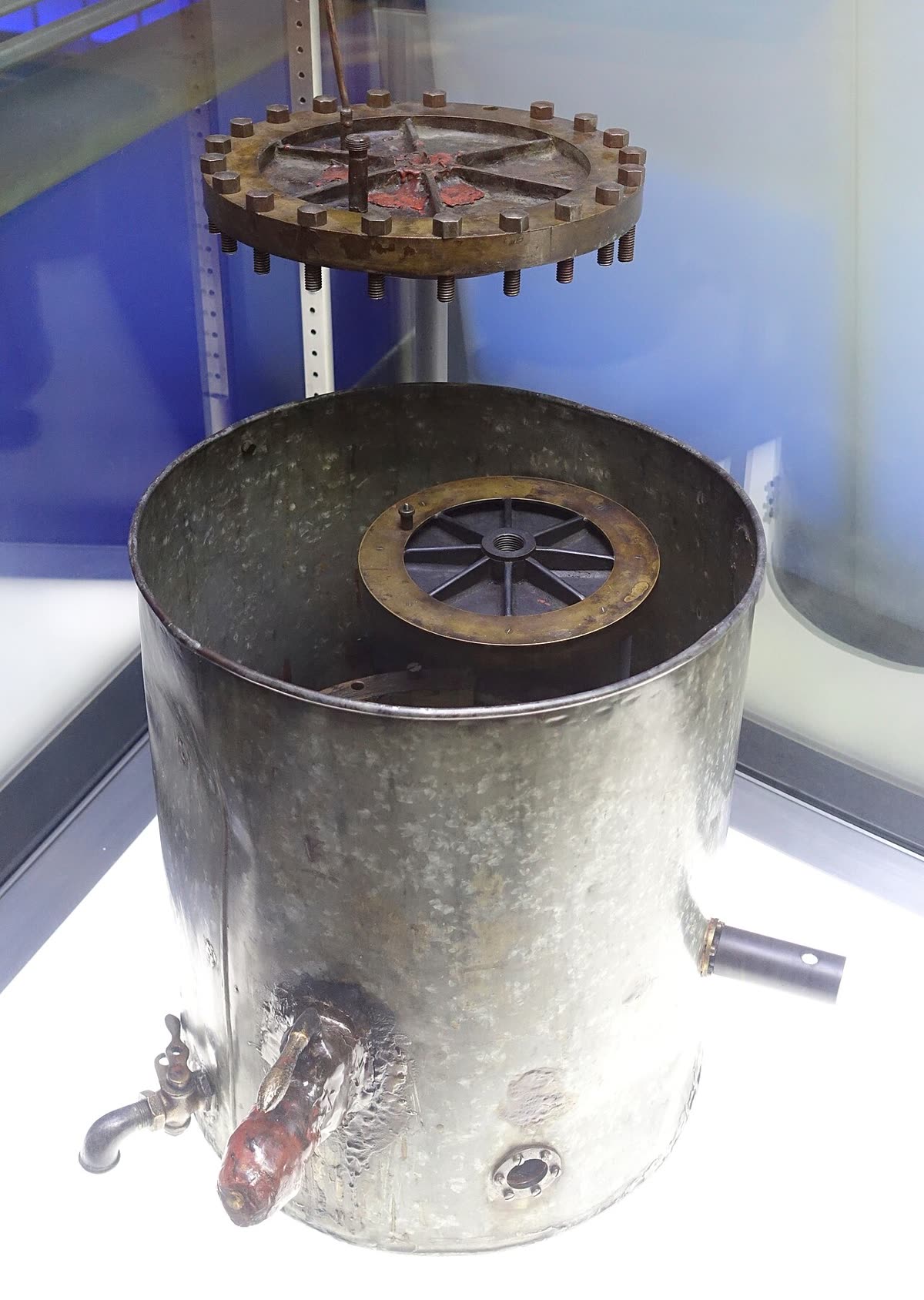
Daderot, 2014-08-22 11:14:24. CC0
So he set out to break it — and he picked the right target. Einstein's relation says the maximum electron energy is K = hν − φ. Measured as a stopping voltage, that becomes eV_stop = hν − φ which says: plot the stopping voltage against the frequency of the light and you must get a straight line. That is already a strong claim. Lenard's data were not good enough to establish linearity, and a curve that bent even slightly would be fatal.
Switch metals and watch what changes. The intercept moves; the slope does not.
The experiment is far harder than the equation suggests, and the obstacle is chemistry rather than physics. The work function is a property of a surface, not of a bulk material. And the metals with work functions low enough for visible light to work at all are the alkali metals — sodium, potassium, lithium — which are precisely the metals that react most violently with everything. A freshly exposed sodium surface begins oxidising within seconds of meeting the faintest trace of residual gas. Measure a tarnished surface and you are measuring the tarnish. Worse, you are measuring a tarnish that thickens while you work, so your numbers drift and you cannot tell physics from contamination.
A machine shop inside a vacuum tube
- The question
- Is Einstein’s photoelectric equation exactly right — is stopping voltage strictly linear in frequency, with a slope of h/e identical for every metal?
- The apparatus
- An evacuated glass vessel containing what Millikan called "a machine shop in vacuo". Inside it: cylinders of sodium, potassium and lithium on a rotating wheel, a sharpened cutting tool, and a Faraday cage to collect electrons — all operated from outside by electromagnets, so a fresh metal surface could be shaved in vacuum and rotated into the light beam without ever breaking the seal. Monochromatic light was selected from a mercury arc, and a retarding potential was raised until the photocurrent ceased.
If Einstein is right: a strictly straight line of stopping voltage against frequency, of slope h/e = 4.14 × 10⁻¹⁵ V·s, identical across all three metals, with the intercept giving each metal’s work function. If the light-quantum picture is wrong, the relation should bend, or the slope should vary between metals, or both.
Straight lines, over the visible and near ultraviolet, for all three alkali metals, with slopes agreeing among themselves. Planck’s constant extracted from the slopes: h = 6.57 × 10⁻²⁷ erg·s.
How sure could they be? Millikan quoted about 0.5%. The modern value is 6.626 × 10⁻²⁷ erg·s, so he was low by 0.85% — consistent with his stated uncertainty. It was the most accurate determination of h then available, and it came from a completely different phenomenon than Planck’s.
The decisive confirmation of the photoelectric equation, obtained by a distinguished experimentalist who had set out to refute it and said so in print. It also gave a third independent route to h, agreeing with the blackbody value from a wholly unrelated experiment. Millikan shared the 1923 Nobel Prize for this and for the elementary charge.
Einstein’s photoelectric equation … appears in every case to predict exactly the observed results … Yet the semicorpuscular theory by which Einstein arrived at his equation seems at present to be wholly untenable.
It is easy to read that as comedy. It is more useful read as a real distinction, carefully drawn. Millikan accepted the equation and rejected the mechanism. He believed the formula was exactly right, and that some other explanation — one not requiring light to be corpuscular — would eventually be found for why it held. Given that light demonstrably diffracts, interferes and polarises, and that Maxwell's equations were among the most successful in the history of science, that was not a foolish hope. He was wrong. But being wrong about the interpretation did not diminish the measurement by one part in two hundred, and he published the result that undermined his own position because that is what the data said. The separation is worth keeping: "is this formula right?" and "is the story behind it right?" are different questions, and they can have different answers for years at a time. Planck's law was right for a decade before anyone believed the quantum. Kepler's laws were right for eighty years before Newton explained them.
Millikan was a paragon of experimental integrity, and his data speak for themselves.
It would be unbalanced to leave it there. In the oil-drop papers, Millikan wrote that his published values represented "all of the drops experimented upon during 60 consecutive days". His surviving notebooks show otherwise: he observed substantially more drops than he published, and annotated them — "beautiful, publish", "something wrong", and in one case "very low, something wrong". Historians who have gone through the notebooks in detail, notably Allan Franklin, generally conclude that most exclusions were defensible on experimental grounds and that the published value was not materially changed by them. But the sentence in the paper was not true, and the fact that the conclusion survives does not make the misstatement acceptable. Selection is only legitimate when the criteria are stated in advance and reported — which is exactly the standard Eddington’s team met in 1919 and Millikan did not.
- 1905Einstein proposes light quanta. Millikan calls the hypothesis reckless.
- 1909Millikan’s oil-drop experiment measures the elementary charge to about 0.5%.
- 1912He begins the photoelectric work, intending to refute Einstein.
- 1916He confirms the equation to 0.5% — and declares the underlying theory untenable.
- 1923Compton shows X-rays carry momentum h/λ. Millikan shares the Nobel Prize.
- 1926Gilbert Lewis coins the word "photon".