Gravitational waves
Einstein predicted them in 1916, then published a paper in 1936 saying they did not exist. Confirming them took a century and an instrument that measures a length change of four parts in a billion billion.
- Say what a gravitational wave physically does, and why it is a stretch rather than a push
- Explain why the effect is so small, and what an interferometer does about it
- Describe what LIGO actually detected and how it was known not to be noise
If spacetime can bend, it ought to be able to ripple. Einstein worked this out in 1916, within months of the field equations, by taking the geometry to be flat space plus a small perturbation. Out of the linearised equations comes a wave equation, and the waves travel at exactly c. That last part is not an incidental detail. Newtonian gravity acted instantaneously across any distance — the flaw that made it irreconcilable with special relativity in the first place. A theory in which gravitational influence propagates at light speed must have gravitational waves, because "propagates" is what waves do.
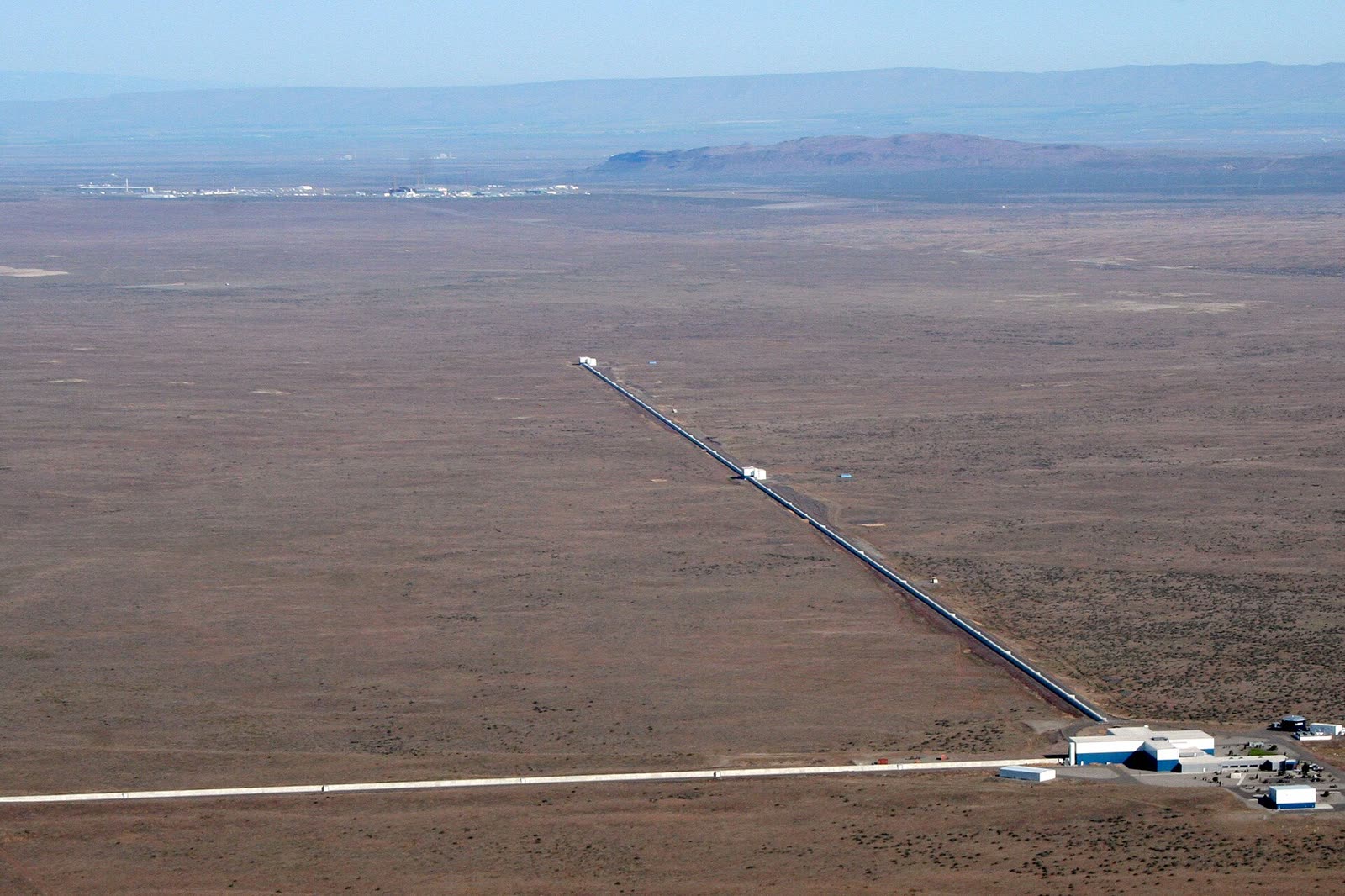
LIGO Laboratory, 2008-05-02 07:57:13. Public domain
And then Einstein spent twenty years unsure whether they were real. The difficulty is genuine, and it is the same one that confused everybody about black-hole horizons: in general relativity you can produce things that look like waves but are only your coordinate system wobbling. Describe flat, empty spacetime badly enough and it will appear to ripple. Distinguishing a physical wave carrying energy from a coordinate artefact carrying nothing is subtle, and in the 1930s the tools to do it cleanly did not exist. In 1936 Einstein and Nathan Rosen submitted a paper to Physical Review arguing that gravitational waves do not exist.
And the effect is fantastically weak, for the reason that was sitting in the field equations two lessons ago. The coupling constant 8πG/c⁴ is about 2 × 10⁻⁴³ in SI units. Spacetime is, in the relevant sense, extraordinarily stiff. So it takes something enormous, moving at a substantial fraction of light speed, in a violently asymmetric way, to produce a ripple anyone could hope to detect. In practice that means compact objects — black holes or neutron stars — in the final moments before they merge. And even then, by the time the wave has crossed a billion light-years to reach us, the strain is about one part in 10²¹.
Try the neutron-star preset — far lighter, so it merges at much higher frequency and takes a hundred times longer.
GW150914 — the first direct detection
- The question
- Do gravitational waves exist as physical, energy-carrying disturbances — and can a strain of 10⁻²¹ actually be measured?
- The apparatus
- Two Michelson interferometers with 4 km arms, Fabry–Pérot cavities giving an effective path near 1,600 km, 40 kg fused-silica mirrors on quadruple pendulum suspensions, and ultra-high vacuum. Two widely separated sites are essential: a real signal must appear at both, with a delay no greater than the 10 ms light travel time between them. The detectors had just finished a five-year, $200M upgrade and were two days into engineering runs — not yet formally observing.
A binary black hole merger should produce a chirp: amplitude and frequency sweeping upward, terminating in a merger and a damped ringdown, matching templates computed from general relativity in advance.
A chirp sweeping 35 → 250 Hz over 0.2 s, peak strain 1.0 × 10⁻²¹, arriving at Livingston 6.9 ms before Hanford. Best-fit parameters: black holes of 36 and 29 solar masses at about 410 Mpc, merging into a 62-solar-mass hole. Roughly 3 solar masses were radiated as gravitational waves.
How sure could they be? The false alarm rate was estimated at less than one per 203,000 years — a significance above 5.1σ — by time-shifting the two detectors’ data against each other to build up a background of accidental coincidences. The signal was strong enough to be visible by eye in the filtered data, which is not usually true of a first detection.
The last unconfirmed prediction of general relativity, verified 99 years after it was made. It also confirmed that stellar-mass black holes exist in binaries and merge within the age of the universe, neither of which had been directly observed. Weiss, Barish and Thorne received the 2017 Nobel Prize.
How do you know a one-off wiggle is not noise, or a fault, or somebody's prank? The last is not facetious. The collaboration deliberately ran blind injections: a tiny group secretly inserted fake signals into the data to test whether the analysis pipeline — and the several hundred people running it — would catch them honestly. In 2010 one such fake ("Big Dog") survived every check and reached a signed discovery paper before the envelope was opened and it was revealed as an injection. That is an unusually rigorous way to keep yourself honest, and it meant the 2015 checks were serious ones. For GW150914 the case rested on four things: Two detectors, 3,002 km apart, recorded the same waveform. Local noise does not do that. The 6.9 ms delay is less than the 10 ms light travel time between the sites, so the source direction is physically consistent. The waveform matched templates computed from general relativity years earlier — not fitted after the fact. The background was measured, not assumed. Sliding the two data streams against each other in time produces coincidences that cannot be real, building an empirical false-alarm distribution. Against it, this event sat beyond one in 200,000 years.
What this really did was open a new sense. Every instrument in the history of astronomy before it detected electromagnetic radiation — optical, radio, infrared, X-ray, gamma. Different wavelengths of the same phenomenon. Gravitational waves are not light, and they interact with matter so feebly that they pass through stars and planets essentially unimpeded. That is what makes them nearly impossible to detect, and it is also what makes them valuable: they carry information out of places light cannot leave. On 17 August 2017 that paid off immediately. Two neutron stars merged 40 Mpc away, and the event was seen both ways: a 100-second gravitational chirp, then a gamma-ray burst 1.7 seconds later, then some 70 telescopes on every continent and in orbit finding the optical afterglow within hours. That single event: confirmed gravitational waves travel at light speed to within about one part in 10¹⁵; identified neutron star mergers as a source of short gamma-ray bursts; and showed, from the spectrum of the fading glow, that such collisions forge much of the universe's gold, platinum and other heavy elements. Some meaningful fraction of the gold in any wedding ring was made in a collision like that one.
- 1916Einstein predicts gravitational waves from the linearised field equations.
- 1936He and Rosen submit a paper arguing the waves do not exist. The referee shows they are wrong.
- 1974Hulse and Taylor find a binary pulsar whose orbit decays at exactly the rate gravitational radiation requires — indirect but decisive. Nobel Prize 1993.
- 1994LIGO construction begins, after two decades of argument about whether it was possible.
- 2010Initial LIGO completes its runs having detected nothing, as expected.
- 2015Two days into Advanced LIGO engineering runs, GW150914 arrives.
- 2017GW170817: neutron stars seen in gravitational waves and light together. Nobel Prize to Weiss, Barish and Thorne.
Every plot on this page is a picture of a sound. The signal sweeps through human hearing range on its way up, so it can simply be played — and the rising chirp, then the sudden stop, is the clearest possible statement of what "inspiral, merger, ringdown" means. The simulation above can draw the waveform; it cannot let you hear a quarter of a second of it.