Black holes
Schwarzschild solved the field equations exactly within weeks, while serving on the Russian front. It took another forty years to work out that the horizon in his solution is not a place where physics breaks — it is a place where you cannot come back.
- Say what the event horizon is, and why nothing special happens there locally
- Explain why the distant and infalling accounts of a fall differ so completely, without either being wrong
- Describe how we know black holes exist, and what has actually been observed
Einstein published the field equations in November 1915 and doubted anyone would find an exact solution soon — they are ten coupled nonlinear equations, and he had reached Mercury only by approximation. Within about two months, Karl Schwarzschild had solved them exactly, for the spacetime outside a spherical mass. He did it while serving as a lieutenant in the German army on the Russian front, computing artillery trajectories by day. He posted the result to Einstein, who replied that he had not expected the solution to be so simple. Schwarzschild had contracted pemphigus, a rare and then-untreatable autoimmune disease, at the front. He died four months later, aged 42. The most famous solution in general relativity is named after a man who never saw what it meant.
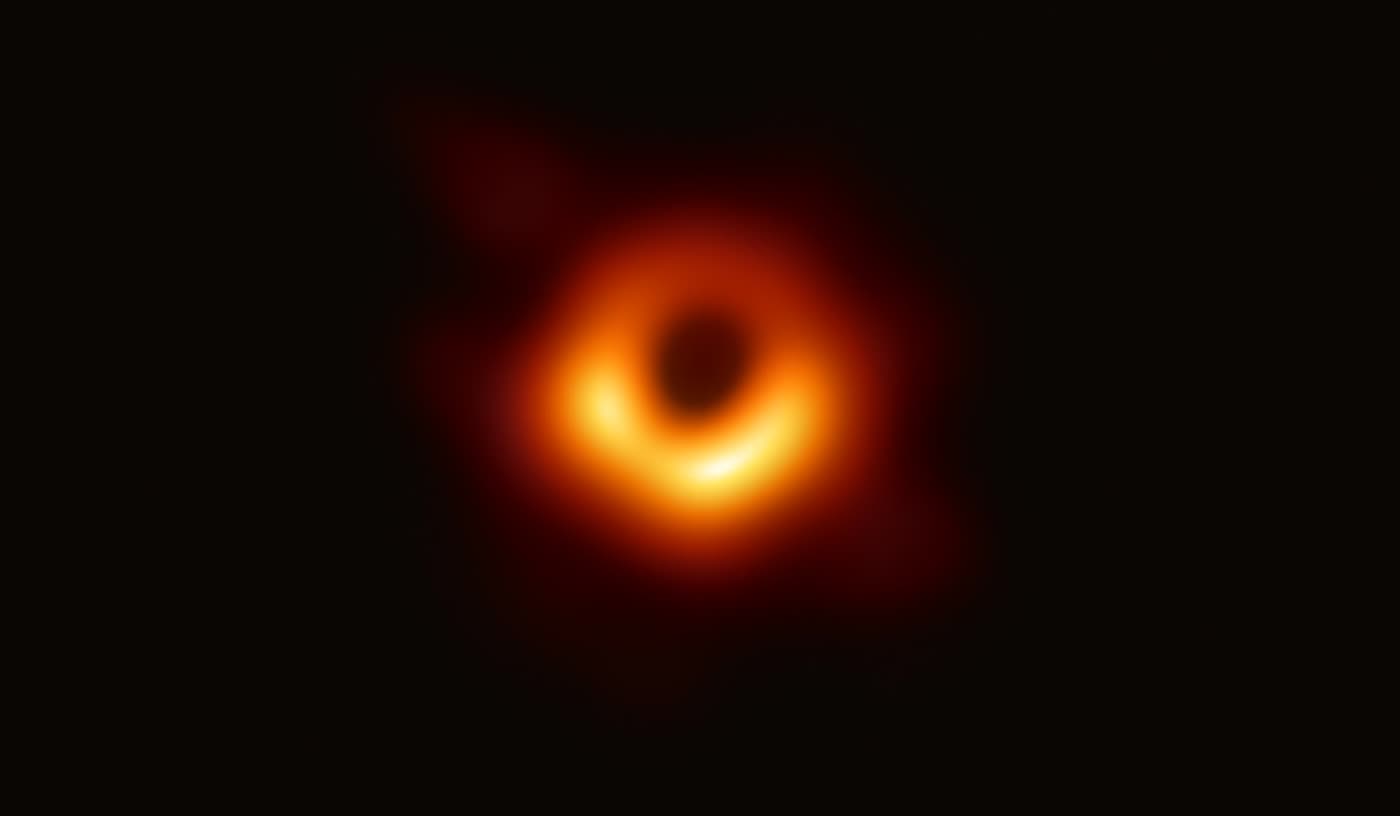
Event Horizon Telescope, circa April 2017. CC BY 4.0
The event horizon is a singularity — a place where physics breaks down and the theory stops working.
The horizon is a coordinate artefact, not a physical one, and the analogy that settles it is longitude at the north pole. Lines of longitude all meet there and the coordinate becomes meaningless; nothing whatsoever is wrong with the north pole. In exactly the same way, changing to better-behaved coordinates makes the horizon perfectly smooth. The test is to compute a curvature invariant — a quantity every observer agrees on — and at r = r_s it is finite and unremarkable. At r = 0 it genuinely diverges. Eddington spotted this in 1924 and Finkelstein made it explicit in 1958, forty-two years after Schwarzschild wrote the solution down.
Drag the ray inward past b = 5.20 and watch it stop coming out.
Drop a clock into a black hole and ask what happens to it. There are two answers, they are wildly different, and both are correct.
From far away. You watch the clock fall and slow down. Its ticks stretch out; its light reddens and dims. As it nears the horizon the redshift runs away without bound, and you never see it cross — it fades asymptotically, taking forever, getting darker until there is nothing left to detect. In your coordinates, the crossing simply does not happen. Riding with the clock. It falls in, crosses the horizon in a perfectly finite time, and notices nothing at all at the moment of crossing. No bump, no flash, no barrier. For a large enough hole, no local measurement of any kind would tell you it had happened.
What would actually kill you is the thing that survived the equivalence principle: tides. Gravity pulls harder on your feet than your head, and the difference stretches you. And here the result is backwards from intuition. The smaller the black hole, the more dangerous. Tidal stretching near the horizon scales as M/r³, and since r_s is proportional to M, the tidal force at the horizon falls off as 1/M². So falling into a 10-solar-mass hole, you are torn apart thousands of kilometres before reaching the horizon. Falling into Sagittarius A*, 4.3 million solar masses, the tidal stretching at the horizon is gentler than standing on the Earth. You would cross intact and entirely comfortable, with several minutes of proper time remaining.
Inside the horizon, something happens to the coordinates that is genuinely hard to picture: the radial direction becomes timelike, and time becomes spacelike. Moving further inward is no longer a direction you can choose or refuse. It is the passage of time. The singularity at the centre is not a place ahead of you in space; it is a moment in your future, and every possible path leads there. Turning around is as impossible as turning around in time was in Act 3 — and for exactly the same reason. And this is where general relativity stops being trustworthy. As r → 0 the curvature diverges without limit, and a theory of smooth geometry has nothing left to say about a place where the geometry is not smooth. The singularity is not a prediction to be believed; it is the theory announcing its own limit. What actually happens there requires quantum gravity, and nobody has one.
For decades all of this was a theorist's argument, and a fairly disreputable one — Einstein himself did not believe black holes formed in nature, and published a paper in 1939 arguing they could not. Oppenheimer and Snyder showed in the same year that gravitational collapse to a horizon is unavoidable for a sufficiently massive star. It is now a measurement, several times over. Cygnus X-1, found in 1971: an X-ray source where a visible star orbits an unseen companion of about 21 solar masses, compact enough that nothing else fits. The Galactic Centre. Since the 1990s, two teams have tracked individual stars orbiting the centre of our own galaxy — and one of them goes round fast enough to watch.
Weighing an invisible object by watching stars orbit it
- The question
- Is there a black hole at the centre of our galaxy? If so, tracking stars in orbit around it should reveal a mass far too large to be contained in a region that small by anything else.
- The apparatus
- Near-infrared imaging through adaptive optics, which corrects atmospheric blurring in real time and is what made the measurement possible at all — the Galactic Centre is invisible in optical light behind 30 magnitudes of dust. Later, the GRAVITY interferometer combined all four 8-metre VLT telescopes to reach astrometric precision of about 30 microarcseconds. Thirty years of patient annual astrometry, tracking individual stars through their orbits.
If the mass is a black hole, the orbits are Keplerian ellipses about a common focus containing several million solar masses in a region smaller than the solar system — and general relativity additionally requires the orbits to precess by 6πGM/c²p per revolution, exactly as for Mercury.
The star S2 has a 16.05-year orbit, reaching 7,650 km/s at closest approach — about 2.5% of light speed. The enclosed mass is 4.30 × 10⁶ solar masses. In 2020 the GRAVITY team measured S2’s Schwarzschild precession: about 12 arcminutes per orbit, with f_SP = 1.10 ± 0.19 where general relativity predicts exactly 1.
How sure could they be? The mass is now known to about 1%, and the precession to roughly 20%. Because the orbit has been followed for more than a full period, the result does not depend on extrapolating a partial arc — the star has been watched all the way round.
The most direct evidence that black holes exist: a mass of 4.3 million Suns confined inside a region smaller than our solar system, which no known matter can do. And the precession is the same term as Mercury’s 43″ per century — 6πGM/c²p — evaluated where the field is some 11,000 times stronger, giving a precession 7,300 times larger per orbit. One formula, two widely separated regimes.
In April 2019 the Event Horizon Telescope published a photograph. Eight radio observatories, from Hawaii to the South Pole, were combined by very-long-baseline interferometry into a single instrument effectively the size of the Earth, and pointed at the centre of the galaxy M87. The data — several petabytes — had to be flown on hard drives because no network could carry it. The result is a bright asymmetric ring around a dark centre: light bent around a shadow. The shadow is about 2.6 times the diameter of the horizon, because light passing near it is deflected into the ring, and its size matches the general-relativistic prediction for a 6.5 × 10⁹ solar mass black hole to about 10%. In 2022 the same collaboration produced the image of Sagittarius A* at the centre of our own galaxy — a far harder target, because it varies on timescales of minutes rather than days.
- 1916Schwarzschild solves the field equations exactly, from the Russian front. He dies four months later.
- 1935Eddington publicly ridicules Chandrasekhar for arguing that collapse cannot be stopped.
- 1939Oppenheimer and Snyder show collapse to a horizon is unavoidable. Einstein publishes a paper arguing it is not.
- 1958Finkelstein shows the horizon is a coordinate artefact, not a singularity — 42 years late.
- 1967Wheeler popularises the name "black hole".
- 1971Cygnus X-1 identified as a black hole candidate.
- 2019The Event Horizon Telescope images the shadow of M87*.
- 2020Genzel and Ghez share the Nobel Prize; GRAVITY measures S2’s Schwarzschild precession.