Relativity in your pocket
Both of Einstein’s theories, pulling opposite ways, in a machine four billion people carry. Get either one wrong and your position drifts eleven kilometres a day.
- Explain how satellite navigation actually works, and why it is a clock problem rather than a distance problem
- Compute both relativistic corrections and say which dominates and why
- Judge the common claim that GPS "proves" relativity, and what it actually shows
Start with how satellite navigation actually works, because most people have it slightly wrong. Your phone does not talk to the satellites. It only listens. There is no two-way exchange, no handshake, and the satellites have no idea you exist — which is why the system serves unlimited users at once. Each satellite continuously broadcasts a signal that says, in effect: I am satellite 11, my orbit is described by these numbers, and the time is now. Your receiver picks up several of these and compares each timestamp against its own idea of the current time. The difference is how long that signal has been in flight. Light covers a fixed distance per unit time, so a time difference is a distance, and four satellites give you enough to solve for latitude, longitude, altitude and your own clock error together.
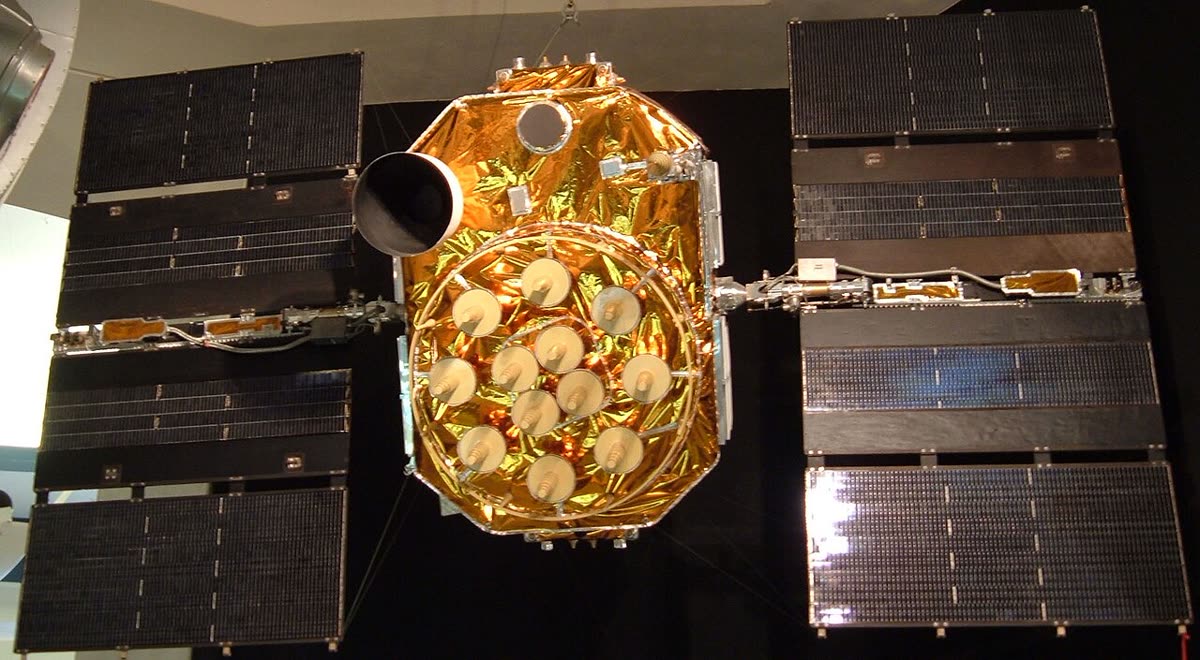
Scott Ehardt, 2005-06-02 20:25:02. Public domain
And each satellite sits in a situation where both of Einstein's theories apply strongly, in opposite directions. Special relativity. The satellite orbits at about 3.87 km/s. A moving clock runs slow. This costs about 7 microseconds a day. General relativity. It sits 20,184 km up, where the gravitational potential is much shallower. A higher clock runs fast. This gains about 46 microseconds a day. The two do not cancel. Gravity wins by roughly a factor of six, and the net is about +38.5 microseconds per day.
Compare GPS with the ISS — the balance flips, and somewhere between them the two effects cancel exactly.
It is worth sitting with what 38 microseconds a day means operationally, because the failure is not graceful. After 2 minutes: about 16 metres of error — already worse than the system's specification. After 1 hour: about 480 metres. Your phone would place you in the wrong part of town. After 1 day: 11.6 kilometres, and growing without limit. There is no regime in which an uncorrected system is approximately right. It would work for a few seconds after synchronisation and then diverge for ever.
GPS proves relativity — it would not work otherwise, so relativity must be right.
This overstates a good point. A functioning GPS is not really a test: the correction is applied by design, and had the physics been wrong, engineers would have discovered a systematic drift during commissioning and fitted an empirical offset until the system worked. Any theory predicting the same 4.47 × 10⁻¹⁰ would do. What GPS genuinely demonstrates is subtler and arguably better — that relativity is not an exotic effect confined to accelerators and neutron stars, but a routine engineering constraint. There are people whose day job requires getting relativistic corrections right and who would not describe themselves as physicists. That is a stronger statement about a theory’s maturity than another decimal place.
Launching the correction switched off
- The question
- Does an atomic clock in a 12-hour orbit actually run fast by 38 microseconds a day, as general and special relativity together require?
- The apparatus
- NTS-2, the first satellite carrying a caesium beam atomic clock into high orbit, tracked against ground-based clocks. The frequency synthesiser was built with the relativistic offset available but switchable — a deliberate compromise, because there was genuine disagreement within the programme about whether the correction was real and necessary. It was launched with the correction turned off.
General relativity plus special relativity predict a net gain of about +38 microseconds per day relative to ground clocks — a fractional rate offset of 4.5 × 10⁻¹⁰.
Tracking over about 20 days showed the clock running fast at 4.42 × 10⁻¹⁰ against a predicted 4.46 × 10⁻¹⁰. The synthesiser was switched on and has been on in every navigation satellite since.
How sure could they be? About 1% on the rate offset, limited by the stability of the caesium standard and by uncertainties in the orbit. Modern versions of the measurement do far better: two Galileo satellites accidentally launched into elliptical orbits in 2014 had a varying altitude, which turned them into a redshift experiment and improved on Gravity Probe A by a factor of about five.
The one moment when satellite navigation genuinely tested relativity rather than assuming it. After 1977 the correction became a design parameter, which is why a working GPS is evidence of engineering maturity rather than a live experiment. It is also a nice historical corrective: the physics was not universally accepted by the engineers building the system, and they arranged to find out.
The same corrections apply to every satellite navigation constellation — Russia's GLONASS, Europe's Galileo, China's BeiDou. None of them can work without both theories. Galileo also handed relativity an accidental gift. In August 2014 a launch failure put two satellites into the wrong orbits — significantly elliptical instead of circular. They were nearly written off. Instead, physicists realised that a satellite whose altitude varies over each orbit is a gravitational redshift experiment that runs continuously for years: the clock should speed up and slow down in step with its height. Two groups analysed several years of that data and measured the redshift to about 2.5 parts in 10⁵, improving on the 1976 Gravity Probe A result by roughly a factor of five. A launch failure produced the best measurement of its kind.
- 1955Friedwardt Winterberg proposes testing relativity with atomic clocks in orbit — before satellites exist.
- 1977NTS-2 launches with the relativistic correction switchable, and switched off. It is turned on within a month.
- 1978The first operational GPS satellite launches, correction built in.
- 1983GPS is opened to civilian use after the KAL 007 shootdown.
- 2000Selective Availability is switched off; civilian accuracy improves tenfold overnight.
- 2014Two Galileo satellites are launched into wrong orbits — and become a redshift experiment.
- 2018The Galileo analyses improve on Gravity Probe A by a factor of five.