Reactions that stop halfway
Forward and back at the same rate, and a quotient that always lands on the same number however you get there. The evidence is a reaction run from both ends at once, and a label that moves through a mixture whose composition never changes.
- Explain why a reaction reaching the same mixture from both ends forces both directions to be running
- Write the equilibrium quotient for a reaction and say what K does and does not depend on
- State Le Chatelier’s principle precisely enough that it stops giving wrong answers
- Predict a shift by comparing Q with K, rather than by asking what the system would "want"
Start with the picture of chemistry that this lesson takes apart, because it is a good one and it was built out of real work. A reaction goes, or it does not. Torbern Bergman published the great affinity tables in 1775: for every substance, a ranked list of the others that would drive it out of a compound. Silver above copper, copper above lead, and so on down. Look up your two reagents, find which sits higher, and you know what will happen. And the tables worked. They were assembled from thousands of real displacements, they predicted new ones correctly, and every assayer and apothecary in Europe could use them. This is not a superstition being cleared away. It is a working instrument with an assumption buried inside it. The assumption is completeness. If A drives B out, it drives all of B out. Affinity is a fixed property of a pair of substances, like a rank in an army, and the outcome of putting them together does not depend on how much of each you brought. That last clause is the one that fails, and the evidence for its failing turned up in a place nobody was looking.
Claude-Louis Berthollet went to Egypt with Bonaparte in 1798, as one of the scientists attached to the expedition, and on the shores of the salt lakes west of the Nile delta he saw something the affinity tables forbade. Sodium carbonate — natron — crusting out of the ground. The lakes sat on limestone, calcium carbonate, and the water was thick with common salt. The tables said the reaction ran the other way: sodium carbonate plus calcium chloride gives limestone plus salt, reliably, in any laboratory in Europe. Here was the reverse happening on a scale you could shovel. Berthollet drew the right conclusion. Affinity is not the only thing that decides. The quantity present decides too — enough salt standing over enough limestone, with the products removed as they form, will run a reaction backwards against its own affinity. He published it in the Essai de statique chimique in 1803. It is worth saying plainly that Berthollet is remembered mainly for being wrong. He argued that compounds did not have fixed compositions, lost that argument to Proust over eight years, and lost it decisively. He was right about this, and being right about this is the more useful of the two.
The formation and decomposition of ethers
- The question
- Berthollet said quantity matters. Does a reaction have a definite stopping point that depends on nothing but the amounts you started with — and if so, can it be reached from either side?
- The apparatus
- Acetic acid and ethanol, sealed into glass tubes in measured amounts and held hot for weeks at a time, some for over a year. The acid remaining was measured by titration. Then the mirror run: ethyl acetate and water, equal amounts, sealed and held the same way.
On the affinity view, the reaction should run until one reagent is exhausted. On Berthollet’s view it should stop somewhere short, at a place set by the quantities — but nobody had said the two directions had to agree.
Equimolar acid and alcohol stopped at about two thirds conversion, with a third of the acid still present and the tube still hot. Ester and water, sealed alone, decomposed until the mixture was two thirds ester. Both tubes end up holding the same four substances in the same proportions.
How sure could they be? The runs were long enough to remove any doubt that the endpoint was simply "not finished yet" — some tubes were held for more than a year without moving further. The limit is reproducible to the accuracy of the titration, and it is untouched by how much total material is in the tube, because two species on each side means the volume cancels.
A reaction with a definite stopping point that can be reached from either end cannot be a one-way process that halts. Something must be running in both directions at once, and the mixture sits where the two directions balance. Everything in this lesson is a consequence of those two sealed tubes.
Take a moment on why two thirds is such a hard number to explain away. It is not exhaustion. A third of the acid is still in the tube. If the reaction were a one-way process running to completion, it has no reason to be sitting next to a reagent it could still consume. It is not slowness. The tubes reached this point and then held it for a year. A reaction that is merely slow gets further given a year. It is not the apparatus. Change the size of the tube and nothing moves: this particular reaction has two molecules on each side, so the concentrations cancel and dilution does not touch the answer. Change the proportions you start with and the endpoint moves in a way you can calculate. And it is not one-directional. That is the sealed tubes of ester and water. They arrive at the same mixture with no acid or alcohol anywhere in sight at the start. One explanation covers all four at once.
Two runs of the same reaction, one from each end. Watch where the curves finish, then drag K and watch both endpoints move together.
Cato Maximilian Guldberg and Peter Waage — a mathematician and a chemist, brothers-in-law, working in Christiania, the city now called Oslo — wrote the rule down in 1864. Their claim, the law of mass action: the rate at which a reaction proceeds is proportional to the "active masses" of the substances reacting, meaning their concentrations. Equilibrium is where the forward expression and the backward expression are equal. And the ratio that falls out of setting them equal is a constant for that reaction at that temperature. They published it in Norwegian, in the proceedings of the academy in Christiania. Nobody read it. They published a French edition in 1867. Nobody read that either. It took a German edition — Ueber die chemische Affinität, in the Journal für praktische Chemie — in 1879, fifteen years after the original, and even then it landed only because Jacobus Henricus van ’t Hoff had reached the same law independently in the meantime and the subject had become fashionable. Guldberg and Waage were not obscure figures pushing a crank idea. They were correct, in print, and in the wrong language. This site keeps running into that shape, and it is worth naming: being right and being read are different achievements, and the second one is mostly about where you are standing.
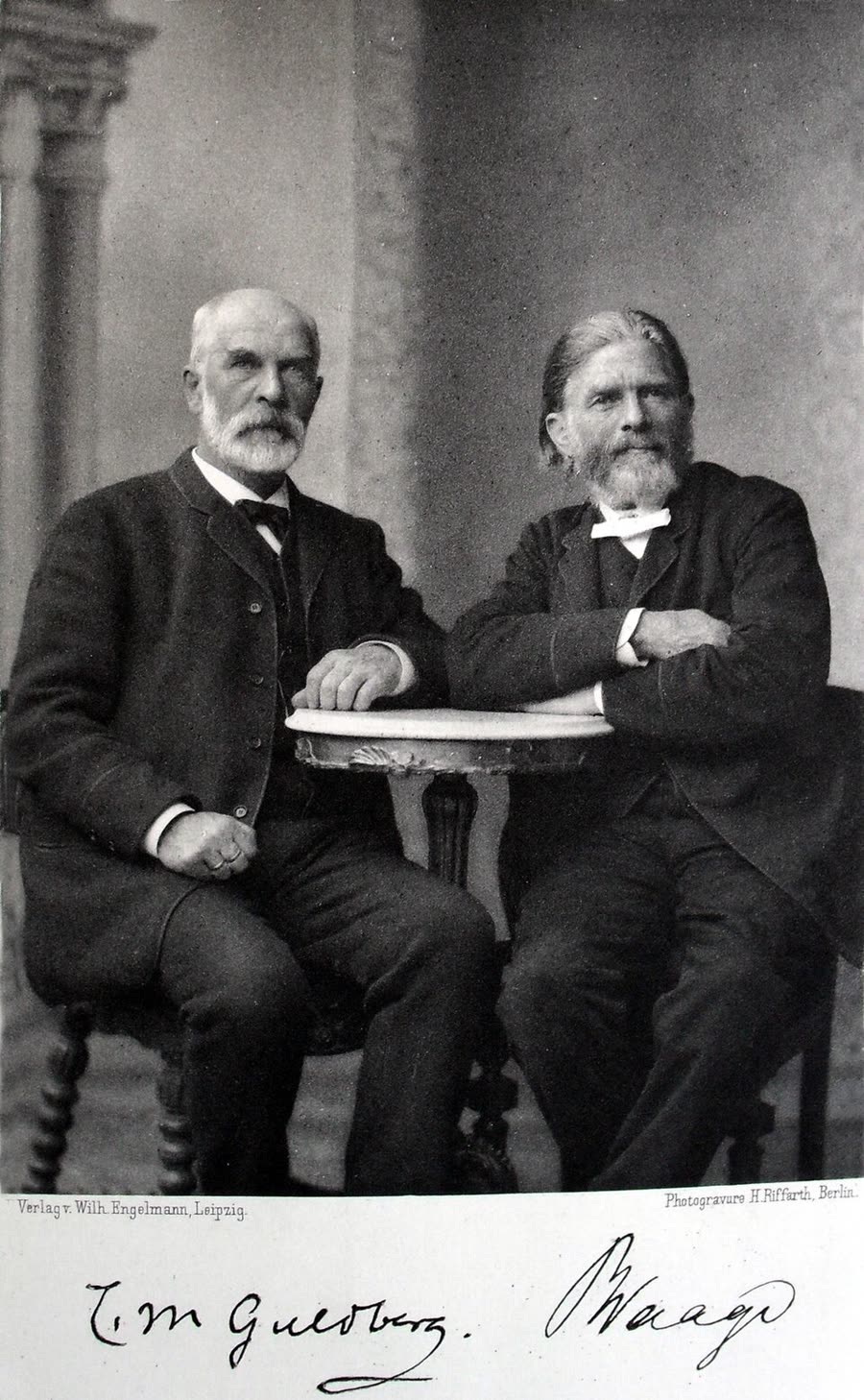
Photogravure by H. Riffart, Berlin. Scanned, image processed and uploaded by Kuebi = Armin Kübelbeck, prior or equal 1891. Public domain
Let the counts settle, then label the unreacted acid and leave the mixture completely alone. Watch the labelled count, and watch the total.
Isotopic exchange in a saturated solution
- The question
- A solid sitting under its own saturated solution has a concentration that does not change, for days. Is anything happening?
- The apparatus
- A radioactive isotope of the metal — Hevesy and Paneth used radium-D, which is lead-210, from the radium decay chain — added to the solution as a tracer. Chemistry cannot separate isotopes; a Geiger counter can detect a vanishingly small number of them. That combination is the entire trick, and it is why the method was worth a Nobel Prize.
If saturation is a static balance — the solid has finished dissolving, the solution has finished depositing — the label should stay in the solution. Composition says nothing is happening, and nothing is what you should find.
Filter the solid out and count it, and the label is in the solid. Leave it longer and the label distributes itself between solid and solution in exactly the proportion the amounts of each would predict. Not one measurable property of the mixture changed while this happened.
How sure could they be? The sensitivity is the point. A counter registers individual disintegrations, so it detects quantities of tracer far below anything a balance or a titration could see — which is what allows the experiment to be run without disturbing the equilibrium it is measuring.
This is the direct evidence that equilibrium is dynamic, and there was no way to get it before isotopes. Composition is blind to it: two mixtures with identical concentrations, one genuinely inert and one exchanging atoms furiously, are indistinguishable by every classical measurement. The label is the only thing that can tell them apart, and it says every equilibrium anyone has looked at is the second kind.
Henry Louis Le Chatelier stated the general rule in 1884, in a note to the Comptes Rendus; Karl Ferdinand Braun arrived at it independently in 1887, which is why it is sometimes the Le Chatelier–Braun principle. What everyone learns is the short version: disturb a system at equilibrium and it shifts to oppose the disturbance. What Le Chatelier wrote is longer, uglier, and full of conditions — and the conditions are the part doing the work. His statement restricts itself to a change in temperature or in "condensation", says the change must be applied from outside, and, crucially, describes the response as the internal change that would if it occurred alone push back on that same variable. Every one of those clauses is load-bearing. The short version drops all of them, and once they are gone it will happily give you the wrong sign. The honest replacement is not harder. Work out the reaction quotient Q from whatever amounts you now have, and compare it with K. If Q is less than K the reaction runs forward; if Q is greater, it runs back; if they are equal, nothing happens. That rule tells you the direction and how far, and it has no exceptions to memorise.
Predict each push before you make it. Start with the sealed vessel and add argon — then switch to constant pressure and try the same four again.
Disturb a system at equilibrium and it shifts to oppose the disturbance.
This is a mnemonic that behaves like a law, which is the worst thing a mnemonic can do. Three cases where it gives the wrong answer, all of them ordinary. Argon into a rigid vessel. The total pressure rises, so the slogan predicts a shift towards the side with fewer moles of gas. Nothing moves at all. K is written in the partial pressures of the reacting gases, and adding an inert gas at constant volume changes not one of them. Argon into a vessel at constant pressure. Now the mixture has to expand to make room, every reacting partial pressure falls, and the equilibrium shifts towards the side with MORE moles — backwards, and in the opposite direction to the previous case, from what the slogan treats as the same disturbance. Extra nitrogen at constant pressure, into a mixture that is already nitrogen-rich. Adding a reactant is supposed to make more product. Past the point where nitrogen is half the gas, extra nitrogen dilutes the hydrogen faster than it feeds the reaction, and you get less ammonia than you had. The replacement rule is not harder: compute Q from the amounts you actually have and compare it with K. Below K it goes forward, above K it goes back. That version is exact, it tells you the size of the shift as well as its direction, and it does not need a list of exceptions bolted onto it.
From the wrong end
Ethyl acetate and water are sealed into a tube in equal amounts — 1.00 mol of each, and no acid or alcohol whatsoever. The equilibrium constant for the esterification is K = 4.0. How many moles of ester are left when the tube stops changing?
- Reaction
- CH₃COOH + C₂H₅OH ⇌ CH₃COOC₂H₅ + H₂O
- K at this temperature
- 4.0
- Starting mixture
- 1.00 mol ester, 1.00 mol water
- Acid and alcohol present
- none
Every system in stable chemical equilibrium, submitted to the influence of an exterior force which tends to cause variation either in its temperature or its condensation — pressure, concentration, number of molecules in unit volume — either as a whole or in some of its parts, can undergo only those interior modifications which, if they occurred alone, would produce a change of temperature, or of condensation, of a sign contrary to that resulting from the exterior force.
- 1775Bergman’s affinity tables: for every substance, a ranked list of what displaces it. Reactions go, or they do not.
- 1799Berthollet, on the Egyptian expedition, finds sodium carbonate forming where the tables say it cannot.
- 1803Essai de statique chimique: quantity matters as much as affinity, and a reaction can be pushed backwards.
- 1862Berthelot and Péan de Saint-Gilles reach the same ester mixture from both ends, in sealed tubes held for a year.
- 1864Guldberg and Waage state the law of mass action. In Norwegian.
- 1867A French edition. Still nobody reads it.
- 1877Van ’t Hoff reaches the same law independently, and is heard.
- 1879A German edition of Guldberg and Waage, fifteen years late, and the law finally acquires their names.
- 1884Le Chatelier states the principle, hedged with conditions that will be dropped from every later retelling.
- 1887Braun states it independently.
- 1913Hevesy and Paneth invent the radioactive tracer, which will finally make a dynamic equilibrium visible.