The reaction that gets cold
Dissolve ammonium nitrate and the beaker chills your hand — and it happens anyway. Heat cannot be what decides. What decides is the entropy of the whole universe, and Gibbs found a way to compute that using only what is in the flask.
- State the Thomsen–Berthelot principle, and the everyday counterexample that sinks it
- Derive ΔG = ΔH − TΔS from the entropy change of the universe, and say why that rearrangement is the whole point
- Get the signs right, and read off which of the four cases a reaction is in
- Work out the temperature at which a reaction changes its mind
Chemistry had a word for why reactions go long before it had an answer. Affinity. Iron has an affinity for oxygen; silver has an affinity for chlorine; put a metal into a solution of a salt of a metal it beats and it will displace it. Étienne Geoffroy printed a table of affinities in 1718, and it worked: it told you which displacements would happen and which would not, for a great many pairs. But a ranking is not a theory. It says A beats B without saying what A has more of, and it cannot tell you anything about a pair you have not already tried. Worse, the tables turned out to be conditional — heat a mixture and the order could change, which on a picture of affinity as a fixed attraction between substances makes no sense at all. What chemistry wanted was a quantity: something you could measure for each reaction, in numbers, and use to predict a reaction nobody had yet run. By the middle of the nineteenth century there was an obvious candidate sitting on the bench, and it had just been made measurable.
Heat. Julius Thomsen, in Copenhagen, proposed from 1854 that the heat given out by a reaction is the measure of its affinity. Marcellin Berthelot, in Paris, arrived at the same idea by 1867 and stated it as a law — the principle of maximum work: every chemical change accomplished without the intervention of outside energy tends towards the production of the substance or system of substances that sets free the most heat. Before dismissing it, notice how good a proposal this is. It makes affinity measurable, with an instrument that already existed, in units that already meant something. It explains the direction of most reactions correctly. The overwhelming majority of reactions that run on their own do give out heat. As a rule of thumb it is right far more often than it is wrong, which is exactly what makes a wrong principle dangerous. It comes with a mechanism you can picture — reactions rolling downhill into the lowest energy state available, the same way a ball does. Both men were formidable experimentalists, and both spent decades filling the tables that everything after them was checked against. Thomsen published four volumes of thermochemistry; Berthelot built the bomb calorimeter that is still recognisably the modern instrument. The principle was not lazy thinking. It was the best available answer, and it was wrong in a way that took a very ordinary experiment to show.
Dissolving ammonium nitrate
- The question
- If reactions go in the direction that releases heat, what should a strongly heat-absorbing change do?
- The apparatus
- Water, a thermometer, and ammonium nitrate — which is extraordinarily soluble, around 190 g in 100 mL of water at room temperature. Stir in a substantial quantity and watch the thermometer. The commercial version is a sealed pouch of water inside a bag of the solid: squeeze it, the inner membrane bursts, and the two meet.
On the Thomsen–Berthelot principle, a change that absorbs heat is running uphill in affinity and should not proceed on its own — or at best should proceed feebly and stop.
It dissolves immediately, completely, and vigorously, while taking 25.69 kJ of heat in for every mole that goes into solution. The temperature falls by twenty degrees or more; a cold pack reaches close to freezing within a minute and stays there. Nothing is driving it and nothing needs to be.
How sure could they be? The size of the effect is what makes it decisive. This is not a marginal case sitting inside the uncertainty of a calorimeter — it is 25.7 kJ/mol in the forbidden direction, on a reaction so complete that no unreacted solid is left. Nor is it a rarity: ammonium chloride, potassium nitrate and urea all do the same thing, and so does melting ice.
Heat cannot be the criterion. Something else is being gained, it is worth more than 25.7 kJ/mol at room temperature, and it is not in the enthalpy table at all.
The second term is the number of ways. A crystal of ammonium nitrate is one arrangement. Every ion in its assigned place in a lattice, vibrating a little, and essentially nothing else it could be doing. A dissolved crystal is a colossal number of arrangements. Two ions per formula unit, each free to be anywhere in the liquid, in any orientation, exchanging places with water molecules constantly. The count of arrangements is not slightly larger. It is larger by a factor with a great many zeroes in it. Entropy is the logarithm of that count. Boltzmann’s S = k log W is carved on his gravestone, and for this reaction the change comes out at +108.7 joules per kelvin for every mole dissolved. Now the crucial move, and it is a move about units. Entropy is measured per kelvin, so to compare it with an energy you multiply by the temperature: TΔS = 298 × 0.1087 = +32.4 kJ/mol at room temperature — against the 25.69 kJ/mol the dissolution costs in heat. The entropy term is bigger. That is the whole answer. And notice what has just happened to the argument: the balance between the two now depends on T, which means the direction of a reaction can depend on how warm it is. Nothing in the heat-only picture could ever have said that.
The cold pack is loaded. Read ΔH, then TΔS, then their difference — and then press Sweep the temperature and find where the line crosses zero.
Four sign combinations, along the bottom. Step through the reactions and watch which box lights up — and where the crossover line falls when there is one.
The man who wrote this down was Josiah Willard Gibbs, professor of mathematical physics at Yale — appointed in 1871, and for the first nine years unpaid, on the reasoning that he had private means and did not need a salary. He published On the Equilibrium of Heterogeneous Substances in two parts, in 1876 and 1878, in the Transactions of the Connecticut Academy of Arts and Sciences. It is worth being blunt about what that meant. The Transactions was a local journal, kept going largely by subscriptions from New Haven businessmen who could not have read a page of it. Its circulation was tiny. Gibbs’s paper runs to some three hundred pages of dense algebra with almost no worked examples, and it contains — in one go — the phase rule, chemical potential, the thermodynamics of surfaces and mixtures, and the free energy function this lesson is about. It is arguably the most important paper in the history of physical chemistry, and it was published where essentially none of the chemists who needed it would ever encounter it. It reached them by three accidents. James Clerk Maxwell read Gibbs’s earlier geometrical papers, was delighted, built a plaster model of the thermodynamic surface for water with his own hands and posted a cast of it to New Haven — and then died, in 1879, aged 48, before he could do much more. Wilhelm Ostwald translated the whole thing into German in 1892, calling it, accurately enough, the founding of a science. Henry Le Chatelier translated it into French in 1899. So the delay between the work existing and the work being usable was roughly sixteen years, and it was closed by translators rather than by chemists finding it. Meanwhile Helmholtz had arrived at the same free-energy idea independently in Germany in 1882, from a different direction, and it was largely his version that Continental chemists first argued about. Gibbs himself never made much of any of it. He lectured to classes that were sometimes empty, lived in the house he grew up in, and did not appear to mind.
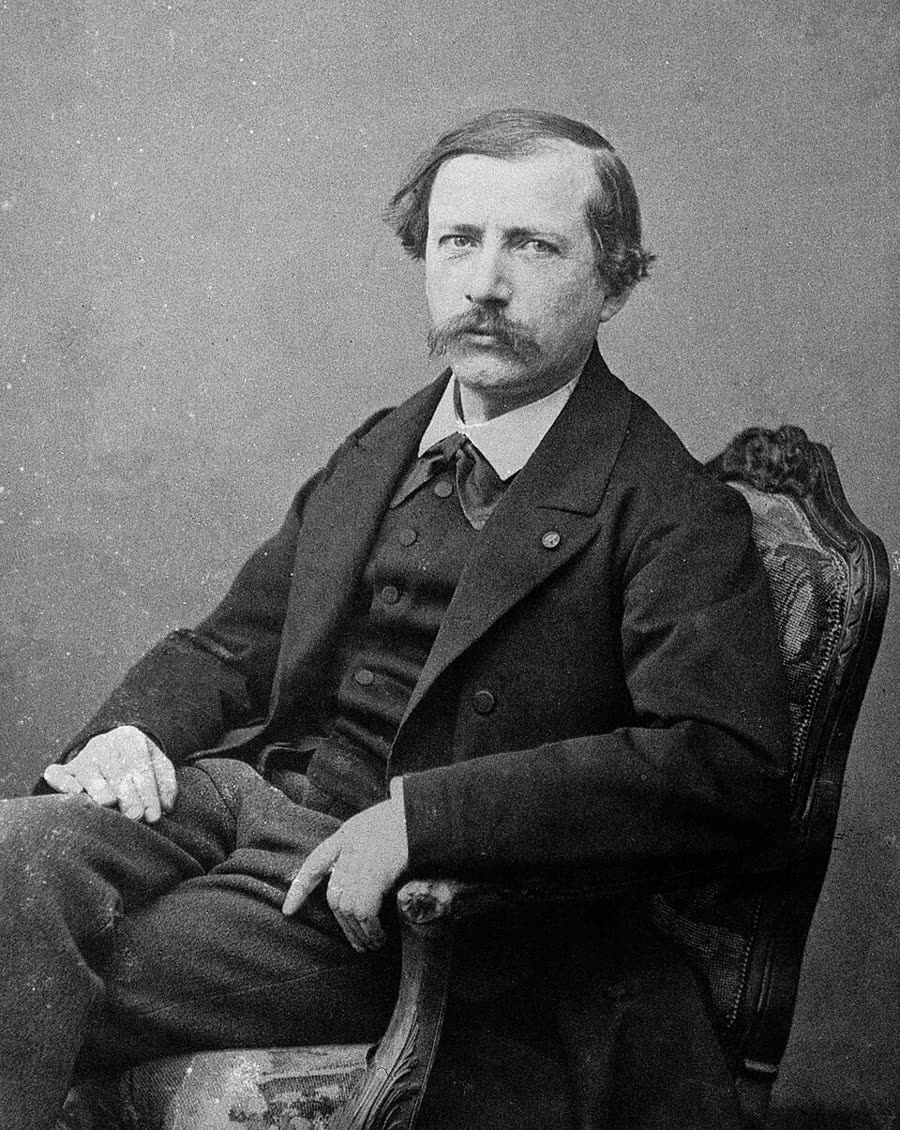
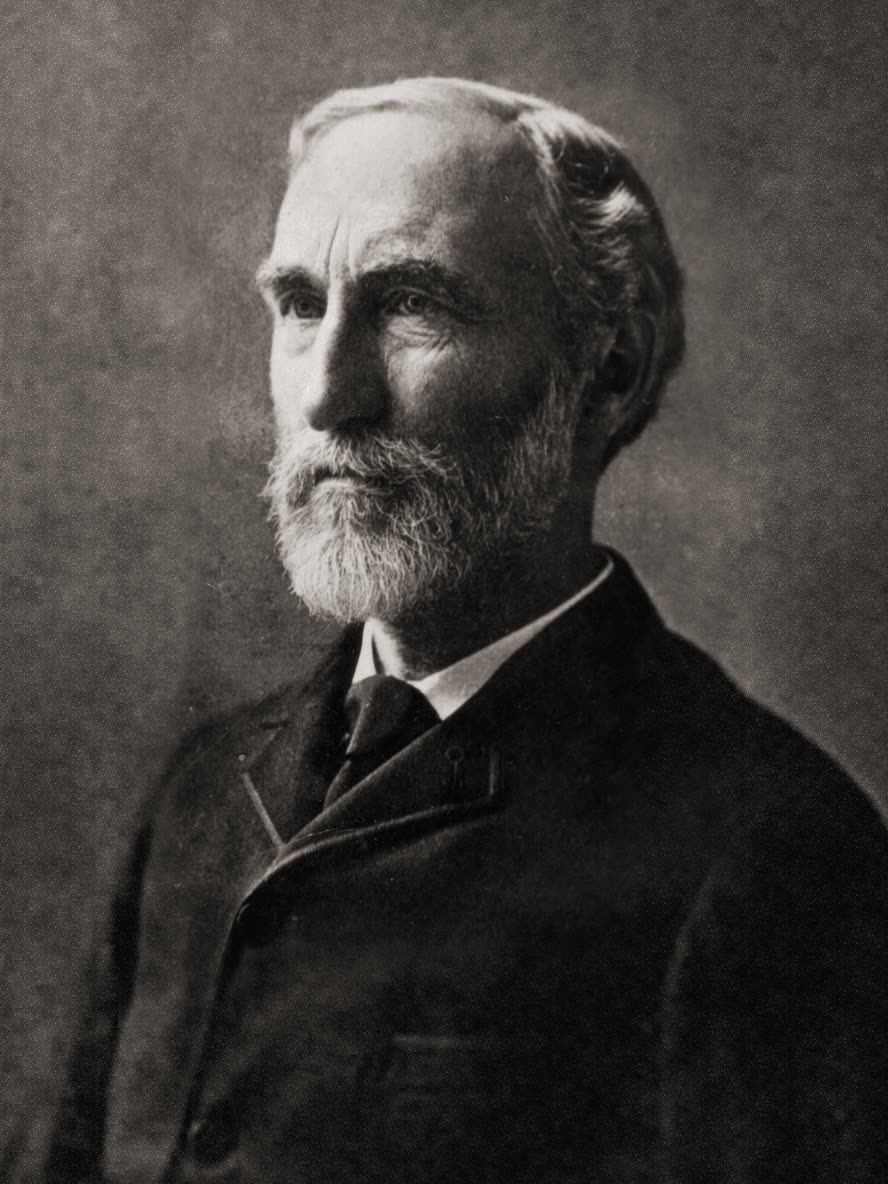
Unknown. Uploaded by Serge Lachinov (обработка для wiki), before 1903. Public domain
A spontaneous reaction is one that happens quickly, or starts on its own.
"Spontaneous" is a technical word here and it means one thing only: thermodynamically allowed, with no continuous input of work needed. It says nothing whatever about speed. A bottle of hydrogen peroxide has ΔG around −234 kJ per two moles at room temperature — ΔH supplies −196 of that and the entropy term the rest — is downhill in both terms at every temperature, and keeps for a year on a shelf — until you drop a scrap of liver into it, at which point it foams over the bench. A jar of hydrogen mixed with oxygen has ΔG of −237 kJ/mol and will sit unchanged for centuries until a spark arrives. Diamond turning into graphite is spontaneous at room temperature and takes longer than the age of the universe. Thermodynamics tells you which way water runs downhill; it says nothing about whether there is a dam in the way, how high the dam is, or whether anybody has built a channel round it. That second question is a different subject with different equations, and every one of the examples above is waiting on it.
How hot does a lime kiln have to be?
Limestone decomposes to quicklime and carbon dioxide: CaCO₃(s) → CaO(s) + CO₂(g). Chalk sits in fields indefinitely, so at ordinary temperatures this does not go. A kiln makes it go. Using the table below, find the temperature above which ΔG° becomes negative. Give it in kelvin.
- ΔfH°(CaCO₃, s)
- −1207.6 kJ/mol
- ΔfH°(CaO, s)
- −634.9 kJ/mol
- ΔfH°(CO₂, g)
- −393.51 kJ/mol
- S°(CaCO₃, s)
- 91.7 J/(mol·K)
- S°(CaO, s)
- 38.1 J/(mol·K)
- S°(CO₂, g)
- 213.79 J/(mol·K)
The energy of the world is constant. The entropy of the world tends to a maximum.
- 1718Geoffroy prints a table of affinities. It works, and explains nothing.
- 1854Thomsen proposes that the heat evolved is the measure of chemical affinity.
- 1865Clausius names entropy and states the two laws in two sentences.
- 1867Berthelot states the principle of maximum work: reactions go the way that gives out the most heat.
- 1876Gibbs publishes the first part of On the Equilibrium of Heterogeneous Substances in the Transactions of the Connecticut Academy.
- 1879Maxwell, one of the few readers, dies at 48 — having built a plaster model of Gibbs’s thermodynamic surface and posted a cast to him.
- 1882Helmholtz reaches free energy independently, and shows that it, not the heat, measures affinity.
- 1884Van ’t Hoff’s Études de dynamique chimique. The new thermodynamics starts being used by chemists.
- 1892Ostwald translates Gibbs into German; Le Chatelier into French in 1899. Sixteen years after publication, the work arrives.
- 1903Gibbs dies in New Haven, in the house he grew up in.