The experiments
Fifty years of a determined sceptic being given nowhere left to stand — ending with detector settings taken from the light of quasars, so that any conspiracy would have had to be arranged before the Earth existed.
- Name the three loopholes and say why each is a legitimate objection
- Explain what a loophole-free test has to do simultaneously, and why that is hard
- Say what the results establish, and what remains logically open
The first person to actually build it was John Clauser, with Stuart Freedman at Berkeley, in 1972. He had trouble getting permission. He was told repeatedly that it was a waste of time, that the answer was known, and that it would damage his career — and it did damage his career; he had difficulty securing permanent positions for years afterwards, and eventually left academic physics. And like Bell, Clauser expected Einstein to be right. He has said since that he was very sad to find otherwise, and that he had rather hoped to overthrow quantum mechanics. Their source was calcium atoms excited to a state that decays through a two-photon cascade, the pair polarisation-correlated by conservation of angular momentum. They measured a violation of the inequality. And the experiment left two doors open.
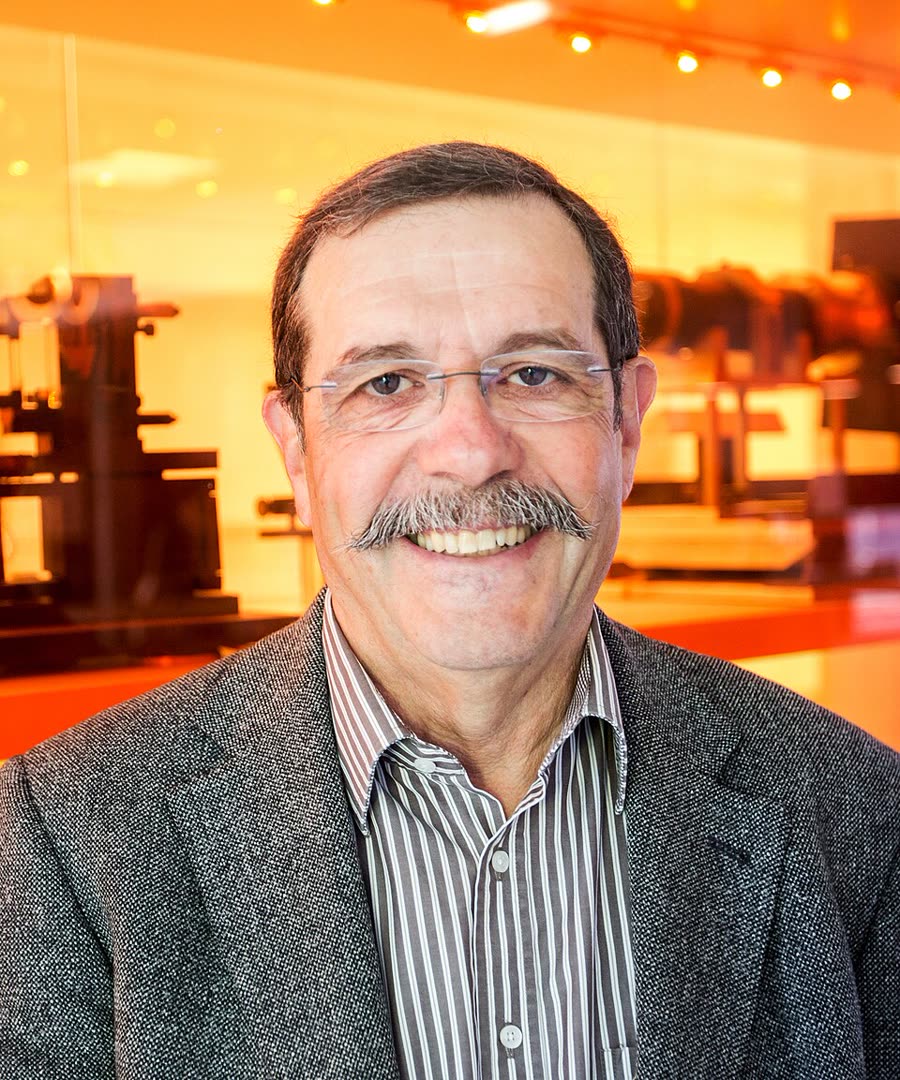
Ecole polytechnique Université Paris-Saclay, 2016-05-03 08:01. CC BY-SA 2.0
Switching the analysers while the photons are in flight
- The question
- Do entangled photons violate Bell’s inequality even when the detector settings are changed after the photons have left the source — so that no signal at light speed could carry the choice from one detector to the other?
- The apparatus
- A calcium-40 two-photon cascade source, pumped by lasers, producing polarisation-entangled pairs at a rate high enough for good statistics. The 1982 two-channel experiment used polarising beamsplitters measuring both outputs rather than discarding one. The switching experiment used acousto-optical switches — standing ultrasonic waves in water acting as diffraction gratings — to redirect each photon to one of two differently oriented polarisers, changing every 10 ns, with the detectors 6.5 m apart.
Local realism requires S ≤ 2. Quantum mechanics predicts about 2.70 for this apparatus — below the ideal 2√2 because real sources, imperfect polarisers and finite collection angle all reduce the visibility.
Two-channel experiment: S = 2.697 ± 0.015, against a Bell bound of 2 — a violation by 46 standard deviations, and 95.4% of the maximum quantum mechanics permits. Switched-analyser experiment: S = 2.404 ± 0.080, a 5σ violation with the settings changing faster than light could cross between the wings.
How sure could they be? Light needs 21.7 ns to travel 6.5 m; the switches changed every 10 ns, so the setting on one side genuinely changed faster than the news could arrive at the other. Aspect was careful about the residual weakness: the switching was quasi-periodic rather than random, so a sufficiently determined sceptic could argue the pattern was in principle predictable. He said so in the paper.
The result that made Bell tests mainstream physics rather than a curiosity. It substantially closed the locality loophole and largely removed the fair-sampling assumption, and its sheer statistical weight — 46σ — made the violation impossible to attribute to noise. Aspect shared the 2022 Nobel Prize with Clauser and Zeilinger.
Aspect measured 2.697 against a bound of 2 — 95% of the way to the quantum maximum.
Aspect closed the locality loophole substantially, and was careful to say so rather than claim more. His switching was quasi-periodic rather than genuinely random, so a determined sceptic could argue the pattern was in principle predictable in advance. That was closed properly in 1998, in Innsbruck, by Weihs, Zeilinger and colleagues: genuinely random settings from quantum random number generators, with the detectors 400 metres apart and the whole choose-and-measure sequence completed well inside the light travel time. The detection loophole was closed separately, and later. First in 2001 with trapped beryllium ions at NIST, where essentially every event is registered — but the ions were only micrometres apart, so locality was wide open. Then with photons in 2013, once superconducting nanowire detectors reached efficiencies above 70%.
It was achieved in 2015, by three groups independently within months of each other. Delft (Hensen and colleagues) used electron spins in nitrogen-vacancy centres in diamond, 1.3 km apart across the university campus, entangled by a scheme that swaps entanglement through photons detected at a midpoint. Detection of the spin state is near-perfect. The technique is desperately inefficient — they recorded 245 events in total — and that was enough for a violation. Vienna (Giustina and colleagues) and NIST (Shalm and colleagues) did it with photons, using the new high-efficiency superconducting detectors and fast random switching. All three closed locality and detection at the same time. There is no longer a version of local realism that survives any of them.
Bell tests have closed every possible loophole, so nothing remains open.
Superdeterminism cannot be experimentally refuted, and honesty requires saying so. Any test involves choices — by a machine, a quasar or a human — and superdeterminism holds that those choices were themselves fixed by the same past that fixed the particle properties. The quasar experiments push the required conspiracy back billions of years; they cannot eliminate it, and no experiment can. A few serious physicists take this seriously, notably Gerard ’t Hooft. Most do not, on the grounds that a universe arranged to make experiments systematically misleading would undermine the possibility of doing science at all. That is an argument from consequences rather than from evidence, and it is worth noticing the difference. What can be said is that the alternative has been made extraordinarily expensive: it now requires a conspiracy older than the solar system.
- 1972Freedman and Clauser perform the first Bell test. Clauser is warned it will damage his career, and it does.
- 1982Aspect switches the analysers while the photons are in flight: S = 2.697 ± 0.015.
- 1998Innsbruck closes the locality loophole properly, with truly random settings at 400 m.
- 2001NIST closes the detection loophole with trapped ions — but at micrometre separation.
- 2015Delft, Vienna and NIST independently close locality and detection simultaneously.
- 2017–18Settings taken from starlight, then from quasars 7.8 billion light-years away.
- 2018The BIG Bell Test: 100,000 humans generate the settings for twelve laboratories.
- 2022Nobel Prize to Clauser, Aspect and Zeilinger.