Qubits
Three hundred of them hold more amplitudes than there are atoms in the universe, and you can read out three hundred bits. Which is why the popular account of quantum computing — trying every answer at once — is not merely simplified but wrong.
- Say what a qubit is and locate any state of one on the Bloch sphere
- Explain why the phase is invisible to measurement and matters anyway
- Say why quantum computers are not fast because they try everything in parallel
Something changed in the 1980s, and it changed the field completely. For fifty years the strangeness of quantum mechanics had been a problem — something to be interpreted, argued over, or set aside in favour of getting on with the calculation. Then people began asking a different question. Not what does this mean, but what is it good for. Not how to explain superposition away, but: given that it is real, thoroughly confirmed, and not going anywhere — what can be built with it? Nothing in the foundations was resolved. The measurement problem sits exactly where Act 6 left it. What changed was that the strangeness became a resource rather than an embarrassment.
OJB Quantum, 2024-05-22 11:25:29. CC BY 4.0
Drag θ and watch the probabilities move. Then drag φ and watch them not move.
Try H, then H again. Then try Z and watch the probabilities refuse to change.
A qubit in superposition is like a coin spinning in the air — it is really 0 or 1, we just do not know which yet.
The H gate settles this in one move. Take |0⟩, apply H, and you have a 50/50 state. Apply H again and you get |0⟩ back with certainty, every time. If the first H had produced a genuine random 0 or 1 that you merely did not know, the second could not undo it — randomising twice gives you more randomness, not less. What is being manipulated is an amplitude, which can be reversed and can cancel. The double-Hadamard is the single-qubit version of the double-slit result from Act 6: adding a second operation can make an outcome go away entirely, and no ignorance-based account permits that.
Measure, then measure again. Notice how little you learn the second time.
A quantum computer is fast because it tries all 2ⁿ possible answers simultaneously.
This is the standard popular account and it is wrong, not merely simplified — and you can see why from the Holevo bound above. Suppose the machine really did evaluate every possibility at once. You still have to read the answer out, and reading out gives you one of them, chosen at random by the Born rule. You would have performed an exponential amount of work to obtain a random guess, which you could have had for free. Parallelism without a way to select the right branch is worthless. What actually happens is interference: the algorithm arranges the phases so that amplitudes leading to wrong answers cancel and amplitudes leading to right answers reinforce. It is not a search of a large space — it is the construction of an interference pattern whose bright fringes are the answers you want. Shor’s algorithm is, at bottom, a very clever way of making the period of a function appear as a sharp peak, in much the same sense as a diffraction grating.
So what is it actually good for? Less than the coverage suggests, and it is worth being specific. Exponential speedup, for a short list of structured problems. Factoring large numbers (Shor, 1994), which is why the field is funded. And simulating quantum systems — chemistry, materials, catalysis — which is probably the application that will matter most, and which is the one Feynman proposed in 1981 on the straightforward grounds that if nature is quantum, a quantum machine is the natural thing to model it with. Quadratic speedup for unstructured search (Grover, 1996). Useful, and much less dramatic: it turns 10¹² operations into 10⁶, not into 40. Nothing at all, for most of what computers do. Word processing, databases, rendering, the overwhelming majority of ordinary computation gains nothing. A quantum computer is not a faster computer. It is a machine that is good at a peculiar and narrow class of problem, and the class happens to include two extremely valuable members.
Making an electrical circuit behave as a single qubit
- The question
- Superposition is established for photons, electrons and atoms. Can a manufactured, macroscopic object — a circuit built by lithography, containing billions of atoms — be made to behave as a single controllable two-level quantum system?
- The apparatus
- A "Cooper-pair box": a superconducting island connected through a Josephson junction, cooled to around 30 mK, so small that adding one Cooper pair changes its energy appreciably. The two charge states of the island play the roles of |0⟩ and |1⟩. Short voltage pulses drove transitions between them, and the resulting charge state was read out through a probe junction.
If the circuit is genuinely a two-level quantum system, varying the pulse duration should produce coherent oscillation between the states — the population moving smoothly back and forth, rather than saturating at 50% as an incoherent process would.
Coherent oscillations, with the state cycling as a function of pulse length. The circuit was behaving as a single quantum object with a definite phase, not as a statistical ensemble of its billions of constituent atoms.
How sure could they be? Coherence lasted around 2 nanoseconds — enough to see a few oscillations and nothing more. That figure is the reason the result mattered and also why it looked, at the time, like a curiosity rather than a technology. Superconducting qubits now reach coherence times of order 100 microseconds, an improvement of roughly 10⁵.
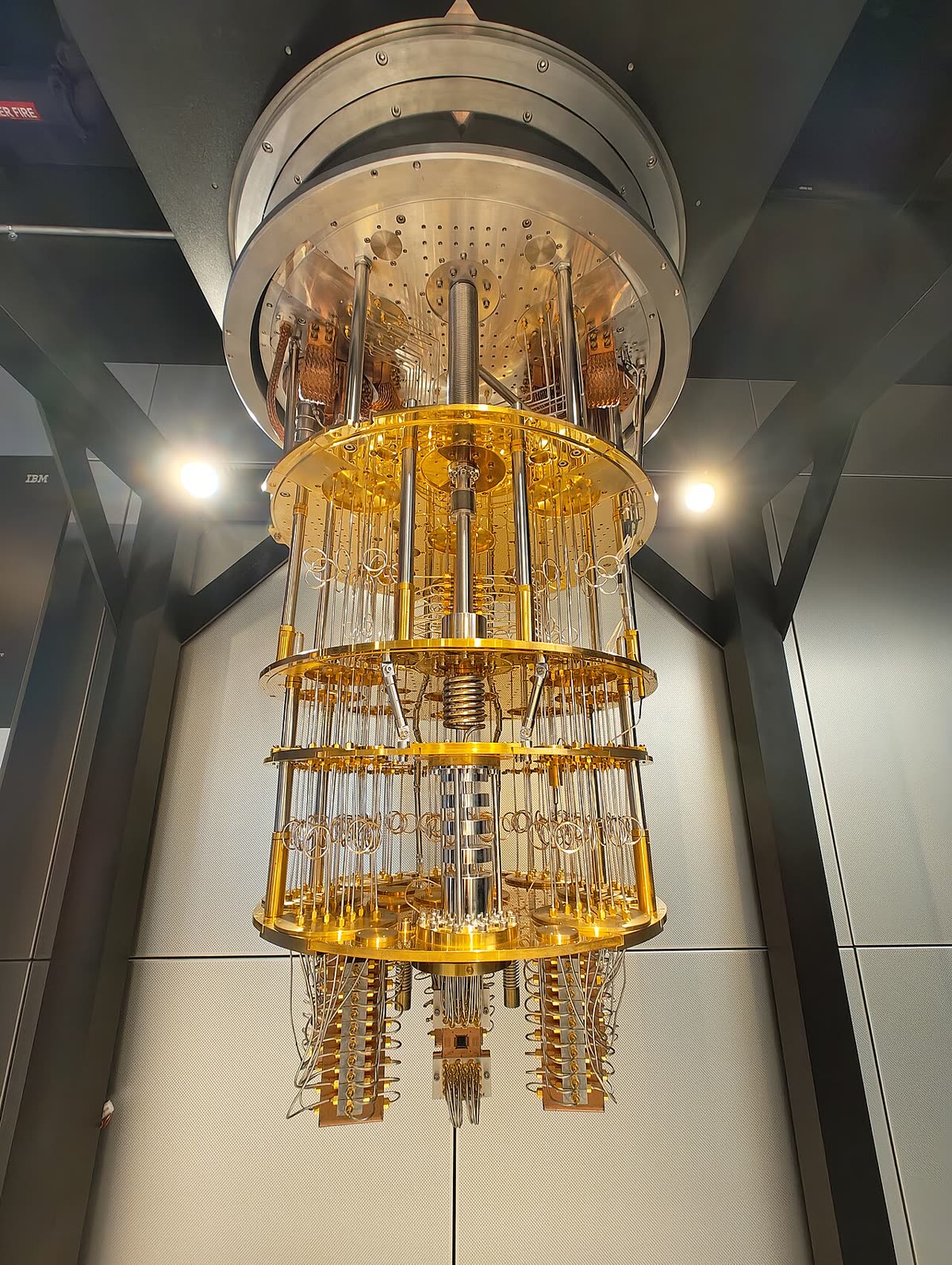
The birth of the solid-state qubit, and the ancestor of essentially every superconducting quantum processor built since. It also makes a point about scale: the object was fabricated, macroscopic, and made of ordinary metal — and it held a superposition. Whatever separates quantum behaviour from classical, it is evidently not size.
- 1973Holevo proves that n qubits can carry at most n classical bits.
- 1981Feynman proposes quantum computers for simulating quantum systems.
- 1985Deutsch defines the universal quantum computer.
- 1994Shor’s factoring algorithm. Funding follows.
- 1996Grover’s search algorithm — quadratic, not exponential.
- 1999Nakamura and colleagues demonstrate a superconducting qubit.
- 2019–Processors reach tens then hundreds of qubits; error correction remains the obstacle.