Bell's theorem
An accelerator engineer at CERN, working on it in his spare time, proved that a thirty-year-old philosophical dispute could be settled by counting. He expected the answer to favour Einstein.
- Follow the counting argument and see that it uses no physics at all
- State the three assumptions the theorem actually requires
- Say what the theorem does and does not rule out
John Stewart Bell was born in Belfast in 1928 to a working-class family. He left school at sixteen because there was no money for more, and took a job as a laboratory technician at Queen's University — where the staff, recognising what they had, let him attend lectures. He eventually took a degree in experimental physics, then a second in mathematical physics, then a doctorate, and ended up at CERN designing particle accelerators. That was his job. Foundations of quantum mechanics was his hobby — his own word — pursued in evenings and on sabbaticals, and kept deliberately separate from the work he was paid for. Part of the reason for that separation was professional. In the 1950s and 60s, worrying about the foundations of quantum mechanics was regarded as slightly disreputable: a sign of philosophical confusion, or of not having enough real work to do. Bell was careful.
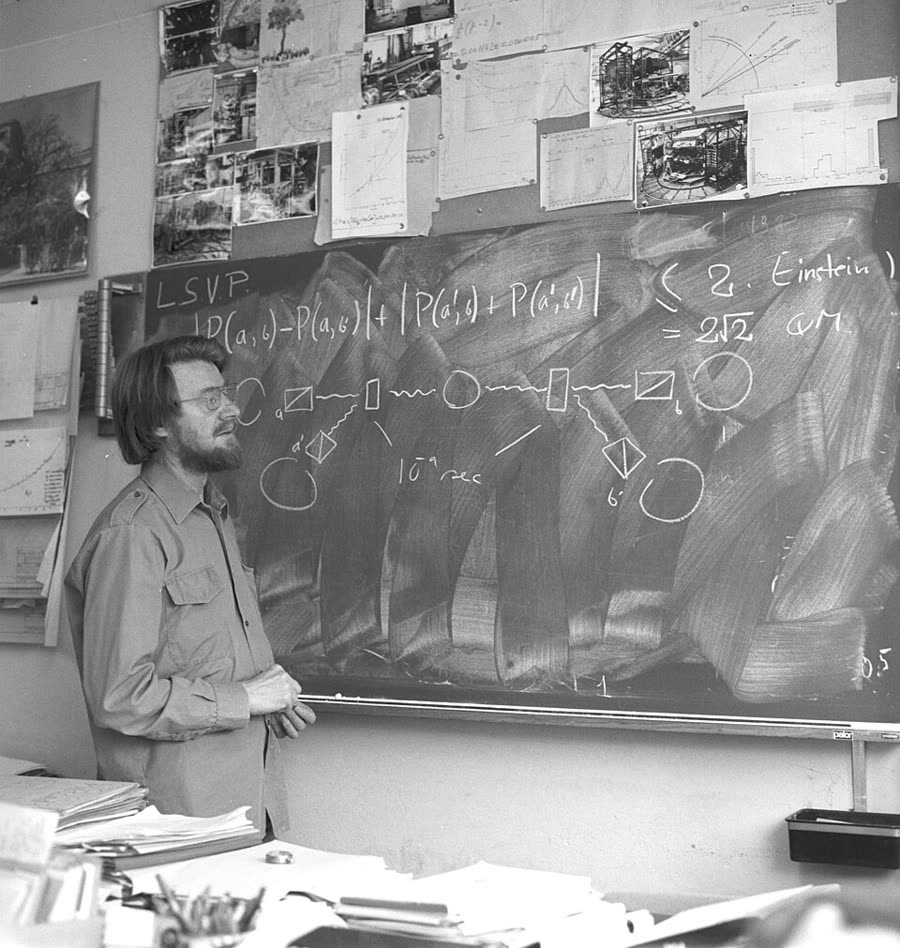
CERN, 1982-06-24. CC BY 4.0
There was a specific reason the question was considered closed. In 1932 John von Neumann published a proof that hidden-variable theories are impossible. Von Neumann was among the most formidable mathematicians of the century; the proof appeared in a rigorous and intimidating book; and for three decades it was taken to have settled the matter. If hidden variables are mathematically impossible, then Einstein's programme is not merely unfashionable but incoherent, and there is nothing left to argue about. Max Born said the proof showed that no concealed parameters could be introduced. It was cited, repeatedly, as the end of the discussion.
Von Neumann proved that hidden-variable theories are impossible.
He proved something much weaker than was claimed for it. The mathematics is correct; the trouble is an assumption smuggled into the setup — that a hidden-variable theory must assign values to sums of observables additively, even for observables that cannot be measured together. No sensible hidden-variable theory has that property, and Bohm’s does not. Bell put it bluntly: von Neumann’s proof was not merely false but foolish. And here is the uncomfortable part — Bell was not first. Grete Hermann, a mathematician and philosopher who had studied under Emmy Noether, published exactly this criticism in 1935, three years after the proof appeared. She was ignored for over forty years, and her paper was not widely known until the 1970s. A generation of physicists believed a question was closed because nobody read the person who had reopened it.
The bound is not a quantum quantity — no local theory of any kind can pass it.
Real experiments use a different but equivalent form, due to Clauser, Horne, Shimony and Holt in 1969 — the CHSH inequality. It is preferred for two practical reasons. It needs only two settings per side rather than three, which halves the apparatus. And it is stated in terms of correlations rather than counts, so it tolerates detectors that miss most of the particles — which every real detector does. It combines four correlation measurements into one number: S = |E(a,b) − E(a,b′) + E(a′,b) + E(a′,b′)| Every local realist theory gives S ≤ 2. Quantum mechanics predicts 2√2 ≈ 2.828 at the optimal settings. And 2√2 is not merely the quantum answer — it is the maximum any quantum state can reach, a limit known as the Tsirelson bound. Which raises a question nobody has fully answered: why does quantum mechanics violate the classical bound, but not maximally? Theories exist that would give S = 4 without permitting signalling. Nature apparently declines to use them.
Bell proved that hidden variables are impossible, and that quantum mechanics is non-local.
Neither. Hidden variables are alive. Bohmian mechanics is a fully worked hidden-variable theory that reproduces every quantum prediction and survives Bell comfortably — by being frankly, explicitly non-local. What Bell rules out is the conjunction of hidden variables and locality. And the theorem does not single out locality as the casualty. It shows that at least one of realism, locality and free choice must go; which one is an interpretive choice. Many-worlds, for instance, claims to preserve locality by abandoning single definite outcomes. Most importantly, the theorem is not about quantum mechanics at all. It is a constraint on any local realist theory whatsoever. If quantum mechanics were overturned tomorrow, Bell’s inequality would stand unchanged, and the measured violations would still demand an explanation.
The paper nobody read
- The question
- Can any theory in which particles carry definite properties, with no influence between distant measurements, reproduce the correlations quantum mechanics predicts for entangled pairs?
- The apparatus
- None — a two-page derivation. The essential move was to consider correlations at unmatched detector settings, which nobody had examined because both theories agree at the aligned, perpendicular and opposed configurations that everyone naturally tried.
Bell was a realist by inclination, admired Bohm’s theory, and thought Einstein had been treated poorly by the historical record. He expected to find that local hidden variables could reproduce the correlations, or failing that, that experiments would come out on Einstein’s side.
Local hidden variables cannot reproduce them. Any such theory obeys an inequality that quantum mechanics violates by a factor approaching 1.87 in the counting form, and reaches 2√2 against a bound of 2 in the CHSH form.
How sure could they be? It is a proof, so exact — but its significance is that it converts a philosophical dispute into a measurable quantity. The paper appeared in Physics Physique Fizika, a new journal that paid its contributors and folded after four issues; Bell never claimed his fee. It went essentially uncited for five years.
Thirty years of argument about whether quantum mechanics is complete turned out to have an experimental answer, and the answer was obtainable with equipment that already existed. Bell built the instrument that could refute his own preference, published it, and urged people to use it. Nobody did for eight years.
For me, it is so reasonable to assume that the photons in those experiments carry with them programs, which have been correlated in advance, telling them how to behave. This is so rational that I think that when Einstein saw that, and the others refused to see it, he was the rational man.
- 1932Von Neumann publishes his impossibility proof. The question is considered closed.
- 1935EPR. And Grete Hermann finds the flaw in von Neumann, to no effect whatever.
- 1952Bohm builds a working hidden-variable theory — which should have ended the impossibility claim, and did not.
- 1964Bell’s theorem, in a journal that folds after four issues.
- 1966Bell publishes his critique of von Neumann — written earlier, delayed two years by an editorial mishap.
- 1969CHSH give the form experiments can actually use.
- 1972Freedman and Clauser perform the first test.