The Standard Model
Seventeen fields and about two dozen numbers nobody can explain. It has survived every experiment aimed at it for fifty years, predicted particles decades before they were found, and its own authors regard it as obviously incomplete.
- List what the Standard Model contains, and say which of its numbers are predictions and which are inputs
- Explain what the Higgs field does, and why it is the exception among all the fields
- Say what the theory gets spectacularly right and what it does not address at all
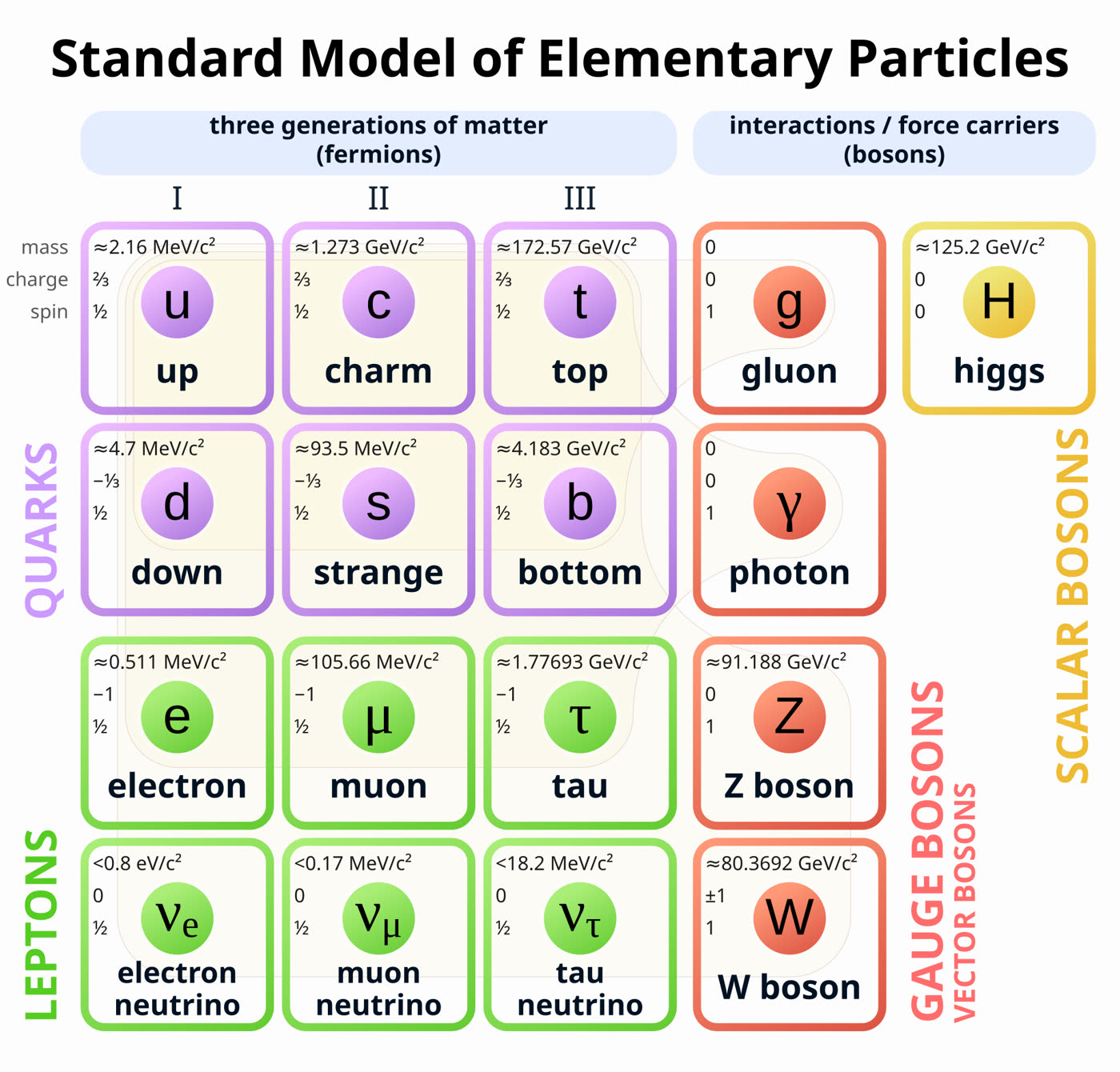
Cush, 2019-09-17. Public domain
Find the up quark, the down quark and the electron. Those three, plus the photon and the gluon that bind them, are everything you have ever touched.
The striking thing about that chart is how little of it is load-bearing. Every object you have encountered — every rock, every living thing, the device you are reading this on — is made of up quarks, down quarks and electrons, bound by the photon and the gluon. Five fields. The rest of the chart is real, and has been made in laboratories, and mostly decays within a fraction of a microsecond. It is not part of anything.
The matter fields come in three copies, called generations. The muon is an electron with 207 times the mass and no other difference: same charge, same spin, same couplings. The tau is heavier still. The same triplication runs through the quarks. We know there are exactly three — the way the Z boson decays is sensitive to how many light neutrino species exist, and the answer is 3.0. What nobody knows is why. Ordinary matter needs one generation. The other two appear to do nothing except exist. When the muon was identified, I. I. Rabi is supposed to have asked: "Who ordered that?" The question is still open.
The field that is not zero
In the vacuum lesson, every field averaged to zero in empty space. ⟨φ⟩ = 0, with a non-zero spread. The Higgs field is the exception, and as far as anyone knows it is the only one. It sits at a non-zero value everywhere in the universe — about 246 GeV — and that value is not a fluctuation but a permanent offset. That number is not guessed. It follows from the Fermi constant, measured from how muons decay: v = (√2·G_F)^(−½) = 246.2 GeV.
Switch to Higgs couplings and look at the top quark against the electron. One is 0.991; the other is 0.0000029.
Finding the last field
- The question
- Does the Higgs field exist? Everything else in the Standard Model had been confirmed; the mechanism giving mass to the W and Z had not.
- The apparatus
- Two independent general-purpose detectors on opposite sides of a 27 km ring, colliding protons at 7–8 TeV. The collaborations deliberately did not share results before the announcement, so that each provided a genuine check on the other. The Higgs decays almost immediately, so the search is for excesses in decay products — chiefly two photons, and four leptons via two Z bosons.
A resonance at an unknown mass. This is the crux: the theory does not predict the Higgs mass, which is a free parameter, so the experiments had to search the whole accessible range and could not know where to look.
Both experiments independently reported a new boson at about 125 GeV, each at 5σ. The modern value is 125.20 ± 0.11 GeV.
How sure could they be? Mass known to about 0.1%. The measured couplings to other particles match Standard Model predictions to roughly 10%, which is currently the sharpest place to look for a crack.
The last unobserved field of the Standard Model, proposed in 1964 and found 48 years later. Peter Higgs, aged 83, was in the auditorium; he and François Englert received the Nobel prize the following year. It completed the model — and, since no unexpected particles came with it, it also deepened the problem the next lesson is about.
- 1961–67Glashow, Weinberg and Salam unify the electromagnetic and weak forces.
- 1964Higgs, Englert, Brout and others propose the mechanism.
- 1970The charm quark is predicted to explain a missing decay. Found 1974.
- 1973Quantum chromodynamics: the gluon and asymptotic freedom.
- 1983The W and Z are found at CERN, at the predicted masses.
- 1995The top quark is produced at Fermilab, 18 years after the bottom.
- 1998Neutrinos are found to oscillate, so they have mass — which the model did not include.
- 2012The Higgs boson, 48 years after it was proposed.
The Higgs field gives everything its mass.
It gives the elementary particles their masses — the quarks, the charged leptons, and the W and Z. But you are made of protons and neutrons, and about 99% of their mass is not Higgs mass at all. It is the energy of the gluon field and the motion of the quarks inside, bound up by the strong force and counted as mass by E = mc². The three quarks in a proton account for roughly 1% of its weight. So the Higgs is responsible for about one part in a hundred of yours, and the rest is binding energy — which is Act 3 coming back one more time.