Particles are excitations
An electron is one unit of disturbance in the electron field. That sounds like a rephrasing until you notice what it explains: why every electron is exactly identical, why particles can be created and destroyed at all, and why antimatter had to exist before anyone found any.
- Say what a particle is in the field picture, and what its energy and momentum are
- Explain why all electrons are identical, and why that is a consequence rather than a coincidence
- Say why a theory of a fixed number of particles cannot describe pair production
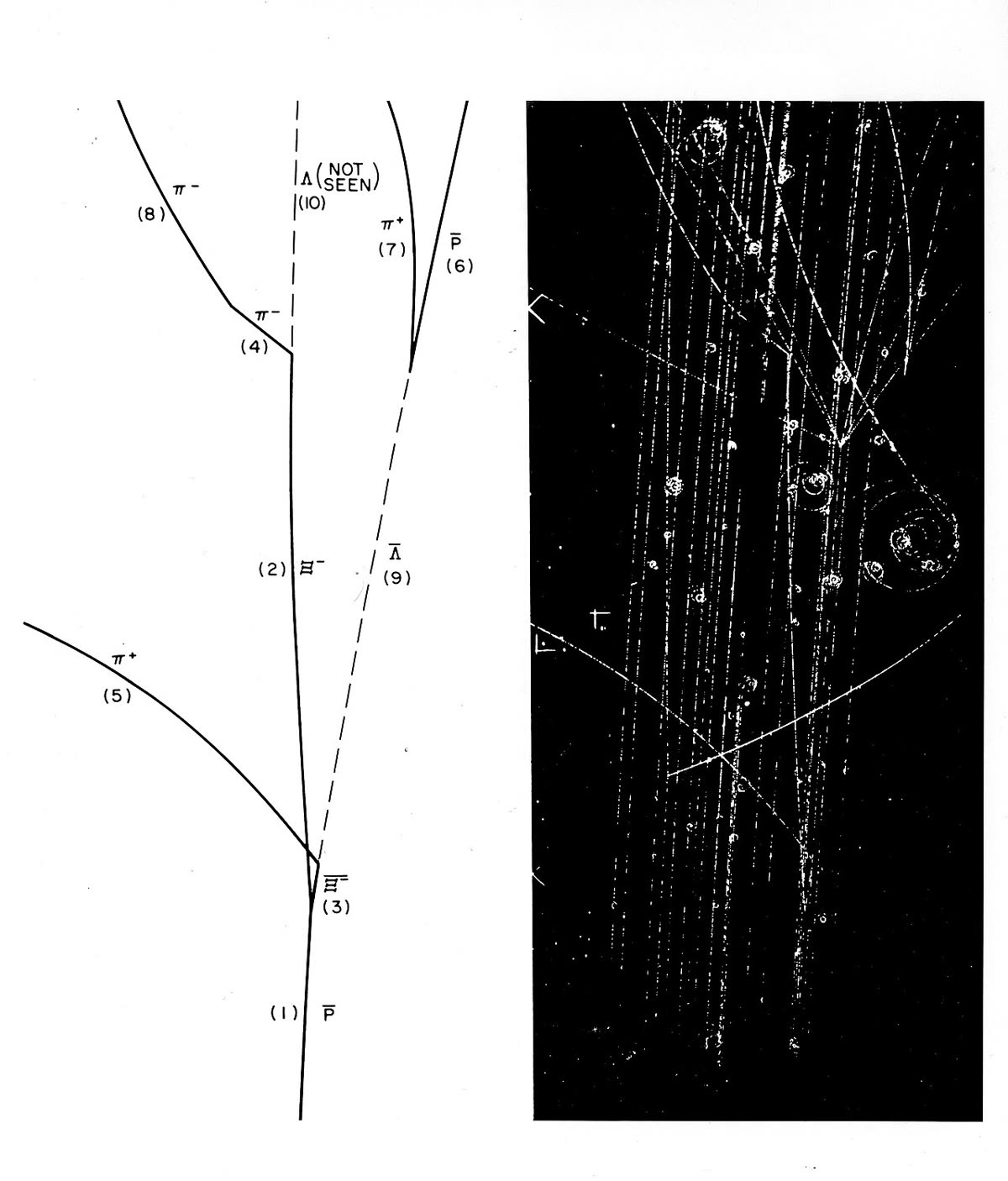
ENERGY.GOV, Unknown date. Public domain
Run the count from 0 to 12 and watch two things: the amplitude of the excited mode, and the background, which never goes away no matter how many you add.
Why every electron is identical
Every electron in the universe has the same mass, the same charge and the same magnetic moment, to every decimal place anyone has managed to measure — and the magnetic moment has been measured to about twelve digits. In a picture where electrons are small objects, that is a staggering coincidence. Something like 10⁸⁰ of them, manufactured by no process in particular, agreeing perfectly on every property. In the field picture it is not a fact about electrons at all. It is a fact about there being one electron field.
Look at what a quantum is here. It is an occupation number: the state records that this mode has three. There is no slot for which three. No place to write a serial number, no property an individual quantum could carry that another quantum of the same mode could lack. The formalism is not being coy about the difference between two electrons — it has no way to express one. So "are these the same electron?" is not a hard question. It is a question with no content, which is a different and much more interesting situation.
Two photons that refuse to separate
- The question
- Is "identical" a real physical condition with observable consequences, or just a statement that we cannot tell two particles apart?
- The apparatus
- Two photons produced simultaneously by parametric down-conversion are sent into the two input ports of a 50:50 beamsplitter. Detectors on both output ports look for coincidences — one photon each side. The arrival times are matched by moving the beamsplitter a few micrometres.
For distinguishable photons, coincidences occur half the time: both-reflected and both-transmitted each have probability ¼, and they add. For truly identical photons those two amplitudes are equal and opposite, so they cancel and the coincidence rate is zero. The photons always leave together.
A sharp dip in the coincidence rate as the path difference passes through zero, reaching close to zero at the bottom. The width of the dip measures the photons’ coherence time — a few hundred femtoseconds — by a purely geometric means.
How sure could they be? Modern sources reach dip visibilities above 99%. The residual is a measure of everything that still distinguishes the two photons.
Identity is not epistemic. Two quanta being the same is a physical condition with a measurable signature, and the signature is a complete cancellation rather than a small effect. The HOM dip is now the standard test of whether two photon sources produce genuinely indistinguishable light, and it underpins optical quantum computing.
What mass is, in this picture
Switch the mass on and off. Watch where the curve meets the vertical axis, and watch the group velocity: exactly c without a mass, always below c with one.
Making and destroying particles
A photon carrying at least 1.022 MeV, passing near a nucleus, can turn into an electron and a positron. One particle in, two particles out. Energy became matter, and the number of particles in the world changed. That threshold is 2mₑc², the rest energy of the two particles you are making — a number that comes straight from the mass–energy lesson and can be checked against the sim’s gap.
There is even a length at which you can watch single-particle quantum mechanics give out. Try to confine an electron to a region smaller than its Compton wavelength, h/mc = 2.4263 pm. By the uncertainty relation the momentum spread required implies an energy above 1.022 MeV — which is exactly the threshold for making a new electron–positron pair. So you do not get a well-localised electron. You get more electrons. Below that scale, "how many particles are there" stops having a fixed answer, and any theory that assumes it does is already wrong.
Antimatter was predicted before anyone found any, which is close to the strongest thing that can be said for a theory. In 1928 Dirac wrote down an equation for the electron consistent with special relativity. It had solutions with negative energy that he could not discard. After some false starts — he first proposed the holes were protons, which fails because the masses do not match — he concluded in 1931 that there must exist a particle with the electron’s mass and the opposite charge. Nothing of the sort had ever been observed.
A track curving the wrong way
- The question
- Do the positively charged particles Dirac’s equation demands actually exist in nature?
- The apparatus
- A cloud chamber in a 1.5 T magnetic field, photographing cosmic-ray tracks. A 6 mm lead plate was fixed across the middle of the chamber — the detail the result turns on.
On the standing view, cosmic-ray tracks should be electrons and protons. A positive track of electron-like mass had no place in the inventory.
A track curving the wrong way for an electron, and far too lightly ionising for a proton of that curvature. Radius of curvature 14 cm below the plate and 5 cm above it, corresponding to 63 MeV and 23 MeV.
How sure could they be? Anderson measured the mass as under twenty times the electron mass and far below the proton’s; the modern value is that the positron’s mass equals the electron’s to better than one part in 10⁸.
The direction of travel was the crux, because a track curving one way for an upward particle is identical to the mirror curve for a downward one. Energy can only be lost crossing lead, and the tighter curve is above the plate — so the particle was travelling upward, and its charge was therefore positive. The positron existed, four years after an equation said it had to.
Antiparticles are particles travelling backwards in time.
This is a real and useful piece of formalism — the Feynman–Stückelberg interpretation, where an outgoing positron of a given momentum is written as an incoming electron of the opposite one — and it is genuinely how the diagrams in the next lesson are drawn. But it is a bookkeeping identity for a term in a calculation, not a claim about a positron’s experience. A positron in a laboratory is created, travels forward in time like everything else, and annihilates. Nothing in the theory lets you send one into your own past.
- 1905Einstein: light comes in quanta. The first particle understood as an excitation.
- 1927Dirac quantises the electromagnetic field; photons become occupation numbers.
- 1928The Dirac equation, and negative-energy solutions that will not go away.
- 1931Dirac concludes a positive electron must exist.
- 1932Anderson photographs one.
- 1934Fermi’s theory of beta decay: particles created, not merely rearranged.
- 1987Hong, Ou and Mandel: identity has a signature, and it is exact cancellation.