Matter waves
A French duke suggested in his doctoral thesis that if light can be a particle, matter can be a wave. His examiners had no idea what to do with it and sent a copy to Einstein.
- Apply λ = h/p and say why the effect is invisible for everyday objects
- Explain how matter waves turn Bohr’s arbitrary rule into a standing-wave condition
- Say how far the relation has since been tested, and on what
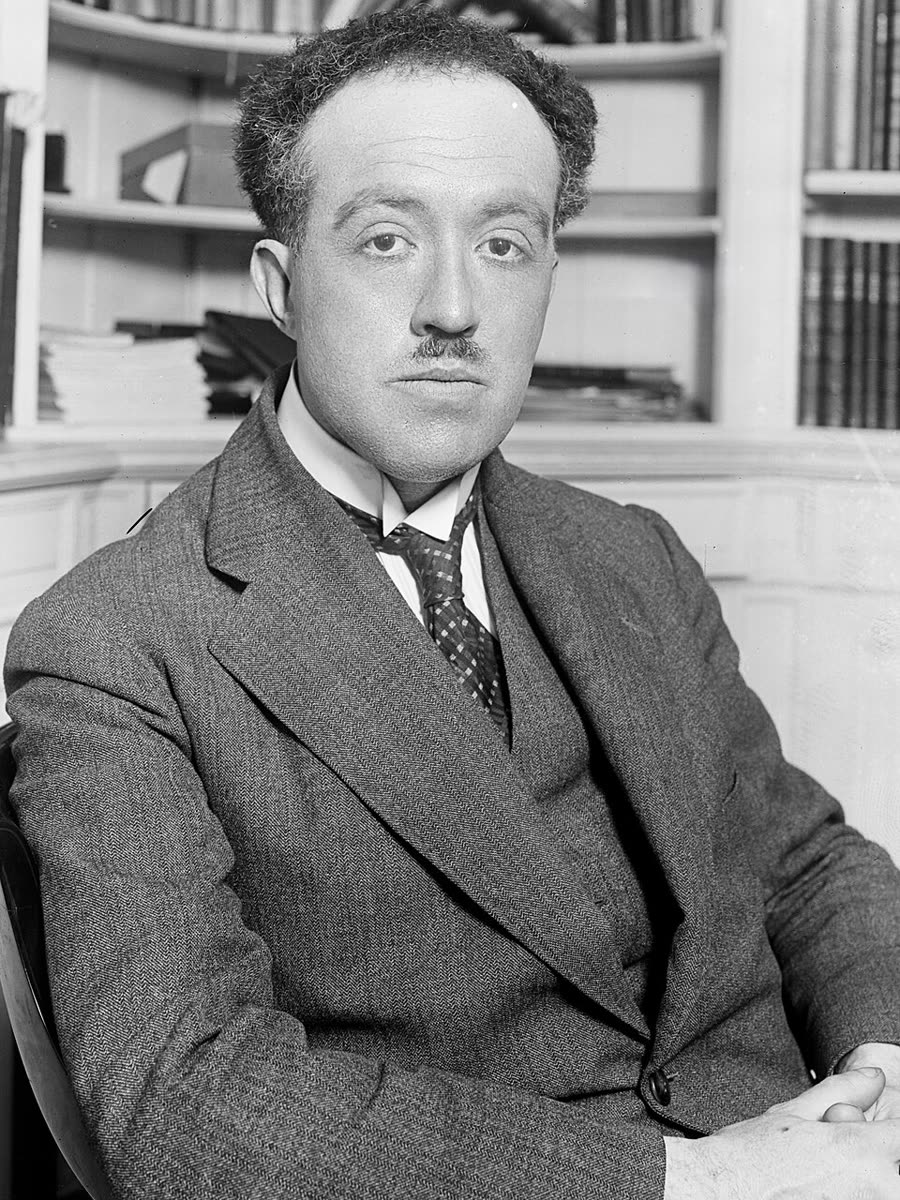
Louis de Broglie did not begin as a physicist. The younger son of a French ducal family, he read history at the Sorbonne intending a career in the diplomatic service. The First World War put him in the army as a radio operator, stationed for the duration at the Eiffel Tower — which had been converted into a military wireless station, and was saved from demolition by that fact. He spent four years working with electromagnetic waves, and came out of it wanting to do physics. His older brother Maurice was already an experimental physicist working on X-rays, and the two of them argued a good deal about whether X-rays were waves or particles. The question stayed with him.
Step from the electron down to the baseball and watch the wavelength fall off the bottom of the chart.
Step through n = 1 to 6. The wave has to join up with itself, and only whole numbers work.
His examiners did not know what to do with it. The thesis was short. The argument was almost entirely qualitative. And it proposed something with no experimental support of any kind — no measurement anywhere suggested that matter diffracts, and none had been attempted, because nobody had thought to try. Unwilling either to pass it on their own judgement or to fail something they could not refute, the committee sent a copy to Einstein and asked what he thought.
He has lifted a corner of the great veil.
That reply mattered enormously, and it is worth being blunt about why. A short, qualitative thesis by an unknown student, proposing something outrageous with no supporting data, does not normally survive. This one had the most famous physicist alive vouching for it — and Einstein went further, incorporating matter waves into his own papers on the quantum theory of gases within months, which is how most physicists first encountered the idea. Schrödinger read those papers. Within eighteen months he had written down a wave equation for matter, and the whole of Act 6 follows from it. De Broglie received the Nobel Prize in 1929, five years after the thesis — one of the shortest intervals in the prize's history, and for a doctoral dissertation, which is unique.
Interfering a molecule of sixty atoms
- The question
- Does λ = h/p hold for objects far larger than anything de Broglie had in mind — a whole molecule, with internal structure, vibrational modes and a temperature of its own?
- The apparatus
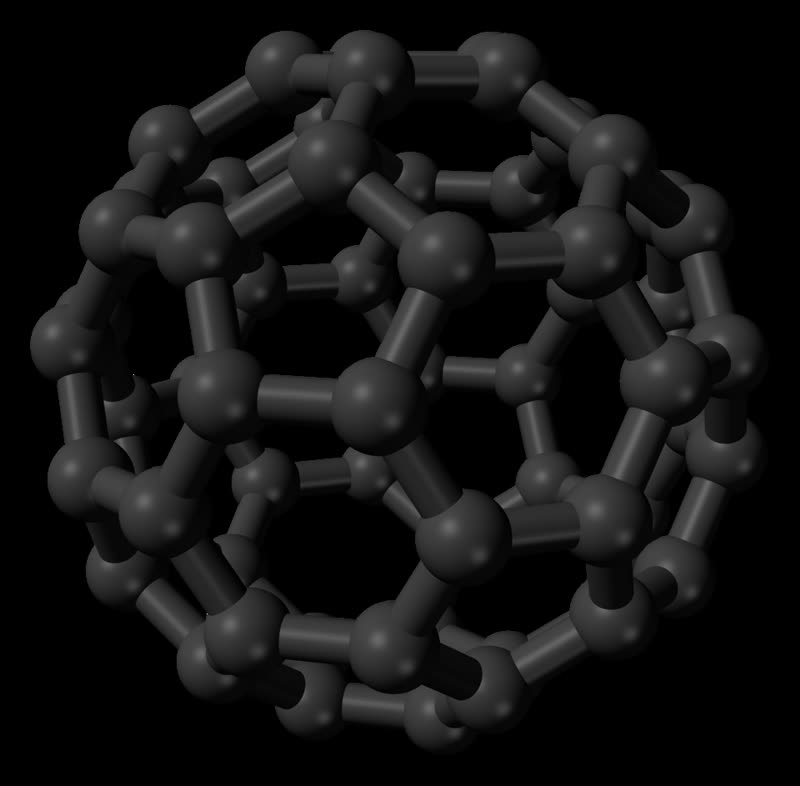
- C₆₀ fullerenes sublimated from an oven at about 900 K, velocity-selected to around 200 m/s, passed through a silicon nitride diffraction grating with 100 nm slits, and detected by ionising them with a focused laser and counting ions. The whole flight path was kept under high vacuum, because a single collision with a background gas molecule destroys the interference.
If the relation is universal, a molecule of mass 720 amu at 200 m/s has λ = 2.8 pm, and the grating should produce a diffraction pattern with fringes at the corresponding angles. If matter waves apply only to elementary particles, no fringes.
A clear central peak with first-order side peaks at the predicted positions, against a flat background when the velocity selector was removed. The measured fringe spacing matched λ = h/mv.
How sure could they be? Sufficient to resolve first-order fringes and rule out a classical shadow. Later work in the same group has extended interference to molecules above 25,000 amu, made of more than 2,000 atoms.
The relation holds for an object 1,300 times the mass of an electron, hot enough to be radiating infrared photons as it flies, and with a de Broglie wavelength roughly 250 times smaller than the molecule itself. That last point is the interesting one: whatever a matter wave is, it is not the object physically oscillating — the wavelength is far too short for that to mean anything.
A matter wave means the particle is vibrating, or spread out like a ripple in something.
The C₆₀ result rules that out directly. Its de Broglie wavelength in that experiment is about 2.8 picometres, while the molecule is roughly 700 picometres across — the wavelength is 250 times smaller than the object. Nothing is oscillating with that wavelength; there is no medium and nothing to wobble. Nor is the molecule smeared out into a ripple: it arrives at the detector as one intact C₆₀ molecule, in one place, every time. What the wave describes is not the shape of the object but the statistics of where it will be found — a point that becomes explicit and unavoidable in the next two lessons.
- 1913Bohr postulates quantised angular momentum, with no justification, and says so.
- 1923Compton shows X-rays carry momentum h/λ — light is definitively particle-like.
- 1924De Broglie’s thesis. The examiners send it to Einstein.
- 1925Einstein publicises it in his papers on the quantum gas. Schrödinger reads them.
- 1927Davisson and Germer, and independently G.P. Thomson, diffract electrons off crystals.
- 1929De Broglie receives the Nobel Prize — for his doctoral thesis.
- 1999C₆₀ molecules interfere in Vienna.
- 2019Interference demonstrated for molecules above 25,000 amu.