Energy levels are real
Every clue about atomic energy levels had come from light. Two physicists in Berlin fired electrons through mercury vapour instead, found the same numbers, and then misunderstood their own result for a year.
- Explain why an independent probe matters more than a more precise version of the same one
- Say what the periodic dips in the current mean, and why elastic collisions cost so little
- Describe how the same energy was confirmed by two completely different measurements
Everything in this act so far has one source: light. Fraunhofer's dark lines, Kirchhoff's fingerprints, Balmer's formula, Bohr's ladder — all of it is about photons coming out of atoms. Even the photoelectric effect is light going in. And that leaves a genuine worry. What if the discreteness is a fact about how atoms emit light, rather than a fact about atoms? Emission and absorption might be quantised for some reason peculiar to the interaction with the electromagnetic field, while the atom underneath is a perfectly ordinary continuous thing. To rule that out, you need to find the same energies using a probe with nothing to do with light.
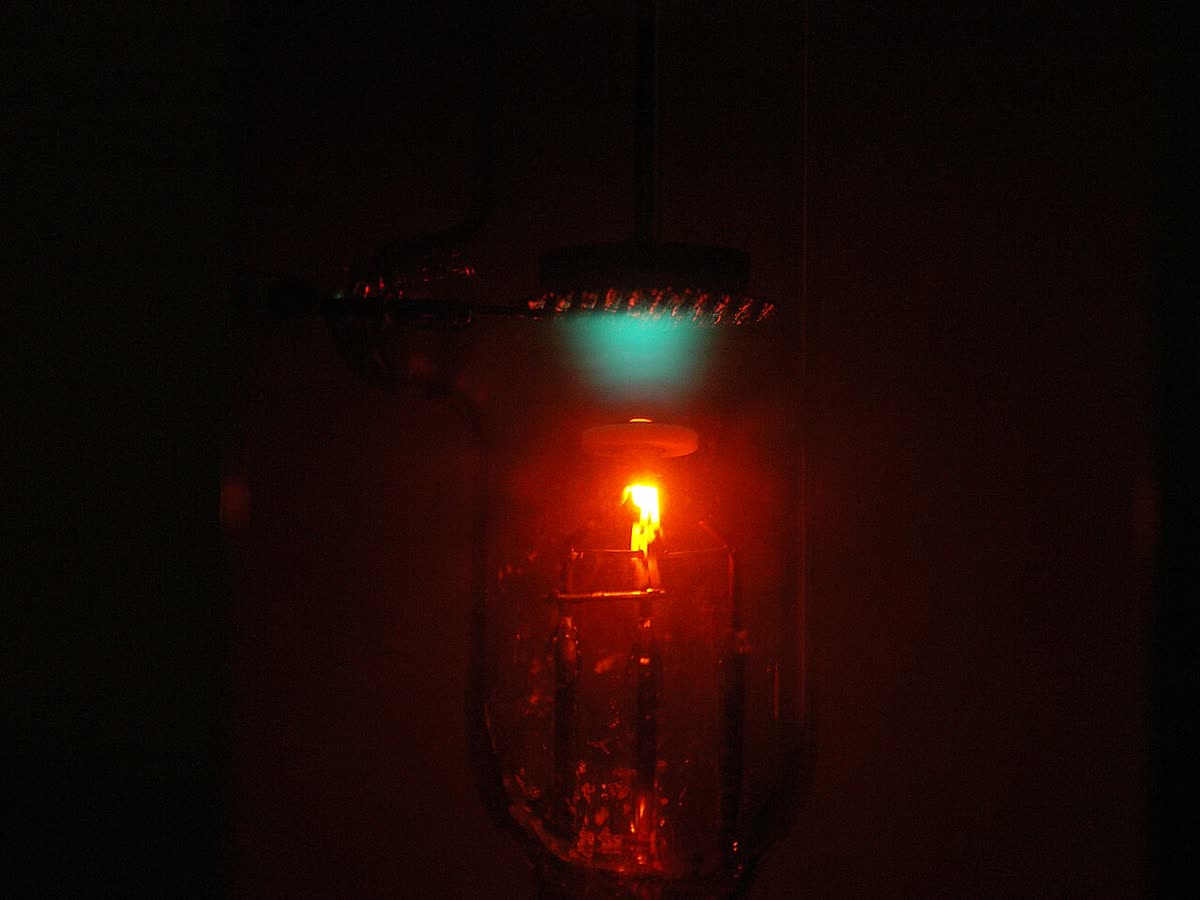
ItDozent, 2007-12-10. CC BY-SA 3.0
James Franck and Gustav Hertz did exactly that in 1914. (Gustav was a nephew of the Heinrich Hertz who has now appeared three times in this course — proving Maxwell right in Act 1, and accidentally discovering the photoelectric effect two lessons ago.) Instead of shining light at atoms, they threw electrons at them. The apparatus is simple to state. A sealed tube of mercury vapour. At one end a hot filament boiling off electrons. Partway along, a grid held at an adjustable positive voltage, which accelerates them. Beyond the grid, a collector plate held slightly negative — so an electron only reaches it if it still has some energy left after crossing. That last detail is what turns the tube into a measuring instrument. The collector counts electrons that survived the journey with energy to spare.
Compare the measured curve with the classical expectation, then switch to neon and watch the spacing change.
And then the pattern repeats — which is what makes it conclusive rather than suggestive. Past 9.8 V, an electron has enough to do the trick twice: excite one atom, get re-accelerated over the remaining distance, and excite another before reaching the grid. Past 14.7 V, three times. The dips continue for as far as the voltage can be pushed, evenly spaced. Evenly spaced is the whole point. Each dip is another identical unit of the same fixed energy being handed over. If atoms absorbed energy in a range, or in amounts that varied, or in decreasing instalments, the dips would drift, blur, or fade. They do none of these. Atoms accept energy in exact, identical, indivisible amounts.
Firing electrons through mercury vapour
- The question
- Do atomic energy levels exist independently of light? If atoms really have discrete internal states, an electron beam should reveal the same energies that spectroscopy does — using no photons at all.
- The apparatus
- A sealed tube containing mercury vapour, heated to control the pressure. A hot filament supplied electrons; a wire grid at adjustable positive potential accelerated them; a collector plate beyond the grid was held about 0.5 V negative, so only electrons retaining some kinetic energy could reach it. The collector current was measured against the accelerating voltage.
Classically, a current rising smoothly with voltage. Elastic collisions can remove at most 1 part in 91,000 of an electron’s energy against an atom 400,000 times heavier, so scattering should not produce structure.
The current rose, then dropped sharply at 4.9 V, rose again and dropped at 9.8 V, and again at 14.7 V — evenly spaced minima continuing as far as the voltage was raised. Below 4.9 V the vapour was dark; above it, the tube emitted ultraviolet light at 253.6 nm and nothing else.
How sure could they be? The spacing was reproducible to better than 0.1 V. Absolute positions are shifted by contact potentials between the electrodes, which is why the measurement is the interval between minima rather than where the first one falls — a point that also matters for the modern teaching version of the experiment.
The first demonstration of atomic energy levels by a method with no light in it. And the two numbers agree: 4.89 eV from a voltmeter and an electron beam, 4.88 eV from hc/λ of the emitted line. Two entirely unrelated measurements landing on the same quantity is what settled that the levels belong to the atom rather than to its dealings with the electromagnetic field. Franck and Hertz received the 1925 Nobel Prize.
Franck and Hertz set out to confirm Bohr’s model, and did.
They did neither. They were investigating the ionisation of gases by electron impact, and interpreted their 4.9 V figure as the ionisation energy of mercury. It is not: mercury ionises at 10.44 eV, more than twice as much. What they had measured was the first excitation energy — a different quantity, and the one that matters. Bohr pointed this out in 1915, observing that 4.9 eV corresponds exactly to the 253.6 nm line their own tube was emitting, and that this was precisely what his theory required. Franck and Hertz resisted the correction for several years. The experiment is one of the cleanest confirmations of quantised atomic energy levels ever performed, and its authors did not know that is what they had done.
- 1914Franck and Hertz find evenly spaced current dips at 4.9 V intervals in mercury vapour.
- 1914They interpret 4.9 V as mercury’s ionisation energy. It is not.
- 1915Bohr identifies it as the first excitation energy, matching the 253.6 nm line.
- 1919Improved tubes resolve additional, smaller steps corresponding to other levels.
- 1925Franck and Hertz receive the Nobel Prize — the same year quantum mechanics replaces the model their result supported.