The ring that is not alternating
All six carbon–carbon bonds are the same length, and the molecule is 150 kJ/mol more stable than it has any right to be. Two independent measurements, neither of which needs a theory of aromaticity in order to be stated.
- State the two measurements that settle benzene’s structure, and why each one alone is not enough
- Do the hydrogenation arithmetic and get the resonance energy out of it
- Give Lonsdale’s 1929 result and say why hexamethylbenzene rather than benzene
- Explain why resonance is not oscillation, and what Kekulé actually proposed
Benzene arrives from the gasworks. In 1825 Michael Faraday was handed the oily residue that collected in cylinders of compressed illuminating gas — the gas that lit London — and pulled a new liquid out of it, which he named bicarburet of hydrogen. Nine years later Eilhard Mitscherlich made the same substance from benzoic acid and lime, and got the formula: C₆H₆. That formula is a scandal. Six carbons in an open chain, fully saturated, is hexane, C₆H₁₄. Benzene is missing eight hydrogens. Every other compound that far short of hydrogen was a violently reactive thing that would add bromine on contact, polymerise if you looked at it, and generally not sit in a bottle.
And benzene sits in a bottle. It does not decolourise bromine water. An alkene does that instantly; it is the standard test. Benzene needs a catalyst before it will react with bromine at all. It substitutes rather than adds. Push it hard enough and a hydrogen comes off and a bromine goes on, and the ring survives. An alkene would have taken the whole Br₂ across the double bond and stopped being an alkene. It is thermally stable, unusually so, in a way that a molecule with three double bonds has no business being. So there are two puzzles, not one. What is the structure — and why does a molecule that unsaturated behave like a saturated one? For seventy years the second question had no answer at all, and the first had an answer with a hole in it.
August Kekulé’s answer, published in Paris in 1865, is the ring. Six carbons in a closed loop, one hydrogen on each, and the bonds alternating — single, double, single, double, single, double. Every carbon gets its four bonds. The formula comes out exactly right. And it does something a formula alone cannot: it predicts a count. One monosubstituted benzene. Replace any hydrogen on a ring and you can rotate the ring to superimpose it on any other choice. However you make C₆H₅Br, you get the same substance — and however anyone made it, they did. Three disubstituted benzenes. Put the second substituent one, two or three positions round: ortho, meta, para. Three, and no more. Chemists had found three and no more. That is a real prediction, checked against real bottles, and it is why organic chemistry became a subject about arrangements in space rather than a catalogue of reactions. It deserves the reputation it has.
Start on the alternating ring, drawn with its bonds to scale, and drag it round to see it is flat. Then press "What was measured" and compare the six numbers.
The structure of the benzene ring in hexamethylbenzene
- The question
- Is the six-membered ring flat, and are its six carbon–carbon bonds the same length or two alternating lengths?
- The apparatus
- X-ray diffraction photographs of crystalline hexamethylbenzene — benzene with a methyl group in place of every hydrogen. The choice of compound is the whole design: hexamethylbenzene is triclinic with ONE molecule in the unit cell, which forces the molecule onto a centre of symmetry and leaves nothing to disentangle. Benzene itself is a liquid at room temperature and an awkward crystal below it.
On the alternating structure, three short bonds around 1.34 Å and three long ones around 1.54 Å. On the oscillation hypothesis, a time average — which for a diffraction measurement means an apparent length near 1.44 Å, midway between them.
A planar, regular hexagon. All six ring bonds equal at about 1.42 Å within her uncertainty, and the six methyl carbons attached at 1.53 Å — an entirely ordinary single-bond length, which is the internal control that says the method could have seen a long bond if there had been one.
How sure could they be? Solved by hand. Structure factors were computed with logarithms and a slide rule, Fourier syntheses summed by arithmetic, and the trial structure adjusted until the calculated intensities matched the photographs. There were no machines of any kind involved, and it took months.
The ring is flat and regular. That kills the static alternating structure outright — three long bonds and three short ones is not what a regular hexagon looks like — and it puts the oscillation hypothesis under pressure, because later, better measurements on benzene itself gave 1.397 Å, well short of the 1.437 Å that alternating bonds would average to. What it cannot do on its own is kill oscillation completely, since diffraction averages over time. That takes a heat.
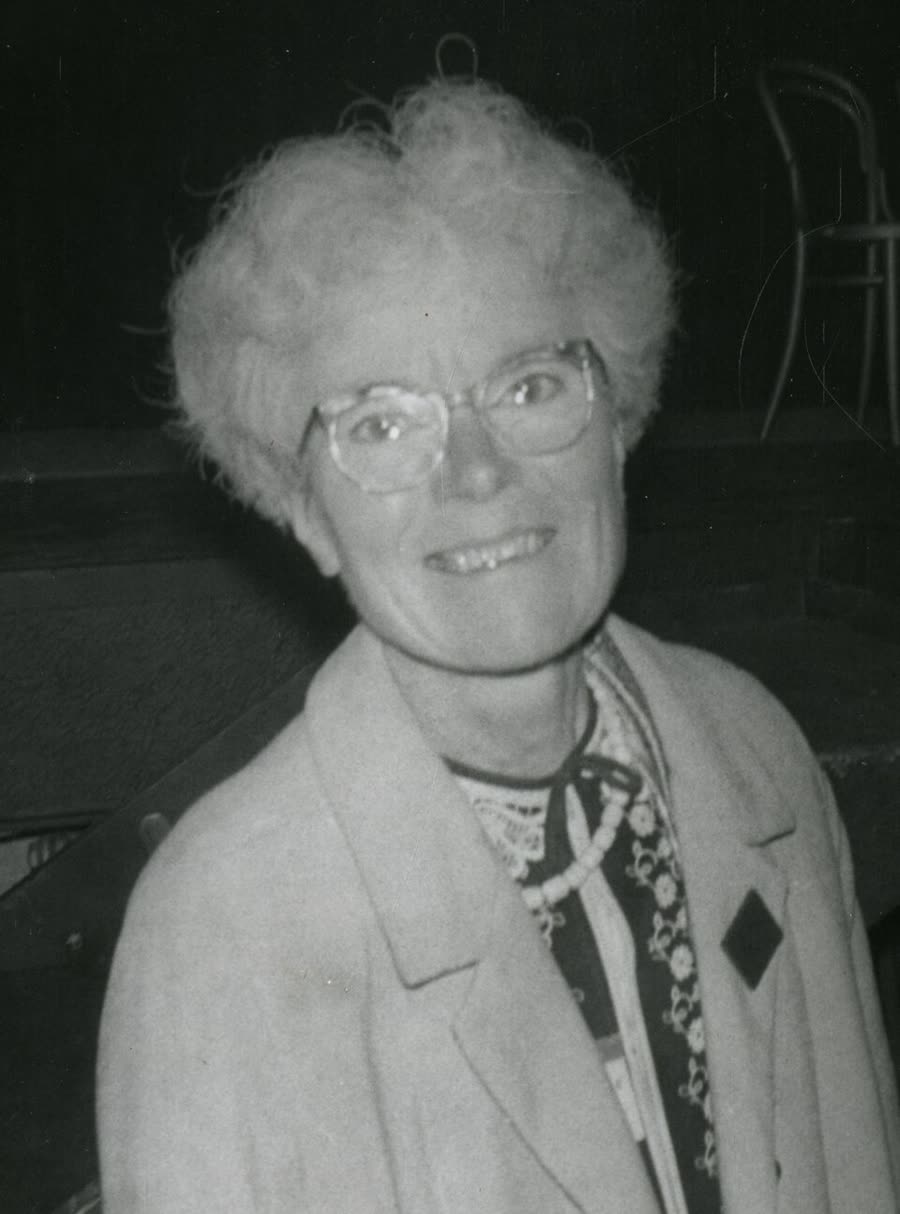
Lonsdale is usually a footnote in this story, and she should not be. She was born Kathleen Yardley in Newbridge, County Kildare, the tenth child of a postmaster, and joined W. H. Bragg’s group at the Royal Institution in 1922 at the age of nineteen. The hexamethylbenzene structure was hers, and so was the choice of compound that made it tractable at all. She went on to compile the International Tables for X-ray Crystallography, which is the book every structural chemist on earth then worked from, and to establish the C–C distances in diamond and graphite by the same methods. In 1945 she and the microbiologist Marjory Stephenson became the first two women elected Fellows of the Royal Society. She was the first woman to hold a professorship at University College London, the first to preside over the International Union of Crystallography, and the first to preside over the British Association. In 1943 she spent a month in Holloway prison. A Quaker and a pacifist, she had refused to register for civil defence duties, and then refused to pay the fine.
Heats of hydrogenation of cyclohexene, cyclohexadiene and benzene
- The question
- Structure aside — how much energy does benzene actually hold, compared with a molecule made of three ordinary double bonds?
- The apparatus
- A gas-phase calorimeter at 82 °C with a nickel catalyst. Hydrogen is added to each unsaturated ring in turn and the heat released is measured. The design point is that all three rings end up as the same substance, cyclohexane, so the heats are directly comparable without any assumption whatever about what the starting materials are made of.
If a double bond in a ring releases about the same heat wherever it sits, then two double bonds should release twice as much as one, and three should release three times as much. Cyclohexene gives 119.6 kJ/mol, so a ring with three isolated double bonds should give about 359 kJ/mol.
1,3-cyclohexadiene gives 231.7 kJ/mol, against the 239.2 that two isolated double bonds predict — short by 7.5, which is what conjugating a pair of double bonds is worth. Benzene gives 208.3 kJ/mol, against 359. Short by 150.
How sure could they be? The measurements are calorimetry on gases with a catalyst, reproducible to about a kilojoule per mole. A 150 kJ/mol discrepancy is a hundred times that, and the diene, measured on the same apparatus by the same people, is the control that shows a small effect looks small.
This is the measurement the oscillation hypothesis cannot survive. A molecule that is a cyclohexatriene at every instant — whichever of the two it happens to be at that instant — still contains three double bonds at every instant, and still owes their hydrogenation energy. It does not pay. Benzene simply starts 150 kJ/mol lower than any structure anyone could draw for it, and the shortfall is a measurement rather than an interpretation.
Read the ladder from the bottom. Cyclohexane is the floor because everything ends there. The dashed rung is the only level that was never measured — it is three times cyclohexene, and benzene sits far below it.
How much is the ring worth?
Cyclohexene, with one double bond, releases 119.6 kJ/mol when hydrogenated to cyclohexane. A hypothetical "cyclohexatriene" — a ring of three isolated double bonds — should release three times as much. Benzene actually releases 208.3 kJ/mol. By how much does benzene fall short of the prediction?
- Cyclohexene → cyclohexane
- -119.6 kJ/mol
- 1,3-cyclohexadiene → cyclohexane
- -231.7 kJ/mol
- Benzene → cyclohexane
- -208.3 kJ/mol
- All three give the same product
- cyclohexane, C₆H₁₂
Benzene flickers rapidly between the two Kekulé structures, and that is what resonance means.
It does not flicker, and resonance is not a rate. There is no interval, no frequency, and no moment at which the molecule is one structure rather than the other; benzene has a single, unchanging electronic state with sixfold symmetry, and the vibrational spectrum shows that symmetry directly. The two Kekulé drawings are basis functions in a mathematical expansion of that one state — the way a musical note is not taking turns between its harmonics, but is made of them at once. The double-headed arrow between the two rings means "these are two terms in one description", and it is drawn differently from an equilibrium arrow for exactly this reason. It is worth being precise about this, because the flickering picture IS Kekulé’s 1872 oscillation hypothesis, which was a claim about time and which the hydrogenation heat refutes: a molecule that really was a cyclohexatriene at every instant would owe three double bonds’ worth of energy at every instant, and benzene does not pay it.
Let us learn to dream, gentlemen, and then perhaps we shall learn the truth. But let us beware of publishing our dreams before they have been put to the proof by the waking understanding.
- 1825Faraday isolates benzene from compressed illuminating gas and calls it bicarburet of hydrogen.
- 1834Mitscherlich makes it from benzoic acid and gets the formula C₆H₆.
- 1865Kekulé proposes the ring with alternating bonds. It predicts one monosubstituted and three disubstituted benzenes.
- 1867 – 1869Rival structures: Dewar benzene, Ladenburg’s prism, Claus’s diagonal formula. All are serious proposals; all are wrong.
- 1872Kekulé patches the ortho problem with the oscillation hypothesis: the double bonds swap places too fast to catch.
- 1890At the Benzolfest, twenty-five years on, Kekulé tells the story of the snake seizing its tail.
- 1929Lonsdale solves hexamethylbenzene by hand: the ring is flat, and its six bonds are equal.
- 1931Hückel’s molecular-orbital treatment of the ring, largely ignored by chemists for a decade.
- 1933Pauling and Wheland give the valence-bond account and the phrase "resonance energy".
- 1936Kistiakowsky measures the heats of hydrogenation. Benzene is 150 kJ/mol short.